Nobody wakes up wanting to spend fifteen thousand dollars on a roof. Trust me, Johnny and I have delivered the news hundreds of times, and it never gets fun. But here is what is worse than hearing you need a new roof: finding out two years too late, after the sheathing is rotted, the attic is full of mold, and what should have been a straightforward replacement is now a $25,000 structural repair. After ten years of roofs across the Fraser Valley, we have learned to read the signs that separate a roof needing maintenance from one that has reached the end. This is the guide I wish every Fraser Valley homeowner had before we show up with the bad news.
Why Fraser Valley Roofs Die Younger Than You Think
Before we get into the signs, you need to understand something about roofing in our corner of BC. The Fraser Valley is not a normal climate for roofing materials. We get 1,500mm of rain per year in Chilliwack, over 1,800mm in Agassiz and Hope. The river fog keeps humidity above 80% from October to March. And we get just enough freezing nights to create freeze-thaw cycles that work moisture into every gap. A shingle rated for 25 years in the Okanagan will often fail at 18 here. That is not a defect, it is just what persistent moisture does. When I see manufacturers quoting 30-year lifespans, I think about the roofs Johnny and I have torn off at 16 years where the plywood underneath was already soft.
The 12 Warning Signs: What We Actually Look For
These are not textbook bullet points. These are the things Johnny and I physically check on every inspection we do, ordered by how often we see them on Fraser Valley homes. Some are obvious. A few are invisible from the ground. All of them tell a story about what is happening underneath.
1. Granule Loss, The Silent Countdown
This is the one homeowners miss most. Look for coarse, sandy grit accumulating on the ground around your home, that is the protective coating washing off your shingles. Some granule loss is normal in the first year after installation. But when an established roof starts shedding granules heavily, the shingles are losing their UV and weather protection. I tell homeowners to look at their downspout splash pads after a heavy rain. If you see a ring of black or grey sediment, your roof is giving you a timeline.
2. Curling and Buckling Across Multiple Slopes
Shingles curl two ways: cupping (edges turn up) and clawing (center lifts up). In the Fraser Valley, cupping is more common because our persistent moisture works under the shingle edges. A few curled shingles on one slope might mean a localized ventilation problem. But when Johnny and I see curling on two or more slopes, that roof is telling us it is done. The shingles have lost their flexibility and their waterproofing integrity. Once they curl, water gets behind them on every single rain, and out here, that means water gets behind them two hundred days a year.
3. Daylight Visible Through Roof Boards
Go into your attic on a sunny day and turn off all the lights. If you see pinpoints of light coming through the roof deck, you have gaps where water is getting in. I climbed into an attic in Rosedale last year where the homeowner had never checked, the light coming through looked like a constellation. Each point of light is a point where rain enters, and in a climate that gets rain six months straight, those tiny holes do enormous damage over time.
If you can see daylight through your roof boards, do not wait for spring. Water has been entering at those points for every rainstorm since the gaps formed. Call us at 604-728-0146 for a free same-week inspection.
4. Sagging Between Rafters
A roof should have straight, clean lines. When you look at it from across the street and see a waviness or dip between the rafters, that means the plywood sheathing underneath has absorbed moisture and is starting to delaminate. We pulled a roof on a heritage home near Yale last fall where the sag was barely noticeable from the ground, maybe two inches of dip across an eight-foot span. When we pulled the shingles, the plywood was so soft we could push a finger through it. A sag is not cosmetic. It is structural, and it means the clock is running fast.
5. Moss Penetration, Not Just Surface Growth
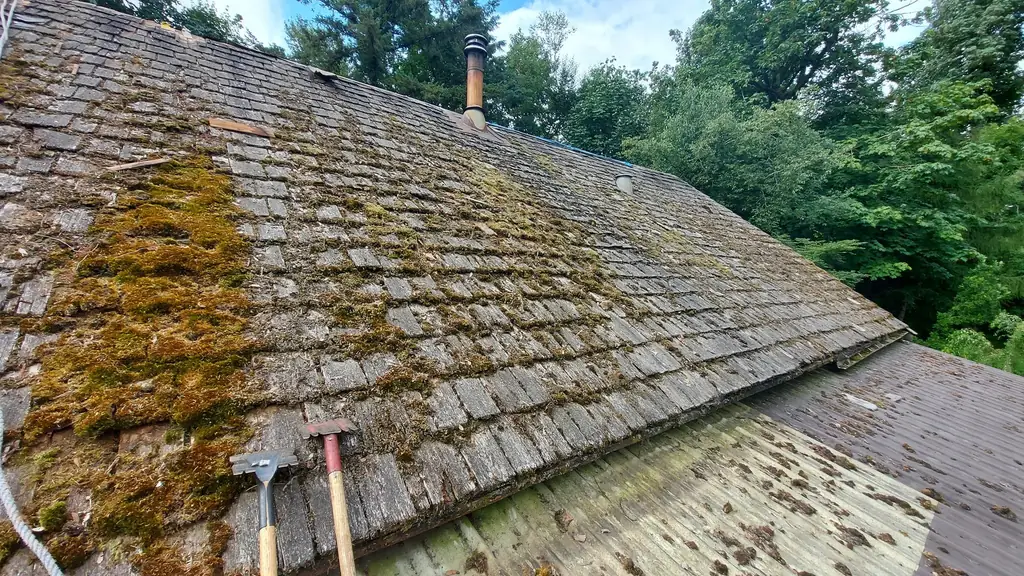
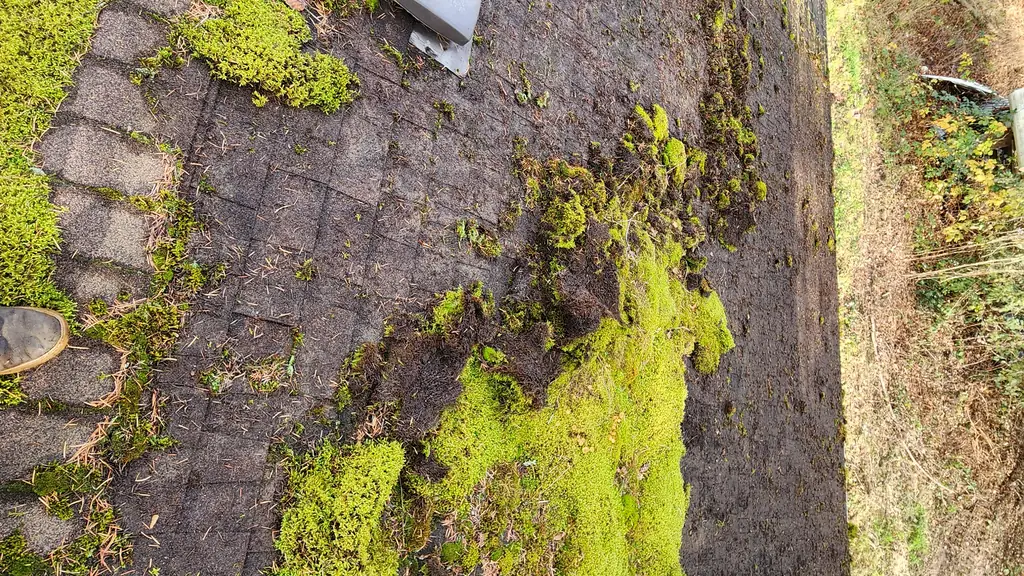
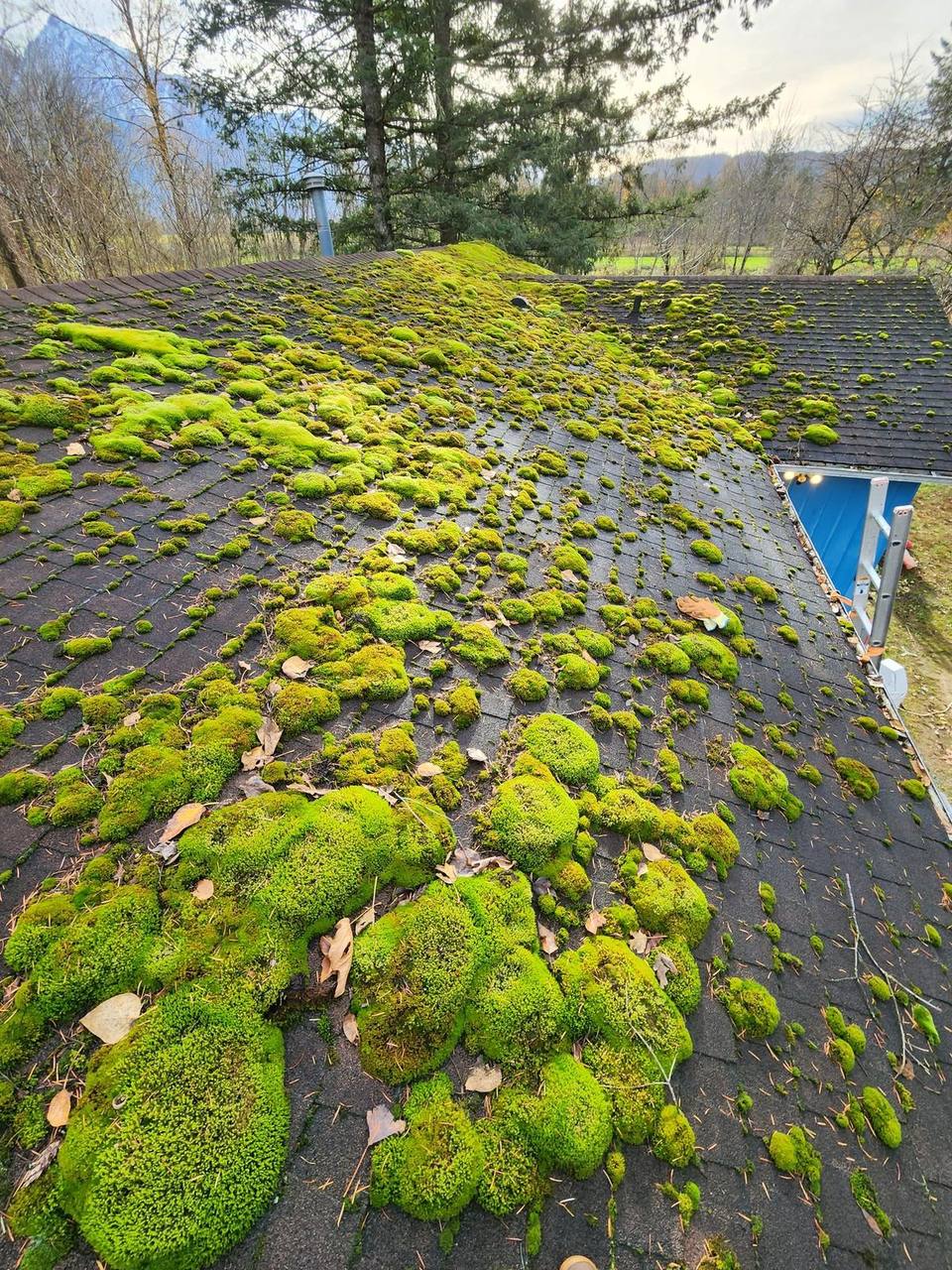
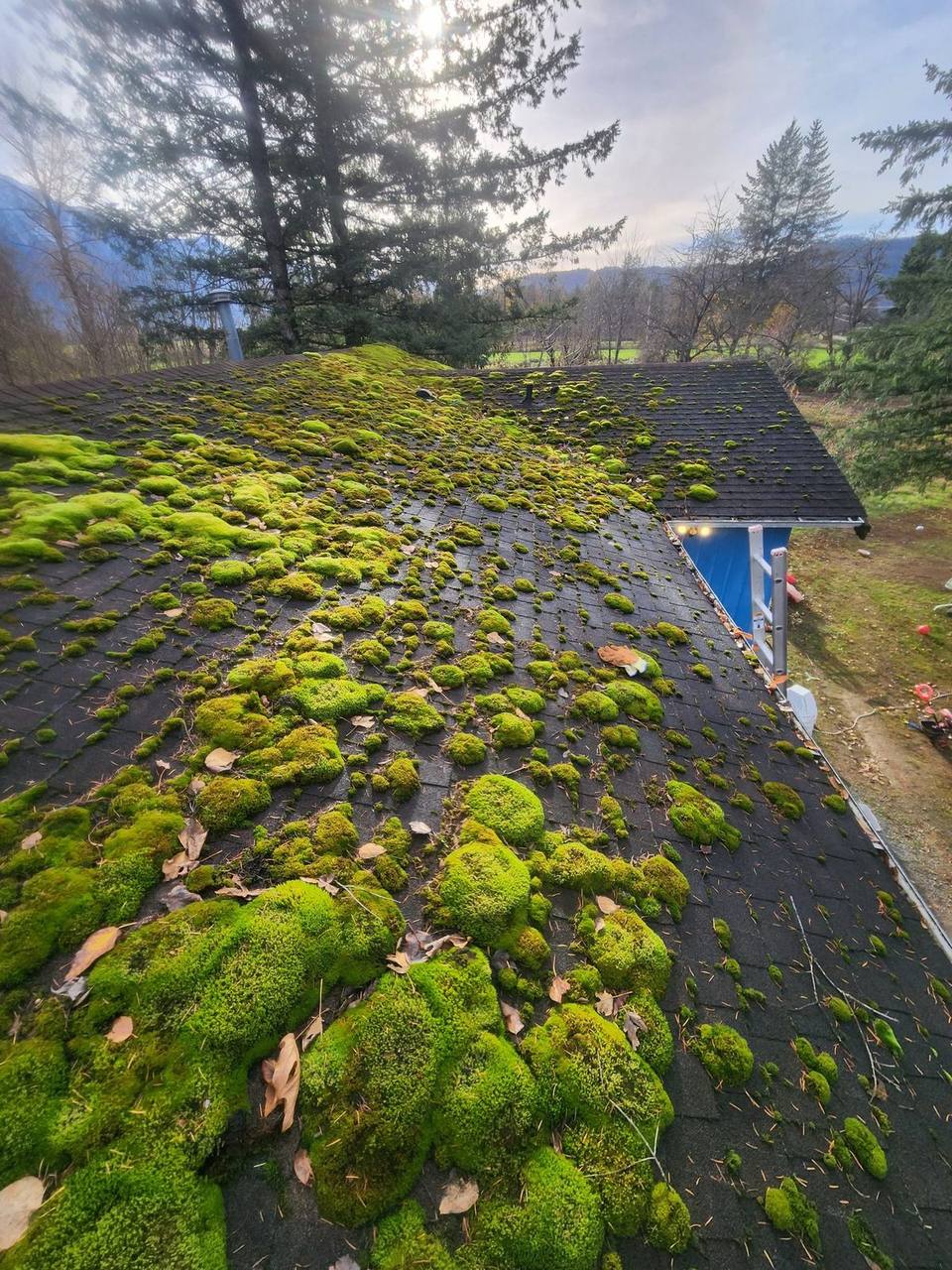
Every roof in the Fraser Valley gets some moss. The question is whether it is sitting on top of the shingles or growing into them. Surface moss you can treat with zinc strips or a gentle cleaning. But when moss has been growing unchecked for years, the rhizoids (the tiny root structures) physically lift shingle edges and create channels for water. I have pulled moss carpets off roofs in Agassiz where the shingle underneath was completely disintegrated. If your moss is thick enough that you cannot see the shingle color, and it has been there for more than two seasons, it has likely compromised the material underneath.
6. Flashing Failure Around Penetrations
Chimneys, vents, skylights, anywhere something pokes through your roof has flashing around it. In the Fraser Valley, thermal cycling and constant moisture cause sealants to crack and metal to fatigue faster than in drier climates. When flashing fails on one penetration, it often means all the flashing was installed at the same time and is reaching end of life simultaneously. We can replace flashing without replacing the whole roof, but if your shingles are also showing age, doing both at once is almost always the better investment.
Flashing leaks are the number one repair call we get from November through February. In a normal Fraser Valley winter, a failed chimney flashing can let in 50-100 litres of water before anyone notices the ceiling stain.
7. Nail Pops, The Invisible Water Highways
Nail pops happen when fasteners work their way up through the shingle surface. You see small bumps or even exposed nail heads. Each one is an open pathway for water to follow the nail shaft down into the sheathing. In the Fraser Valley, thermal expansion from warm days and cold nights is constant, and nails gradually back out over the years. A handful of nail pops can be sealed. But when we count more than ten across a roof face, it means the fastener pattern is failing systemically, and the roof has lost its holding power.
8. Interior Water Stains That Keep Coming Back
Everyone knows a ceiling stain means a leak. But the critical detail is whether it reappears after you fix what you thought was the source. Roofs that are nearing end of life develop multiple leak paths. You fix one spot, and water finds another route through compromised material. We did a job in Chilliwack where the homeowner had paid for three separate spot repairs over two years, each one fixed a real leak, but new leaks kept showing up because the entire roof system was failing. The combined repair bills ended up being nearly half the cost of the replacement they eventually needed anyway.
9. Attic Condensation and Mold You Cannot Smell Yet
This is the scariest one for me because it is completely hidden. In the Fraser Valley, our humidity is brutal. If your attic ventilation is not moving air properly (and we find inadequate ventilation on roughly half the roofs we inspect) moisture condenses on the underside of the roof deck. Over months and years, this creates black mold on the plywood. The roof looks fine from outside. There is no ceiling stain. But the structural integrity of your sheathing is being eaten away. I recommend every Fraser Valley homeowner check their attic at least once a year, in late winter when condensation is worst.
Attic mold remediation alone can cost $3,000-$8,000, and it does not fix the root cause. If your roof and ventilation are driving the moisture problem, remediation without replacement is throwing money away.
10. Energy Bills Climbing With No Other Explanation
A failing roof loses insulation value as moisture degrades the material. If your heating bills have been creeping up and you have ruled out furnace issues, your roof may be the culprit. Wet insulation in your attic (caused by micro-leaks or condensation from poor ventilation) can lose 40% of its R-value. We see this constantly on homes in the Harrison corridor where the heavy precipitation and humidity combine to make attic moisture an ongoing battle.
11. Your Neighbors Are All Getting New Roofs
This sounds like a joke, but it is actually one of the most reliable indicators. In Fraser Valley subdivisions, homes were often built within a year or two of each other using the same materials. If you live in a development in Chilliwack or Abbotsford and three of your neighbors have replaced their roofs in the last couple of years, your roof was installed with the same materials, by similar crews, and has endured the same weather. The odds that yours will outlast theirs by a decade are slim.
12. The Roof Is Past 20 Years in the Fraser Valley
Age alone does not kill a roof, but age plus our climate absolutely does. A 22-year-old roof in Kelowna might have another five good years. The same roof in Agassiz or Hope is living on borrowed time. After ten years of tear-offs, Johnny and I can tell you that the median age of the asphalt roofs we replace in the Fraser Valley is 19 years. Not 25, not 30, nineteen. If your roof is past 20 and you have not had a professional inspection, you are gambling with the most expensive component of your home.
Not sure where your roof stands? We do free, no-obligation inspections anywhere from Hope to Abbotsford. We will climb up, take photos, check the attic, and give you an honest answer, even if that answer is "you have got five more years, do not spend the money yet." Call 604-728-0146 or book online.
The Repair vs. Replace Decision: How We Think About It
People ask us this on every single inspection: should I repair or replace? Here is how Johnny and I actually make that call. If the problem is isolated to one area (say, storm damage on one slope, or a single failed flashing) and the rest of the roof has solid shingles with good granule coverage, we repair. We are not going to tell you to spend $15,000 when $800 fixes the problem. But when we see signs across multiple areas, or the roof is past its realistic lifespan for our climate, we tell you the truth even when it is not what you want to hear. Patching a roof that is systemically failing is like putting new tires on a car with a blown engine.
- One or two problem areas with otherwise healthy material, repair makes sense and we will tell you so
- Multiple signs from this list showing up on the same roof (replacement saves money long-term
- Roof under 15 years with a specific failure point) almost always repairable
- Roof over 20 years with spreading issues (replacement is the honest recommendation
- Sheathing damage found during inspection) replacement with sheathing repair is the only safe option
- Three or more repairs in two years, the roof is telling you something, and we will tell you the same thing
What a Replacement Actually Involves
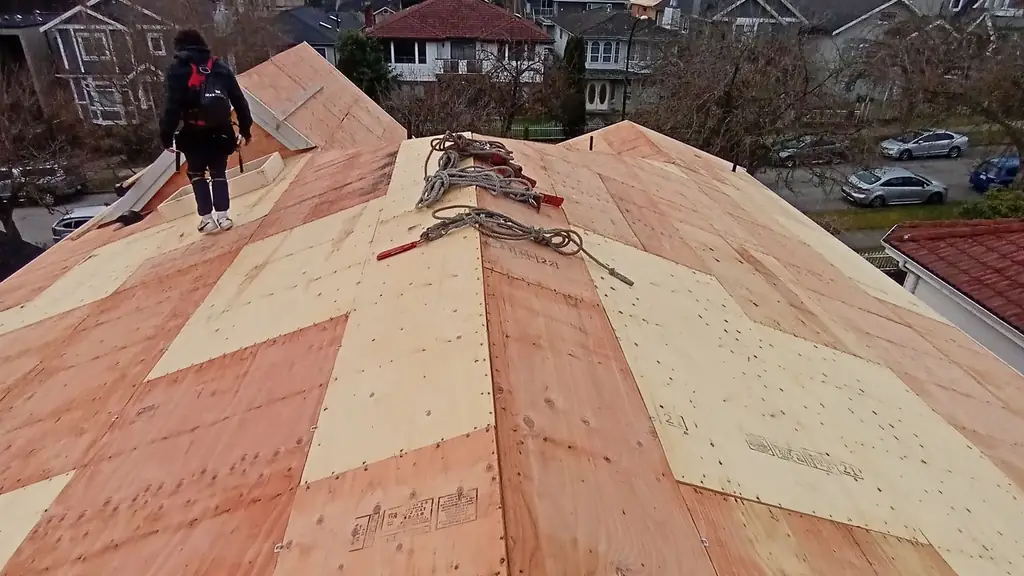
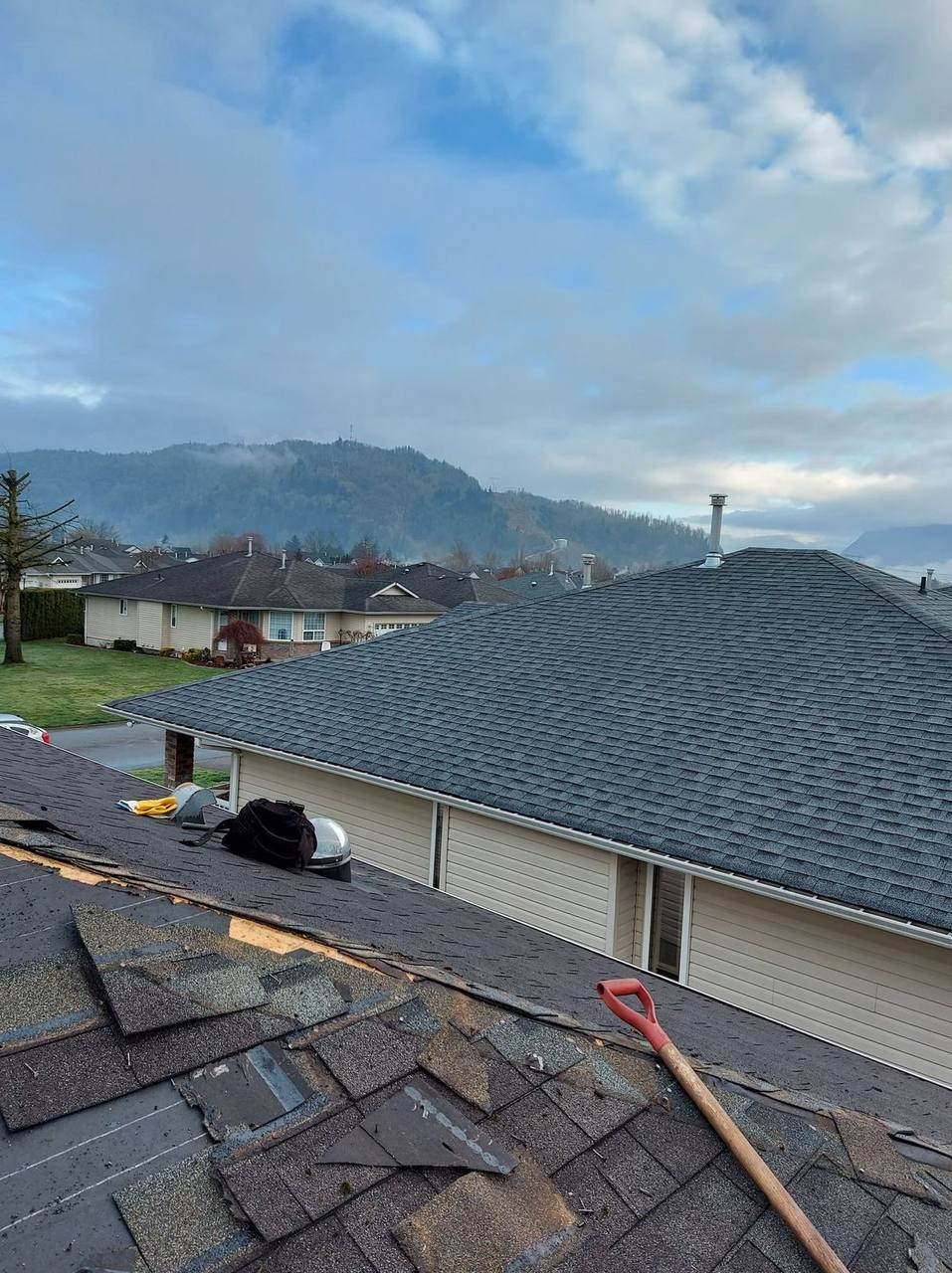
If you have never been through a roof replacement, the process can seem mysterious. Here is what happens when Fraser Roofing shows up. We strip everything down to the sheathing and inspect every square foot of plywood. Any soft spots get cut out and replaced with new material. We install ice and water shield six feet up from the eaves (double what code requires) because we know what Fraser Valley rain does at the drip edge. Then synthetic underlayment over the entire deck, proper flashing at every penetration, starter strips, field shingles or metal panels, ridge ventilation, and a complete cleanup with magnetic nail sweeps of your yard and driveway. The whole process takes two to four days for a standard home, and we do not leave until it is watertight, even if that means working late.
We carry full liability insurance and WorkSafeBC coverage. Every crew member is tied off at all times, a standard we brought with us from oil field safety protocols. Your home and our crew are protected on every job.
The Cost of Waiting Too Long
I am going to be direct because this matters. In the Fraser Valley climate, the gap between "needs replacement soon" and "catastrophic damage" can be as short as two winters. A roof that is shedding granules and showing early curling this fall will be letting water through the sheathing by next spring. That water rots plywood, grows mold, damages insulation, and can eventually compromise the structure of your home. A straightforward replacement on solid sheathing might run $14,000. That same roof two years later (with rotted sheathing, mold remediation, and insulation replacement) can easily hit $25,000 to $30,000. Every month you wait after the signs appear, the price goes up.
Johnny and I started roofing in 2016 because we saw too many Fraser Valley families get blindsided by roof failures that were preventable. We are based in Chilliwack. We drive the same rain-soaked roads you do. We live under the same sky. If your roof is showing any of these twelve signs, the best thing you can do is get a professional set of eyes on it before the next rainy season starts. The inspection is free. The peace of mind is worth everything.