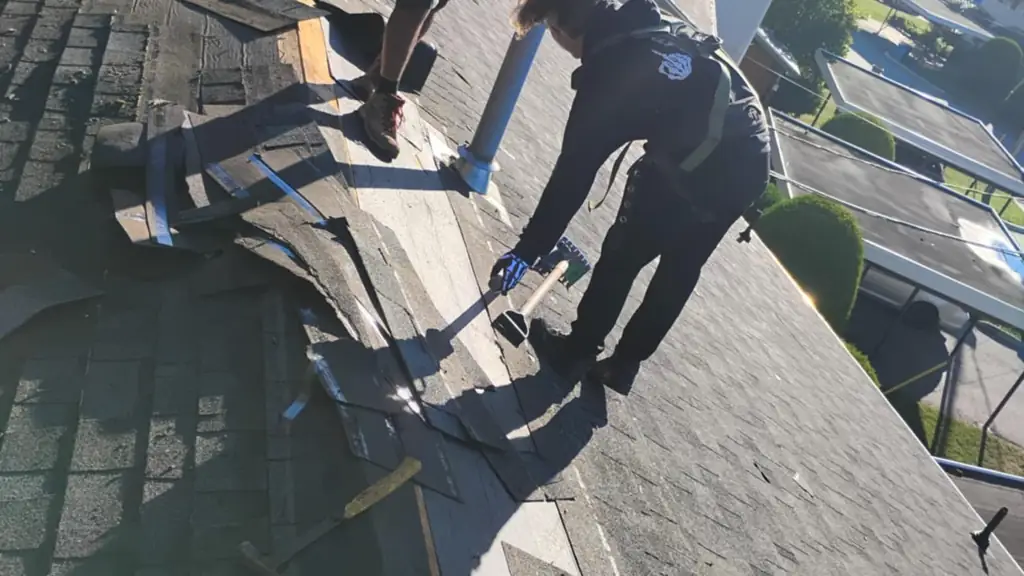
The first time Johnny and I drove to Mission for a roofing job, we came across on Highway 7. The road follows the Fraser River through Deroche and Dewdney, and you can feel the humidity change as you get closer to Mission. By the time you cross into town, the air is heavier, the moss on the power poles is thicker, and the cedar canopy closes in over entire neighborhoods. We looked at each other and said the same thing, these roofs are fighting a different battle than the ones back home in Agassiz.
We were right. Mission sits at the confluence of the Fraser and Stave rivers, with neighborhoods climbing steep hillsides into dense second-growth forest. That geography creates a roofing environment that combines the worst of riverside humidity with the drainage challenges of mountain terrain. After working on dozens of Mission roofs over the past ten years, we have learned exactly what goes wrong and how to prevent it.
The Fraser River Factor: Humidity That Never Quits
Mission is a river town. The Fraser is right there, and the Stave River joins it just upstream. That much moving water generates humidity that hangs in the air from October through April. Unlike Chilliwack or Abbotsford where afternoon sun can burn off morning fog, Mission's north-facing hillsides and dense tree cover trap that moisture against roofing surfaces for days at a time.
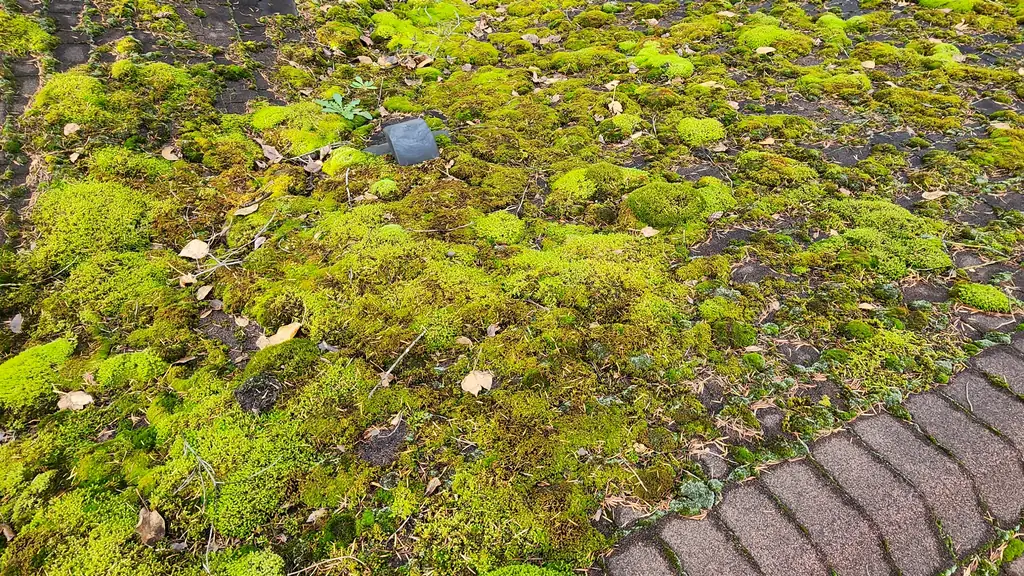
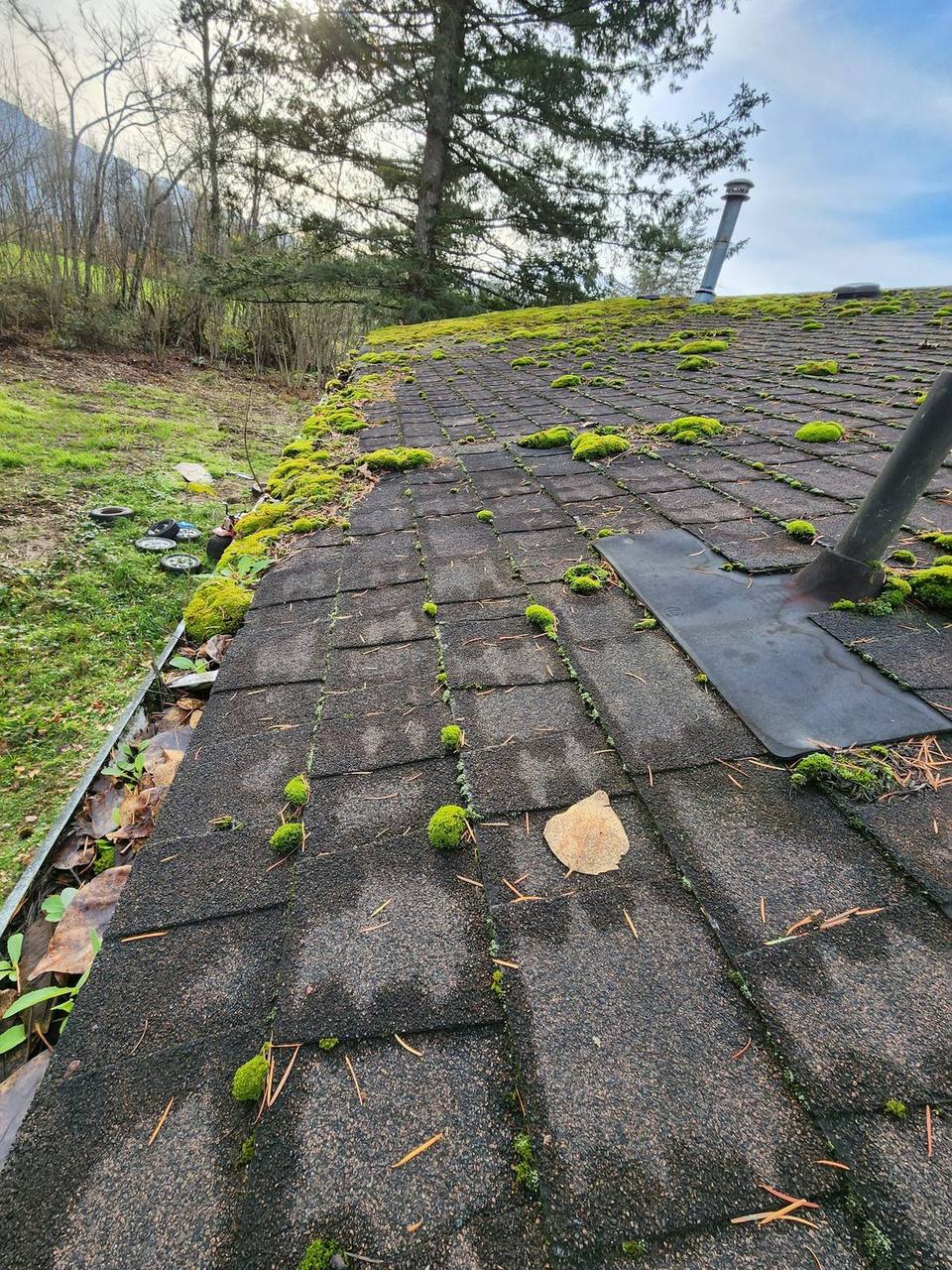
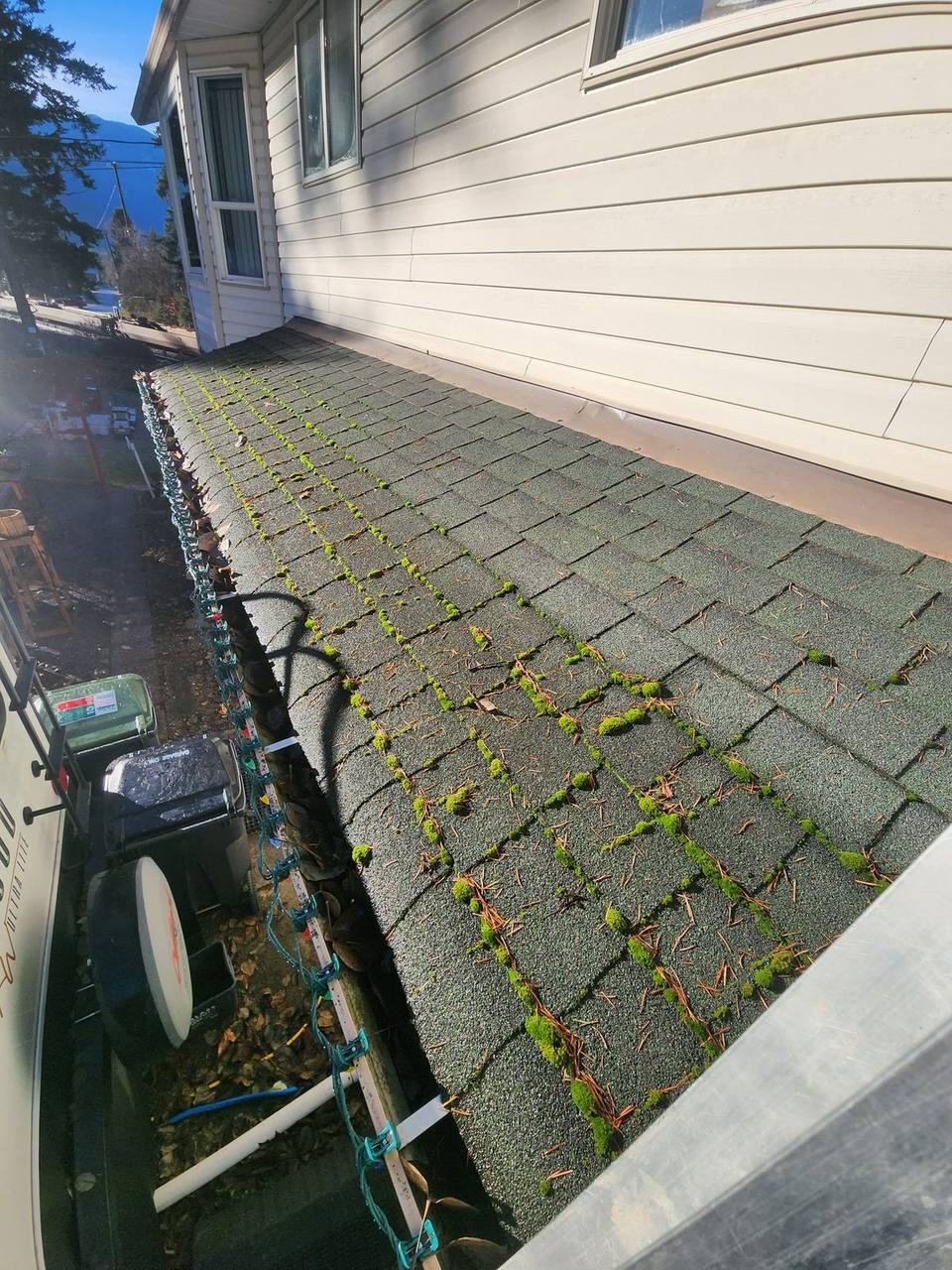
What does that mean for your roof? Moss. Relentless, aggressive moss that does not care what brand of shingle you installed. We have pulled moss mats off Mission roofs that were three inches thick, thick enough to hold water like a sponge against your shingles 24 hours a day. The rhizoids work under the shingle edges and pry them up, creating channels for water to reach the underlayment and eventually the decking. On one Hatzic property, the homeowner had only been in the house four years and the north slope already had moss so established that it required professional removal.
- Fraser River proximity keeps relative humidity above 80 percent for months at a time during fall and winter
- Stave River adds a second moisture source that many Mission residents underestimate
- North-facing hillside slopes receive minimal direct sunlight from November through February
- Morning river fog regularly persists until noon or later in Mission neighborhoods below 100 meters elevation
- Tree canopy blocks solar drying on properties from Ferndale through Silverdale and along Dewdney Trunk Road
Hillside Drainage: Where Gravity Becomes Your Enemy
If you live in the flats near downtown Mission or along the river, your roofing concerns are mostly about moisture and moss. But if you live up the hill (Hatzic Bench, Ferndale, Silverdale, the properties climbing toward Stave Lake) you have an entirely different problem. Steep grades mean water moves fast, and it concentrates at every transition point on your roof.
In the oil sands, we dealt with pressure vessels and pipe systems where you had to think about where fluid would go under force. Roofing on Mission hillsides is the same principle. Water hits a steep roof at velocity. It collects in valleys and races toward the eaves. If your valley flashing is undersized or your ice-and-water shield does not extend far enough, that concentrated flow finds a way in. We have seen hillside roofs in Mission where the valley leaked but the field shingles were fine, the installer just did not account for how much water that valley would carry during a heavy November downpour.
- Steep roof pitches above 6:12 require hand-nailing and specialized installation, no nail guns, because the angle causes the nail to deflect and miss the nailing strip
- Valley flashings on hillside properties need to be a minimum of 24 inches wide, not the 18-inch standard that works on flat lots
- Ice-and-water shield should extend 36 inches up from eaves on slopes above 8:12, double the standard code minimum
- Step flashing at wall transitions on uphill walls gets hit with concentrated runoff from the slope above and must be oversized
The Cedar Canopy Problem
Mission has some of the densest residential tree cover in the Fraser Valley. Cedar, Douglas fir, and big leaf maple tower over entire streets from Silverdale to Ferndale. Beautiful to live under, terrible for your roof. The shade prevents solar drying, tree debris accumulates in roof valleys and around penetrations, and falling branches cause impact damage that homeowners do not notice until the next rain reveals a leak.
Cedar debris is the worst offender. Cedar needles are acidic. When they accumulate in valleys and behind plumbing vents, they create a wet acidic mat that eats through sealant and accelerates granule loss. We cleaned a roof in Silverdale last year where the homeowner had been blowing off the debris every spring, but the valleys had a permanent brown stain where the cedar tannins had leached into the shingle surface. That discoloration was not cosmetic. Under those stains, the granule layer was completely gone and the asphalt was exposed to UV.
- Cedar needles trap moisture and release tannic acid that degrades asphalt shingles from the surface down
- Maple leaves mat flat against the roof and hold water like a tarp, especially dangerous in valleys and at wall transitions
- Branches rubbing on shingles in wind strip granules in a line pattern that weakens the shingle at the contact point
- Overhanging limbs should be trimmed to a minimum of 6 feet from the roof surface, 10 feet is better for large cedars and firs
- Tree debris should be cleared from valleys and roof penetrations regularly to prevent water damming and ice dam formation
Why We Drive Out to Mission
People ask us this all the time. We are based in Chilliwack, why drive 45 minutes to work on roofs in Mission? The honest answer is that we built Fraser Roofing to serve the whole Fraser Valley corridor, and Mission is part of that valley. Highway 7 connects us directly, Agassiz to Deroche to Dewdney to Mission. We know every curve in that road.
But there is a bigger reason. Working the full corridor from Hope to Abbotsford gives us perspective that a Mission-only roofer cannot have. We know what 1,800mm of annual rain does to a roof in Hope. We know what persistent lake fog does to roofs in Harrison. We know what summer heat does to attics in Abbotsford. When we look at a Mission roof, we are not just seeing Mission, we are comparing it against the full spectrum of Fraser Valley conditions and applying ten years of roofs worth of pattern recognition.
My brother Johnny and I were Red Seal boilermakers in the Alberta oil sands before we started roofing. Suncor, Syncrude, MEG Energy, CNRL, we worked the big camps. The discipline we brought back is simple: everything gets tied off, documentation is not optional, and you do not leave until the job is done right. When we say we will be at your Mission property at eight AM on Tuesday, we are there at eight AM on Tuesday. When we say the job will be watertight before we leave, it will be watertight before we leave.
Fraser Roofing has been serving Mission homeowners since 2016. Kory and Johnny Peters bring Red Seal Boilermaker discipline and ten years of Fraser Valley roofs of experience to every job. We offer free inspections across all Mission neighborhoods, call 604-728-0146 or visit fraserroofing.ca.
What Mission Homeowners Should Watch For
After five years of working on Mission properties, we have identified the warning signs that show up earliest. Catching these early saves you thousands compared to waiting for a leak.
- Dark streaks on north-facing slopes, this is algae and early moss colonization. Address it before the moss establishes roots under your shingles.
- Granule loss visible on the ground, some granule loss is normal in the first year, but ongoing loss means your shingles are deteriorating faster than expected, likely due to Mission's humidity and shade conditions.
- Flashing pulling away from walls at step transitions, hillside homes are especially vulnerable because soil movement on slopes can shift the building slightly over time, stressing rigid flashing joints.
- Soft or spongy feeling when walking near the eaves, this indicates decking moisture damage, usually from ice damming or inadequate drainage that has been wetting the fascia and working inward.
Our Mission Service Area
We work in every corner of Mission and the surrounding district. Whether you are on the flats near the Fraser River, partway up the hill in Hatzic, deep in the forest in Silverdale, or out on a rural property along Dewdney Trunk Road, we have been there and we know the conditions. Our service area covers the full District of Mission plus surrounding communities along the Highway 7 corridor.
- Downtown Mission and the Fraser River flats, high humidity, moderate tree cover, standard installation with emphasis on moisture-resistant materials
- Hatzic and Hatzic Bench, transitional zone where river humidity meets hillside drainage challenges, properties here need both moss prevention and enhanced valley flashings
- Ferndale and Silverdale, steep grades, heavy tree cover, limited access for some properties, specialized installation techniques for high-pitch roofs
- Steelhead and Stave Falls, rural properties with extreme tree cover, longest drive times for us but some of the most interesting roofing challenges in the valley
- Dewdney Trunk Road corridor, mixed terrain from flat agricultural land to wooded hillsides, conditions change block by block
Getting a Free Roof Inspection in Mission
We offer free, no-obligation roof inspections to every homeowner in Mission. We drive out, climb up on your roof with proper fall protection, take photos of everything we find, and give you an honest written assessment. No pressure, no upsell, no scare tactics. If your roof is fine, we will tell you it is fine and shake your hand. If it needs work, we will explain exactly what, why, and how much, and you can take that information to any contractor you choose.
That might sound like a strange business model, but it is the one that follows from the trade we came out of. In heavy industry the work gets inspected and signed off, and the only reputation worth having is the one that survives somebody checking. The test we apply on a roof is the same: would this assembly pass an inspection of every detail, not just the parts you can see from the ground? Every Mission roof we touch gets that standard.
Ready for a free roof inspection in Mission? Call Fraser Roofing at 604-728-0146 or email johnny@fraserroofing.ca. We serve all Mission neighborhoods from the Fraser River flats to Silverdale and everywhere in between. Kory and Johnny Peters, Chilliwack-based, Fraser Valley proud.
Last updated: February 2026