How to Install Valley Flashing on a Fraser Valley Roof
Our proven open valley method for BC's heaviest rainfall zone
Last updated: February 2026
Safety Warning
Valleys concentrate 2-4x the water volume of flat roof sections. Mistakes here cause the most expensive leaks.
- Valleys are steep, slippery, and a common fall hazard
- Full fall protection is required when working in valleys
- A single misplaced nail can cause years of hidden water damage
- Improper valley installation is one of the top reasons we get called for leak repairs
- We recommend professional installation for any valley on a complex or steep roof
Why We Take Valleys So Seriously
After completing over 500 roofs across the Fraser Valley since 2026, Johnny and I have seen every type of valley failure imaginable. Valleys are where two roof planes meet at an inside angle, and all the water from both planes funnels into that narrow channel. In a region like ours that gets 1,500-2,000 mm of rain per year, that is an enormous volume of water flowing through a small space.
We have pulled apart roofs in Agassiz where a homeowner's ceiling was destroyed because a previous roofer used 18-inch flashing in a valley that needed 36. We have seen valleys in Chilliwack where someone nailed through the center of the flashing, creating a dozen leak points. Every one of those repairs cost the homeowner far more than doing it right the first time.
The most common valley failure modes we see in the Fraser Valley:
- Corroded galvanized flashing -- rust holes from years of standing moisture and moss contact
- Flashing too narrow for water volume -- 18-inch flashing on a valley that handles runoff from two large roof planes
- Nails in the valley center -- every nail is a potential leak point
- Shingle corners not clipped -- water wicks under adjacent shingles instead of flowing into the valley
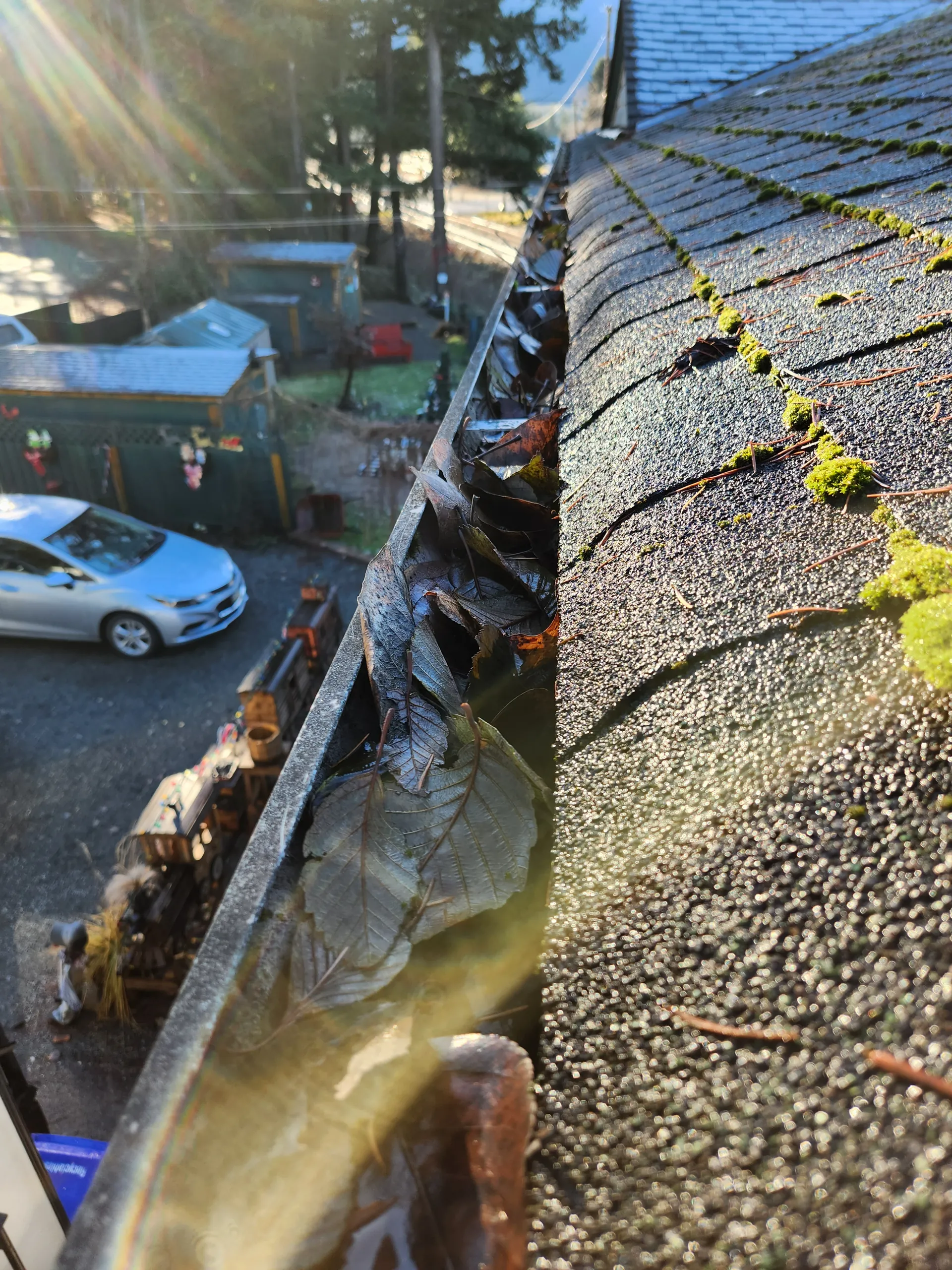
- Debris accumulation -- cedar needles, fir cones, and leaf buildup dam water upward under shingles
- Ice dam formation -- valleys at north-facing junctions are especially vulnerable during Fraser Valley cold snaps
Open vs. Closed Valley -- Our Strong Recommendation
We install open valleys on every roof we do. After years of repairing other roofers' closed valley failures, we will not use the closed method. Here is the breakdown:
Open Valley (What We Use)
- Metal flashing is visible in the valley center, providing a durable water channel
- Shingles are cut back from the center, giving water a clear path
- Superior water-shedding capacity -- critical for Fraser Valley rainfall
- Easy to inspect and clean
- 30-50+ year lifespan depending on flashing material
- Problems are visible before they cause interior damage
Closed Valley (We Do Not Recommend This)
- Shingles cover the valley with no visible flashing
- Relies entirely on underlayment for waterproofing
- When underlayment degrades -- and it will -- the valley leaks with no warning
- Traps debris and moisture, accelerating deterioration
- Extremely difficult to clean or inspect
- We have replaced dozens of failed closed valleys across Chilliwack and Harrison
Before You Start
Skill Level: Intermediate to Advanced. If you have never worked on a roof, this is not a good first project.
Time Required: 2-4 hours per valley, depending on length and complexity
Materials Cost: $50-150 CAD per valley (DIY). Professional installation: $200-600 per valley.
Tools We Use
- Tin snips (aviation snips for cleaner cuts on heavier gauge metal)
- Utility knife with hook blades (for shingle cutting)
- Chalk line
- Tape measure
- 4-6 foot straight edge
- Pneumatic roofing nailer or hammer
- Caulk gun
- Fall protection harness and anchors
Materials
- Valley flashing -- 24 to 36 inches wide. We use galvanized steel or aluminum depending on the application.
- Ice and water shield membrane -- 36 inches wide minimum
- Galvanized roofing nails
- Roofing cement compatible with your flashing material
- Matching shingles
- Drip edge

Step 1: Prepare the Valley Substrate
This is where most DIY jobs go wrong. People rush through prep because they want to get to the "real" work. But in the Fraser Valley, where moisture is relentless, substrate prep determines whether your valley lasts 5 years or 30.
- Strip old material -- Remove old flashing, shingles, nails, and sealant. Go 12 inches beyond the valley center on each side.
- Inspect the deck sheathing -- Probe for soft spots with an awl. We find rotted valley sheathing on about 1 in 5 roofs in Agassiz and Harrison, where moisture is highest.
- Replace damaged plywood -- Do not install new flashing over compromised decking. Cut out and replace any rot.
- Verify drainage -- The valley must drain freely from ridge to eave. Any flat spot or dip will pool water. We have seen valleys in Hope where settling created low spots that held standing water for months.
Step 2: Install Ice and Water Shield
Ice and water shield is your backup waterproofing layer. In a climate like ours, it is not optional -- it is essential.
- Center in the valley -- 36-inch wide membrane, providing 18 inches of coverage on each side of the valley center.
- Start at the eave -- Work upward toward the ridge.
- Overlap courses by 6 inches -- Peel the backing and press firmly as you go.
- Eliminate wrinkles -- Any wrinkle can trap water. Press and smooth as you work.
- Fraser Valley upgrade -- On high-risk valleys (north-facing, under tree canopy, or multi-plane junctions), we extend coverage to 36 inches on each side for 72 inches total width.
Step 3: Install the Valley Flashing
Choosing Your Flashing Material
- Galvanized steel -- Most common. Affordable. 20-30 year lifespan. We use this on most residential projects.
- Aluminum -- Will not rust. Lightweight. 30-40 year lifespan. Good for coastal-influenced areas like Harrison.
- Copper -- Premium choice. 50+ year lifespan. Beautiful patina. Expensive but essentially permanent.
Flashing Width -- Do Not Skimp
- 24 inches -- Our minimum for any Fraser Valley valley. Provides 12 inches of coverage on each side.
- 36 inches -- What we use on complex roofs, high-volume valleys, and steep pitches. The extra material costs a few dollars more but handles significantly more water.
Installation Process
- Center the flashing -- Equal width on each side of the valley center line.
- Start at the eave -- Extend the flashing 1-2 inches past the drip edge so water flows cleanly into the gutter.
- Nail edges only -- Place nails 1 inch from the flashing edge, spaced every 12 inches. This is critical: never nail the valley center. The flashing needs to expand and contract with temperature changes, and center nails create leak points.
- Overlap pieces by 12 inches -- Where flashing sections meet, the upper piece laps over the lower piece.
- Seal every lap -- Apply roofing cement generously to all overlap areas. Use a sealant compatible with your flashing metal.
- Extend over the ridge -- The flashing should continue 6 inches over the ridge line.
Step 4: Install and Cut Shingles
Shingle placement around the valley determines whether water flows into the channel or wicks under the roofing. This is where precision matters.
Shingle Installation
- Work one side at a time -- Install shingles from eave to ridge on one side of the valley first.
- Extend past the center -- Each shingle should reach at least 12 inches past the valley center line.
- Keep nails back -- All nails must be at least 6 inches from the valley center. Closer nails puncture the waterproof zone and create leak paths.
- Install the second side -- Shingles from the opposite plane overlap the first side.
Cutting for the Open Valley
- Snap chalk lines -- 2-3 inches from the valley center on each side. Widen the lines 1/8 inch per foot toward the eave, creating a subtle V-shape that accelerates water flow.
- Cut along the chalk lines -- Use a utility knife with a hook blade and a straight edge for clean, consistent cuts.
- Clip the corners -- Cut a 45-degree angle on the upper corner of each shingle at the valley edge. This directs water into the valley instead of letting it wick sideways.
- Seal every cut edge -- Apply roofing cement under each cut shingle edge. This is not optional.
Step 5: Final Sealing and Quality Check
Before we leave any job site, Johnny or I walk every valley personally. Here is what we check:
- All cut edges sealed -- Every shingle edge at the valley line has roofing cement underneath.
- All flashing laps sealed -- 12-inch overlaps with continuous sealant coverage.
- No nails in the center -- We check every inch of the valley center for stray nails.
- Clear water path -- From ridge to eave, nothing obstructs the flow.
- Valley is clean -- All debris, granules, and excess sealant removed.
- Drip edge connection -- Water exits the valley cleanly into the gutter system.
Fraser Valley-Specific Considerations
Living and working in this region since 2026, we have learned exactly what the Fraser Valley climate does to roof valleys. Here is what sets our installations apart:
Heavy Rain Management
- We default to 24-inch minimum flashing width, upgrading to 36 inches on any valley that handles runoff from more than 200 square feet of combined roof area
- Every valley gets verified for positive drainage -- no flat spots, no dips, no debris traps
- In Agassiz and Harrison, where annual rainfall can exceed 2,000 mm, we treat every valley as high-volume
Ice Dam Prevention
- North-facing valleys and shaded valleys in Hope get extended ice and water shield coverage -- 36 inches on each side
- We verify attic insulation and ventilation in the valley area, because heat escaping from below causes the freeze-thaw cycle that creates ice dams
- For chronic problem valleys, we discuss heat cable options with the homeowner
Moss and Debris Control
- Open valleys are dramatically easier to clean than closed valleys -- another reason we insist on the open method
- We recommend zinc or copper ridge strips above valleys to inhibit moss and algae growth
- Twice-yearly cleaning (spring and fall) is essential. Quarterly if you have overhanging trees.
- Cedar needles, Douglas fir debris, and leaf buildup in valleys cause more leak damage than most homeowners realize
Common Mistakes We Fix on Other Roofers' Work
These are the problems we encounter most frequently when we are called in to repair valley leaks across the Fraser Valley:
1. Nailing through the valley center. This is the single most common mistake. Every nail in the valley center is a potential leak point. Nails go at the edges only, 1 inch from the edge, spaced 12 inches apart.
2. Using flashing that is too narrow. Eighteen-inch flashing on a valley that handles runoff from two large roof planes is a recipe for overflow during heavy rain. Twenty-four inches is our minimum.
3. Skipping the corner clip on shingles. Without the 45-degree corner clip, water wicks sideways along the shingle edge instead of flowing into the valley. It is a small detail that prevents a big problem.
4. No ice and water shield. Some roofers use only felt paper under valley flashing. In our climate, that is not enough. Ice and water shield is self-sealing around nail penetrations, and it is your last line of defense.
5. Using the closed valley method. We see this frequently on older homes in Chilliwack and Abbotsford. The underlayment beneath the shingles degrades invisibly, and by the time the homeowner notices a leak, there is significant deck and interior damage.
Valley Maintenance Schedule
A well-installed valley should last decades, but only with proper maintenance. Here is what we recommend:
Twice-yearly inspection and cleaning (spring and fall):
- Clear all debris -- leaves, needles, granules, moss
- Check flashing for rust spots or corrosion (galvanized steel)
- Inspect shingle cut edges for lifted or unsealed edges
- Look for standing water, which indicates a slope problem or blockage
- Check for moss or algae growth along flashing edges
When to call us for valley replacement:
- Visible rust holes in the flashing
- Severe corrosion or pitting across the flashing surface
- Persistent leaks despite repair attempts
- Flashing is 25+ years old and showing wear
- Any sign of deck damage or staining beneath the valley
The Bottom Line
Valley installation is straightforward in concept but demands precision in execution. A properly installed open valley with adequate flashing width, full ice and water shield coverage, and meticulous shingle cutting will outlast the roof around it. A sloppy valley installation will leak within a few years, especially in the Fraser Valley's demanding climate.
At Fraser Roofing Ltd., every valley we install gets the open method with 24-36 inch flashing, full ice and water shield, and a personal quality check by Kory or Johnny before we leave the site. We have been doing this across the Fraser Valley since 2026 -- from Agassiz to Abbotsford and everywhere in between -- and we stand behind our work.
Frequently Asked Questions
Should I use an open or closed valley on my Fraser Valley roof?
We always recommend open valleys for Fraser Valley roofs. The region receives 1,500-2,000 mm of annual rainfall, and open valleys with exposed metal flashing handle that volume far better than closed valleys. Open valleys are also easier to inspect, clean, and maintain. After 500+ roofs across Agassiz, Chilliwack, Hope, and Harrison, we have never seen a properly installed open valley fail.
How wide should valley flashing be in a high-rainfall area like BC?
We use 24-inch wide flashing as our minimum on every job. For complex roofs with multiple converging planes or steep pitches, we upgrade to 36-inch flashing. The extra width costs a few dollars more per valley but handles significantly more water flow during the heavy downpours common throughout the Fraser Valley.
Why is my roof valley leaking even though it looks fine from the outside?
The most common causes of hidden valley leaks are nails placed too close to the valley center, flashing that is too narrow for the water volume, and deteriorated sealant under shingle cut edges. Closed valleys are especially prone to invisible failures because the underlayment degrades beneath the shingles where you cannot see it. We recommend a professional inspection to pinpoint the source.
How much does valley flashing installation cost in the Fraser Valley?
DIY materials typically run $50-150 CAD per valley. Professional installation ranges from $200-600 per valley depending on complexity, slope, and accessibility. Given that valley failures cause interior water damage costing thousands, professional installation is a sound investment.
How often should I clean my roof valleys in the Fraser Valley?
At minimum, twice a year -- spring and late fall. If your home is near trees, particularly Douglas fir, cedar, or deciduous trees, quarterly cleaning is better. Debris in valleys traps moisture, promotes moss growth, and can dam water upward under shingles. This is especially important in Agassiz and Harrison where tree cover is dense.
Need Expert Help With Your Roof?
Kory & Johnny have completed 500+ roofs across the Fraser Valley since 2026. Free inspections, honest estimates, no pressure.
(778) 860-4747Serving Hope, Agassiz, Chilliwack, Rosedale, Abbotsford & the entire Fraser Valley
Valley leaking? We have seen it all and we can fix it. Call (778) 860-4747 for expert valley inspection and repair across the Fraser Valley.