Roof Underlayment in the Fraser Valley
Why we run six feet of ice shield on every eave and never touch felt paper
Last updated: February 2026
A Lesson We Learned Early
One of the first tear-offs Johnny and I ever did together was a twelve-year-old roof in Chilliwack. The shingles peeled off clean — they still had life left in them. But the moment we started pulling up the felt underneath, our pry bars sank into the plywood. The deck was black, soft, and crumbling. Water had been wicking through that felt paper for years while the homeowner had no idea anything was wrong.
That job cost the homeowner an extra four thousand dollars in decking. The previous crew had saved maybe two hundred bucks by using #15 felt instead of synthetic. Since that day, we have never installed felt paper on a single roof, and we never will.
After 500-plus roofs across the Fraser Valley, our position on underlayment is simple: spend the extra couple hundred dollars now, or spend thousands later pulling apart a roof that rotted from the inside out. This guide explains exactly what goes under your shingles and why we make the choices we do.
What Underlayment Actually Does
Underlayment is the membrane that sits directly on your roof deck, beneath the shingles or metal panels. Most homeowners never see it. Many contractors barely think about it. But it serves four critical functions:
- Backup waterproofing — if a shingle lifts, cracks, or blows off, underlayment keeps water out of the deck
- Installation protection — during a multi-day job, underlayment is the only thing standing between your open deck and Fraser Valley rain
- Wind-driven rain barrier — during storms, water can push upward through shingle seams and the underlayment catches it
- Deck preservation — prevents moisture from slowly absorbing into the plywood or OSB, which is how rot starts
In a dry climate, underlayment is important. In the Fraser Valley, where Agassiz alone receives over 1,500 mm of rain in a normal year and Hope pushes past 1,800 mm, underlayment is the single most consequential material decision on your entire roof.
Felt Paper: Why It Has No Place on a Fraser Valley Roof
Asphalt-saturated felt paper was the industry standard for decades. It is made from organic cellulose fibers soaked in asphalt, available in #15 and #30 weights. It is also cheap — roughly fifty to a hundred dollars per square compared to a hundred-fifty to two hundred for synthetic.
The problem is that felt paper behaves like a sponge in wet conditions. It absorbs rain, stays damp for days, and transfers that moisture directly into the deck. Here is what we have observed pulling felt off Fraser Valley roofs:
- Moisture absorption — felt holds water against the deck surface, accelerating plywood rot in as few as eight to ten years
- Wrinkling — wet felt buckles and distorts, creating channels where water pools instead of shedding
- Tearing — once saturated, felt tears easily under foot traffic, tool drops, or even moderate wind
- UV breakdown — if left exposed for more than a few days (common during Fraser Valley weather delays), felt begins to crack and degrade
- Safety hazard — wet felt on a pitched roof is dangerously slippery for the crew
As Red Seal Journeyman Boilermakers, Johnny and I understand material science at a level that most roofers do not. Felt paper was designed for an era when roofs were built and covered in a single day in dry climates. The Fraser Valley is neither of those things. We refuse to use a material that is guaranteed to fail before the shingles above it.
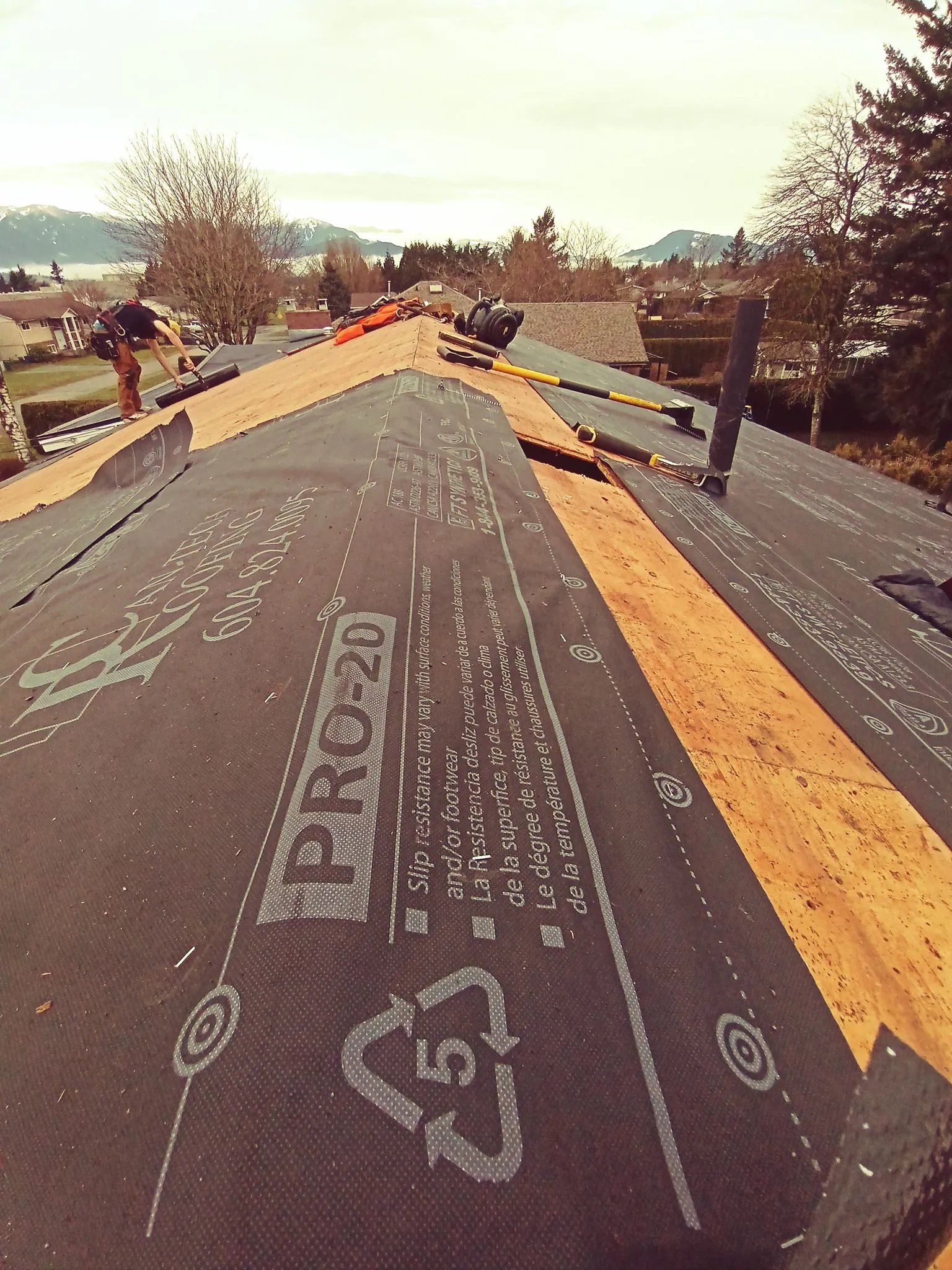
Synthetic Underlayment: Our Standard on Every Job
Every roof we install — from a small repair in Rosedale to a full replacement in Abbotsford — gets synthetic underlayment. No exceptions. No "upgrade packages." It is our baseline.
Synthetic underlayment is woven or spun polypropylene fabric, sometimes reinforced with fiberglass, coated with a polymer waterproofing layer. It does not absorb water. Period.
Why Synthetic Works in Our Climate
- Zero moisture absorption — rain hits it and runs off. The deck stays bone-dry underneath
- Extended exposure tolerance — if we need to pause a job for weather (and in the Fraser Valley, we will), synthetic can sit exposed for weeks or months with no degradation
- Tear resistance — our crews walk on it, drop tools on it, work in wind on it, and it holds together
- 30-plus-year lifespan — it will outlast the shingles above it, meaning when the next roof goes on in twenty-five years, the deck will still be solid
- Non-slip surface — the textured coating keeps our crew safe on wet mornings, which is most mornings around here
What We Use
Our standard product is IKO RoofGard Synthetic. It delivers the performance we need at a price point that keeps your total project cost reasonable. We source it through our local Fraser Valley suppliers so we always have rolls on hand — no waiting, no substitutions.
For homeowners who want the highest-tier option, we also work with Owens Corning ProArmor and CertainTeed DiamondDeck. But honestly, for the vast majority of residential roofs in the Fraser Valley, IKO RoofGard does exactly what it needs to do.
The Real Cost Difference
On a typical Fraser Valley home, the material cost difference between felt and synthetic underlayment is two hundred to four hundred dollars. That is it. On a fifteen-thousand-dollar roof, the premium for synthetic is roughly two percent of your total spend. We have seen homeowners agonize over this decision, then end up paying four to five thousand dollars for deck replacement a decade later because the previous crew used felt.
Ice and Water Shield: Where We Exceed the Code
Ice and water shield is a rubberized asphalt membrane with a peel-and-stick backing. Unlike regular underlayment, it fully adheres to the deck and seals around nail penetrations. It is the most waterproof layer you can put on a roof, and we use it in every area where water concentrates or backs up.
Our 72-Inch Eave Standard

The BC Building Code requires a minimum of 36 inches of ice and water shield at eaves in snow and ice zones. We install 72 inches — double the code requirement — on every single eave, from Hope to Abbotsford.
The reason is straightforward. During Fraser Valley winters, ice dams can extend four to six feet up a roof slope. When snow on the upper roof melts, the water runs down and refreezes at the cold eave edge, creating a dam. Water pools behind that dam and pushes upward under the shingles. At 36 inches of ice shield, that backed-up water can easily reach past the protected zone and into your deck.
At 72 inches, we have a margin of safety. In five years and over five hundred roofs, we have never had a single ice-dam leak on a roof we installed. That is not luck — it is six feet of self-adhering membrane doing its job.
Other Areas We Apply Ice and Water Shield
- Valleys — where two roof planes meet and funnel heavy water flow during storms
- Chimneys and skylights — penetrations where flashing meets the deck and water can find its way in
- Plumbing vents and exhaust fans — every pipe boot gets a ring of ice shield underneath
- Low-slope sections — any area below 4:12 pitch where water moves slowly and has time to find gaps
- Wall-to-roof transitions — dormer walls, step flashing zones, anywhere vertical meets horizontal
Our ice and water shield product is IKO ArmourGard. It adheres aggressively to clean plywood, self-seals around nail shanks, and has proven itself through hundreds of installations across the Fraser Valley.

How We Install Underlayment
Installation technique matters as much as material choice. Here is the process we follow on every job:
- Drip edge first — metal drip edge goes on at the eave before any membrane touches the deck
- Ice and water shield at eaves — 72 inches up from the eave edge, fully adhered, wrinkle-free
- Ice and water shield at critical areas — valleys, penetrations, low-slope zones, wall transitions
- Synthetic underlayment on the field — rolled horizontally, starting at the eave, working upward
- Four-to-six-inch overlap — every horizontal course overlaps the one below by at least four inches
- Cap staple attachment — plastic-cap staples hold the synthetic flat without creating leak points (we never use bare staples or roofing nails for underlayment)
- Ridge termination — underlayment from both sides overlaps at the ridge, sealed and secured
The entire process takes roughly half a day on a standard residential roof. We complete the underlayment in one push so the deck is never left exposed overnight. If weather threatens, we can have the full roof waterproofed with underlayment before a drop falls.
What to Ask Any Roofer About Underlayment
If you are getting quotes from multiple contractors, underlayment is one of the easiest ways to separate crews who cut corners from crews who do the job right. Ask these questions:
- "What type of underlayment is included in your quote?" — If they say felt, that tells you everything you need to know about their standards
- "How many inches of ice and water shield at the eaves?" — 36 inches is the legal minimum; 72 is what the Fraser Valley actually demands
- "Can you name the specific products you use?" — A crew that cannot name their underlayment brand is not paying attention to what matters
- "Is synthetic underlayment standard or an upgrade?" — If they charge extra for synthetic, they consider the bare minimum acceptable
- "Can I see the underlayment before shingles go on?" — Any contractor who says no is hiding something
The Fraser Roofing Ltd. Underlayment Standard
Johnny and I started Fraser Roofing Ltd. in 2026 with a specific approach: build every roof the way we would build it for our own families. Our underlayment standard reflects that commitment.
- Synthetic underlayment on 100 percent of the roof deck — no felt, no exceptions
- 72 inches of ice and water shield at every eave — double the code minimum
- Ice and water shield in every valley, at every penetration, at every wall transition
- Cap staple attachment — never bare staples or nails that create leak points
- Complete underlayment in one session — your deck is never left unprotected overnight
This standard is not optional. It is not an upgrade package. It is what goes on every roof we touch, from a single-slope shed in Harrison to a multi-gable home in Abbotsford. The Fraser Valley is too wet and the consequences of failure are too expensive for anything less.
Frequently Asked Questions
Why does Fraser Roofing Ltd. refuse to install felt underlayment?
Felt absorbs moisture and degrades within ten to fifteen years. In the Fraser Valley, where annual rainfall can exceed 1,800 mm, felt stays wet for days and promotes rot beneath shingles that still look fine on the surface. We have removed felt-underlaid roofs where the plywood decking was soft and black. The extra two hundred to four hundred dollars for synthetic is not an upgrade — it is baseline protection for any roof in this climate.
How much ice and water shield do you install at eaves?
We install 72 inches — six full feet — of self-adhering ice and water shield at every eave. The BC Building Code minimum is 36 inches. We double it because Fraser Valley ice dams can extend four to six feet up a roof slope, and 36 inches simply is not enough to keep backed-up water off the deck. This standard applies to every job from Hope to Abbotsford.
What brand of synthetic underlayment do you use?
Our standard product is IKO RoofGard Synthetic. It is tear-resistant, fully waterproof, and has a non-slip surface that keeps our crew safe during wet conditions. For ice and water shield, we use IKO ArmourGard. Both products are sourced through our local Fraser Valley suppliers so we always have material ready.
Can synthetic underlayment handle rain delays during a multi-day roof job?
Yes. Synthetic underlayment is completely waterproof and can remain exposed for weeks or even months without degrading. This matters in the Fraser Valley, where a clear morning can turn into afternoon rain. If we need to pause work, your deck stays dry. Felt paper, by contrast, must be covered within days or it wrinkles and loses integrity — an unacceptable risk in our climate.
Is underlayment required by BC Building Code?
Yes. The BC Building Code mandates underlayment on all residential roofs, with ice and water shield required at eaves in regions subject to ice damming. Fraser Roofing Ltd. exceeds these minimums on every project because the code establishes a floor, not a ceiling. Proper underlayment compliance also protects your manufacturer warranty and insurance coverage.
Related Guides
Need Expert Help With Your Roof?
Kory & Johnny have completed 500+ roofs across the Fraser Valley since 2026. Free inspections, honest estimates, no pressure.
(778) 860-4747Serving Hope, Agassiz, Chilliwack, Rosedale, Abbotsford & the entire Fraser Valley
Questions about what goes under your roof? Call (778) 860-4747 — Kory and Johnny will walk you through exactly what we install and why.