Asphalt Shingles: What We Install on Fraser Valley Roofs (and Why)
Honest advice from Kory and Johnny Peters after 500+ shingle roofs across the valley
Last updated: February 2026
We Have Installed Hundreds of Shingle Roofs -- Here Is What We Have Learned
When Johnny and I started Fraser Roofing Ltd. back in 2026, we had a lot of opinions about roofing materials from our years as Red Seal Boilermakers working in the oil sands. We understood metal fabrication, weather exposure, and building things that last. But we quickly learned that what works up north doesn't always translate to the Fraser Valley's unique wet climate.
Over 500 roofs later -- from Agassiz to Abbotsford, Hope to Harrison -- we have tested, installed, and watched how different asphalt shingles perform in our specific conditions. This guide is everything we have learned, with no sales pitch. Just what actually holds up on the roofs we service every day.

Why Asphalt Shingles Still Dominate Fraser Valley Roofing
Roughly 80% of homes across Canada use asphalt shingles. In the Fraser Valley, that number is even higher. There are good reasons for that: they are affordable, every contractor knows how to install them, and modern architectural shingles genuinely perform well -- even in our 1,800mm+ annual rainfall.
But there is a catch. The Fraser Valley is one of the hardest environments in Canada for any roofing material. Our combination of constant moisture, seasonal freeze-thaw cycles (especially in Hope and Harrison), heavy moss and algae growth, and occasional windstorms coming through the mountain passes means that cheap shingles installed poorly will fail years before their warranty suggests.
That is why Johnny and I are particular about which products we put on your roof and how we install them. We live here in Agassiz. We drive past our work every day. We are not going to install something that makes us look bad in three years.
How a Modern Asphalt Shingle Is Actually Built
Understanding what is inside a shingle helps you understand why some last and others do not. Here is the layer-by-layer breakdown of a modern fiberglass shingle:
- Ceramic Granules (Top Surface): Tiny colored stone particles embedded in asphalt. They block UV rays, give the shingle its color, and in algae-resistant products, contain copper or zinc to prevent moss growth. When you see bare dark patches on an old roof, that is granule loss -- and it means the shingle is losing its protection.
- Asphalt Coating: The waterproofing layer. Modern premium shingles use SBS (Styrene-Butadiene-Styrene) polymer-modified asphalt, which stays flexible in cold weather instead of cracking. This matters a lot in Hope and Harrison where winter temperatures swing rapidly.
- Fiberglass Mat: The structural backbone. Unlike the old organic felt mats used before the 1990s, fiberglass does not absorb water. This single change is why modern shingles last 25-30 years instead of 15-20.
- Second Asphalt Coating (Bottom): More waterproofing underneath the mat.
- Back Surfacing: Fine sand or mineral powder that prevents shingles from fusing together in the bundle before installation.
- Self-Sealing Adhesive Strip: A heat-activated adhesive that bonds each shingle to the one below it after installation. This adhesive seal is what keeps shingles on your roof during windstorms. If shingles are installed in cold weather without hand-tabbing, this strip may never activate -- and we see wind damage within the first year.
The Old vs. New: Why Your 1990s Roof Is Failing
If you are in Chilliwack, Agassiz, or anywhere in the valley with a roof from the 1980s or early 1990s, there is a good chance it used organic felt-based shingles. These are fundamentally different from what we install today:
Organic Shingles (pre-1990s) -- Discontinued for Good Reason:
- Made with cellulose (paper) felt that absorbs water like a sponge
- Only lasted 15-20 years in the Fraser Valley -- often less
- Failed by absorbing moisture, swelling, cracking, and curling
- Weighed 240-400 lbs per square (heavier = more structural stress)
Modern Fiberglass Shingles (what we install now):
- Non-absorbent fiberglass core that does not swell or rot
- 25-30 year lifespan in the Fraser Valley with proper installation
- Lighter at 200-250 lbs per square
- Better wind ratings, better granule adhesion, better everything
Johnny and I tear off 1980s and 1990s organic shingle roofs regularly. The damage underneath is almost always worse than the homeowner expects -- water-damaged decking, rotted fascia boards, and insulation that has been wet for years. If your roof is from that era, do not wait for a leak. By the time water is coming inside, the damage is already extensive.
The Three Types of Asphalt Shingles (And Which One You Should Pick)
1. Three-Tab Shingles -- The Economy Option We Rarely Recommend
Three-tab shingles are the flat, uniform, single-layer shingles that were standard on every home built before 2005. They are the cheapest option by about $1,000-1,500 on a typical home. And honestly, we almost never install them anymore.
- Lifespan: 15-20 years in the Fraser Valley (often closer to 15)
- Wind Rating: 60-70 mph -- inadequate for Hope's mountain pass winds and exposed hillsides throughout the valley
- Cost: $3,000-5,000 installed on an average home
- Warranty: 20-25 years prorated (coverage drops rapidly after year 10)
Our honest take: Saving $1,000-1,500 upfront to lose 10 years of roof life is not a deal -- it is a trap. We have been called out to too many three-tab roofs in Hope and exposed Chilliwack areas where entire sections have blown off in windstorms. The adhesive strips on three-tab shingles are narrower and less reliable. If a customer insists on three-tab to save money, we will do it, but we make sure they understand the tradeoff.
2. Architectural Shingles -- What We Put on 70% of Our Projects
Architectural shingles (also called dimensional or laminated shingles) are multi-layered, thicker, and dramatically more wind-resistant than three-tab. They have a textured, dimensional look that mimics wood shake. This is what Johnny and I install on the vast majority of homes across the Fraser Valley.
- Lifespan: 25-30 years in the Fraser Valley with proper installation
- Wind Rating: 110-130 mph -- suitable for all Fraser Valley locations including Hope
- Cost: $4,500-7,000 installed on an average home
- Warranty: 30-50 years limited lifetime (read the fine print -- all are prorated)
The brands we use and trust:
- IKO Cambridge -- Our workhorse. Roughly 70% of our shingle installations use IKO Cambridge. We have installed over 200 IKO Cambridge roofs since 2026 with zero material warranty claims. Zero. The performance-to-price ratio is unbeatable, the colors are excellent (Dual Black, Weatherwood, and Driftshake are the most popular in our area), and they are always in stock at Roofmart Chilliwack and Abbotsford.
- Owens Corning Duration -- Our choice for extreme wind exposure. The SureNail technology (a reinforced nailing zone built into the shingle) provides measurably better wind resistance. We use these on Hope hillsides and exposed ridgeline homes.
- CertainTeed Landmark -- Solid mid-range performer with the best color selection in the industry. We install these when a homeowner needs a specific colour match.
- BP Everest -- Budget-friendly architectural option. Adequate for customers with strict budget constraints, but not our first choice.
3. Premium / Designer Shingles -- For Homes That Deserve the Best
Premium shingles use advanced granule technology, thicker multi-layer construction, and often include built-in copper or zinc for moss and algae prevention. They cost $3,000-5,000 more than standard architectural shingles but add 5-10 years of lifespan and look substantially better.
- Lifespan: 30-40 years in the Fraser Valley
- Wind Rating: 130+ mph
- Cost: $8,000-12,000 installed on an average home
- Warranty: Limited lifetime (50+ years prorated)
Products we install in this category:
- IKO Dynasty -- Premium architectural with enhanced granules and polymer-modified asphalt. Our top recommendation for higher-end Fraser Valley homes.
- Owens Corning Berkshire -- Luxury appearance with excellent performance. Beautiful on homes with complex rooflines.
- CertainTeed Grand Manor -- Mimics the look of natural slate at a fraction of the cost and weight.
When we recommend premium: If you plan to stay in your home for 20+ years, if your home has a complex roofline where aesthetics matter, or if you are in a moss-heavy area like Agassiz or north-facing slopes and want built-in algae resistance. The premium pays for itself over time because you are pushing your next reroof out by a decade.
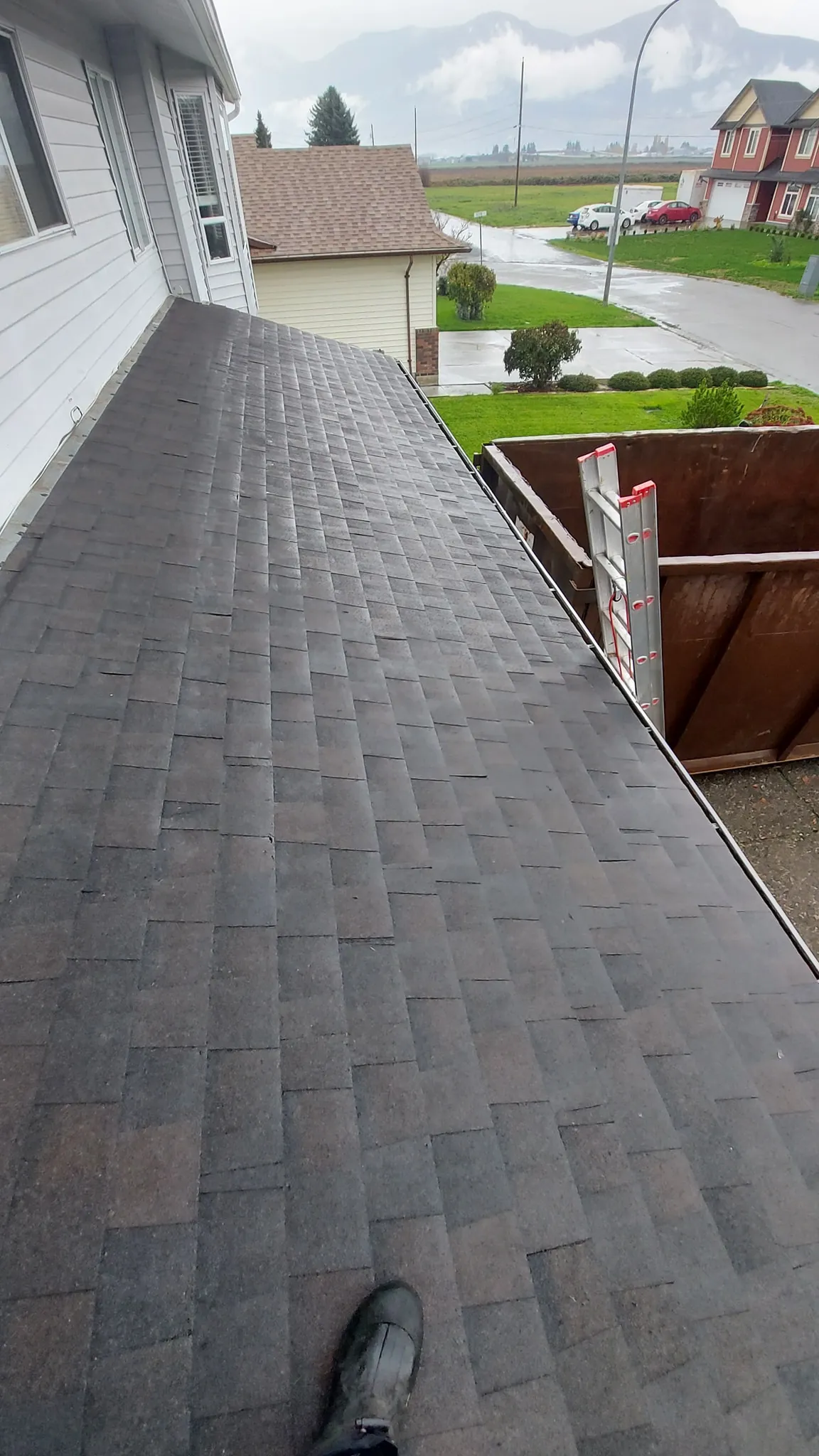
How Asphalt Shingles Fail in the Fraser Valley -- What We See on Every Tear-Off
Johnny and I have torn off hundreds of failed roofs. These are the four ways shingles die in our climate, ranked by how often we see them:
1. Moss and Algae -- The Fraser Valley's Roof Killer
This is the number one cause of premature shingle failure in our area. We see it on virtually every tear-off in Agassiz, where river fog keeps roofs damp for months. North-facing roof slopes, tree-shaded sections, and any roof that does not get consistent sun exposure will grow moss.
Moss is not just cosmetic. It holds moisture against the shingle surface, accelerates granule loss, works its roots under shingle edges, and creates pathways for water to get underneath. A heavy moss layer can shorten a shingle's lifespan by 5-10 years.
Risk levels we see across the valley:
- Extreme: Agassiz (river fog), north-facing roofs everywhere, heavily shaded lots
- High: Tree-lined neighbourhoods in Chilliwack, Harrison, Rosedale
- Moderate: Open south-facing roofs in Abbotsford and Mission
What we do about it: Every shingle we install now uses algae-resistant granules. We recommend zinc ridge strips on all Agassiz installations. And we tell every homeowner: get your roof professionally cleaned every 2-3 years. Never pressure wash -- it strips the protective granules right off.
2. Wind Uplift -- Hope and Exposed Hilltops Are Brutal
The Fraser Valley funnels wind through mountain passes, and Hope sits right where the Coquihalla and Fraser Canyon converge. We have seen 100+ km/h gusts strip three-tab shingles off roofs like playing cards. Even architectural shingles can lift if the adhesive strip was not properly activated during installation.
Risk levels:
- Extreme: Hope (converging mountain pass winds)
- High: Exposed hilltops and ridgelines in Chilliwack, Mission
- Moderate: Open agricultural areas in Abbotsford, Agassiz flats
Our approach: We use a 6-nail high-wind protocol (vs. the code minimum of 4 nails) on every roof in Hope and on any exposed hillside. We hand-tab shingles when installing in cold weather to ensure the adhesive strip activates. And we always use architectural shingles with 110+ mph wind ratings -- no exceptions in wind-prone areas.
3. Granule Loss -- Death by a Thousand Tiny Particles
Every asphalt shingle slowly loses granules over its lifetime. That is normal. But excessive granule loss -- where you can see dark bare patches on the shingle surface -- means the UV protection is failing and the underlying asphalt will deteriorate rapidly.
We see accelerated granule loss from UV exposure at elevation (Hope, Harrison), impact from falling branches, and poor-quality manufacturing. If your gutters are filling with granules faster than normal, your roof is telling you something.
Prevention: Choose shingles with advanced granule technology (IKO ArmourZone, Owens Corning StreakGuard). Trim overhanging branches. Do not walk on your roof unnecessarily -- foot traffic accelerates granule loss.
4. Thermal Cycling -- The Freeze-Thaw Problem
In Hope and Harrison, winter temperatures can swing 15-20 degrees Celsius in a single day. That repeated expansion and contraction cracks shingles, curls edges, and breaks the adhesive bonds between courses. Standard asphalt gets brittle in cold weather. SBS polymer-modified asphalt stays flexible.
Prevention: Proper attic ventilation (reduces temperature differentials across the roof deck), synthetic underlayment instead of felt, and premium shingles with polymer-modified asphalt for homes in Hope and Harrison.
Our Brand Assessment -- Five Years of Real-World Data
This is not based on manufacturer marketing. This is what Johnny and I have observed after installing, maintaining, and repairing hundreds of roofs across the Fraser Valley since 2026.
IKO -- Our Number One Choice
We install IKO on more roofs than every other brand combined. Here is why:
- Local Availability: Always in stock at Roofmart Chilliwack and Abbotsford, Pioneer, and Canex. No waiting weeks for a special order.
- Proven Performance: 200+ IKO Cambridge roofs installed since 2026 with zero material warranty claims. That track record speaks for itself.
- Value: Best performance-to-price ratio in the industry. You get 90% of what a premium shingle offers at 60% of the cost.
- Warranty Support: IKO is Canadian. Their warranty department is responsive and reasonable. We have never had a claim denied.
- Colour Selection: Dual Black, Weatherwood, and Driftshake are consistently the top sellers with our customers.
Cambridge is our everyday workhorse. Dynasty is what we use on premium projects. Marathon is a solid mid-range option we occasionally install.
Owens Corning -- Best for Extreme Wind Exposure
Owens Corning makes excellent shingles. Their SureNail technology (a fabric strip built into the nailing zone) provides genuinely superior wind resistance -- it is not just marketing. Their StreakGuard algae resistance is also top-tier.
The downside: they cost 10-15% more than IKO Cambridge, and local availability is not as consistent. Lead times can be longer.
When we recommend Owens Corning: Hope hillsides, exposed ridgeline homes, and customers who specifically request the brand.
CertainTeed -- Best Colour Selection
CertainTeed's Landmark series is a solid performer with the widest color palette in the industry. Performance is comparable to IKO Cambridge at a similar price. We install CertainTeed when a homeowner has their heart set on a specific colour that IKO does not offer. Available at Canex.
BP (Boral) -- Budget Option Only
BP Everest architectural shingles meet code and cost less than the competition. We install them for budget-conscious customers who understand the tradeoff. Shorter track record in our area, and we would not put them on our own houses. But they are acceptable for cost-sensitive projects.
What Should You Actually Put on Your Roof?
Here is what Johnny and I recommend based on years of doing this work in the Fraser Valley:
For 90% of Fraser Valley Homes -- IKO Cambridge:
- Expected lifespan: 25-30 years
- Cost: $5,000-7,000 installed on an average home
- Warranty: Limited lifetime (50 years prorated)
- Installed with our 6-nail protocol in wind zones, synthetic underlayment, extended ice and water shield at eaves and valleys
For High-End Homes or 20+ Year Ownership -- IKO Dynasty or Owens Corning Berkshire:
- Expected lifespan: 30-40 years
- Cost: $8,000-12,000 installed on an average home
- Warranty: Limited lifetime (50+ years prorated)
- Worth the premium for complex rooflines, homes in heavy moss areas, and long-term homeowners
For Strict Budget Constraints -- BP Everest:
- Expected lifespan: 20-25 years
- Cost: $4,000-5,500 installed on an average home
- Warranty: 30 years limited
- Adequate but not our first recommendation
Related Guides
Need Expert Help With Your Roof?
Kory & Johnny have completed 500+ roofs across the Fraser Valley since 2026. Free inspections, honest estimates, no pressure.
(778) 860-4747Serving Hope, Agassiz, Chilliwack, Rosedale, Abbotsford & the entire Fraser Valley
Not sure which shingle is right for your home? Call Kory or Johnny at (778) 860-4747 and we will bring samples to your door -- anywhere from Hope to Abbotsford.