Picking the Right Roof Shingle Color for Fraser Valley Homes
What we have learned about color selection after 500+ installs from Hope to Abbotsford
Last updated: February 2026
Why This Decision Matters More Than Most People Realize
A new roof is one of the biggest single-day visual changes you can make to a home. Your shingle color will define your curb appeal for the next 25 to 30 years, affect how much heat your attic absorbs through BC's increasingly hot summers, and either help or hurt your resale value when it is time to sell. Choosing well means you pull into the driveway and feel good about it for decades. Choosing poorly means you notice it every single time.
Johnny and I have installed over 500 roofs across the Fraser Valley since we started Fraser Roofing Ltd. in 2026. Between the two of us, we have seen every combination of siding, trim, stone, and landscape you can think of. This guide comes from that on-the-ground experience — what actually works in our region, what fades, what hides moss, and what our customers consistently love five years later.
Understanding Fraser Valley Conditions First
Color choice in the Fraser Valley is not the same as color choice in the Okanagan or downtown Vancouver. Our region has specific characteristics that directly affect how shingle colors look and perform over time.
The Moss Factor
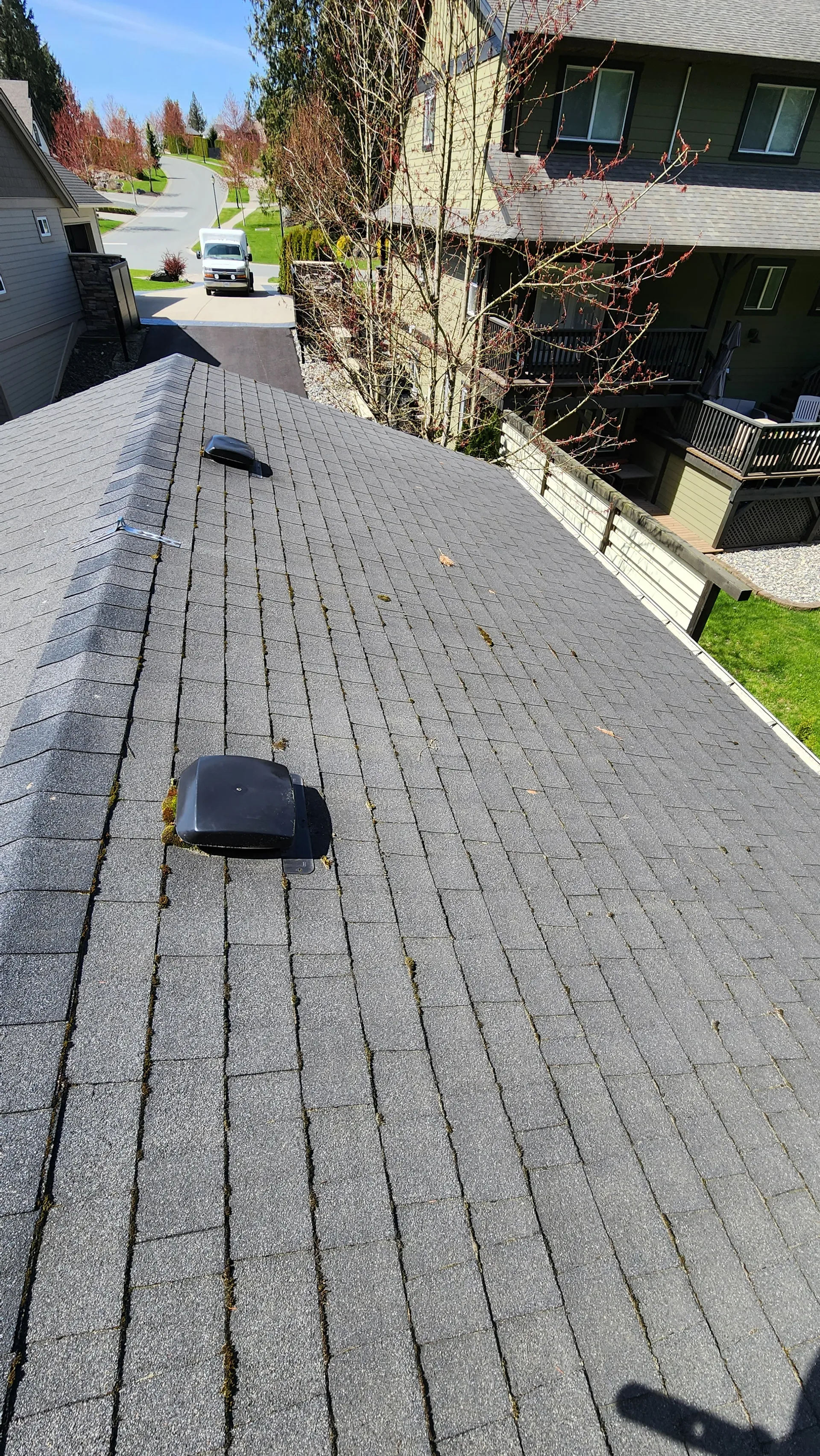
We receive roughly 1,500 to 2,000 mm of rain annually, depending on where you sit between Hope and Abbotsford. That moisture, combined with tree cover and moderate winters, makes moss and algae growth almost guaranteed on north-facing slopes within three to five years. Color choice directly affects how visible that growth becomes.
- Very light shingles (white, pale gray): Green and black organic staining is obvious within two to three years on shaded sections. You will need soft-wash cleaning more frequently to keep them looking clean.
- Very dark shingles (solid black): Actually hide green moss fairly well, but thick moss build-up eventually becomes visible as texture regardless of color. Dust and pollen also show more on pure black during dry stretches.
- Mid-tone blends (weathered wood, driftwood, charcoal blends): These are the sweet spot. The multi-tonal pattern camouflages early-stage organic staining remarkably well. This is the number one reason mid-tones dominate our installs.
Summer Heat
Fraser Valley summers now regularly push past 35 degrees Celsius. Dark shingles can reach surface temperatures of 70 to 80 degrees on a cloudless July afternoon. That heat transfers into your attic space and, without adequate ventilation, into your living areas. A properly ventilated attic with balanced ridge and soffit airflow keeps the temperature difference between dark and light shingles to roughly three to five degrees inside — manageable for most homes. But if your attic ventilation is already marginal, going dark amplifies the problem.
Winter Gray
From October through March, the Fraser Valley sky is often overcast. Under flat gray light, subtle color differences flatten out. A shingle that looked distinctly brown on the sunny day you picked it may read as plain gray for half the year. This is why we strongly encourage viewing samples on a cloudy day in addition to a sunny one. What looks good under both conditions is a reliable pick.
Matching Color to Your Home's Exterior
The single most important principle: your roof should complement your home, not compete with it. The roof is the largest visible surface area on most houses, so it sets the tone. But it should frame the rest of the exterior, not dominate it.
Warm-Toned Exteriors
If your siding is beige, cream, tan, warm gray, or natural wood, stay in the warm color family for your shingles. Weathered Wood, Autumn Brown, and Desert Tan are natural pairings. Avoid cool grays or blue-toned charcoals, which create a disconnected look against warm-toned walls.
Cool-Toned Exteriors
Homes with blue-gray siding, white trim, or cool stone accents pair well with Charcoal, Driftwood, or Estate Gray. These maintain visual harmony without competing. A warm brown shingle on a cool blue house creates a visual tension that most buyers find off-putting.
Dark or Bold Exteriors
Dark siding (deep green, navy, charcoal) benefits from a roof in a complementary mid-tone or a matching dark shade. Dual Black on a dark green home creates a striking, unified look. Going light on top of dark siding can look top-heavy and awkward from the street.
Brick and Stone Homes
Pull your shingle color from the secondary tone in your brick or stone. If your brick has brown and rust tones, a Weathered Wood shingle picks up those undertones naturally. If your stone is primarily gray with flecks of blue, Driftwood or Pewter Gray ties it together.
What We Install Most — And Why
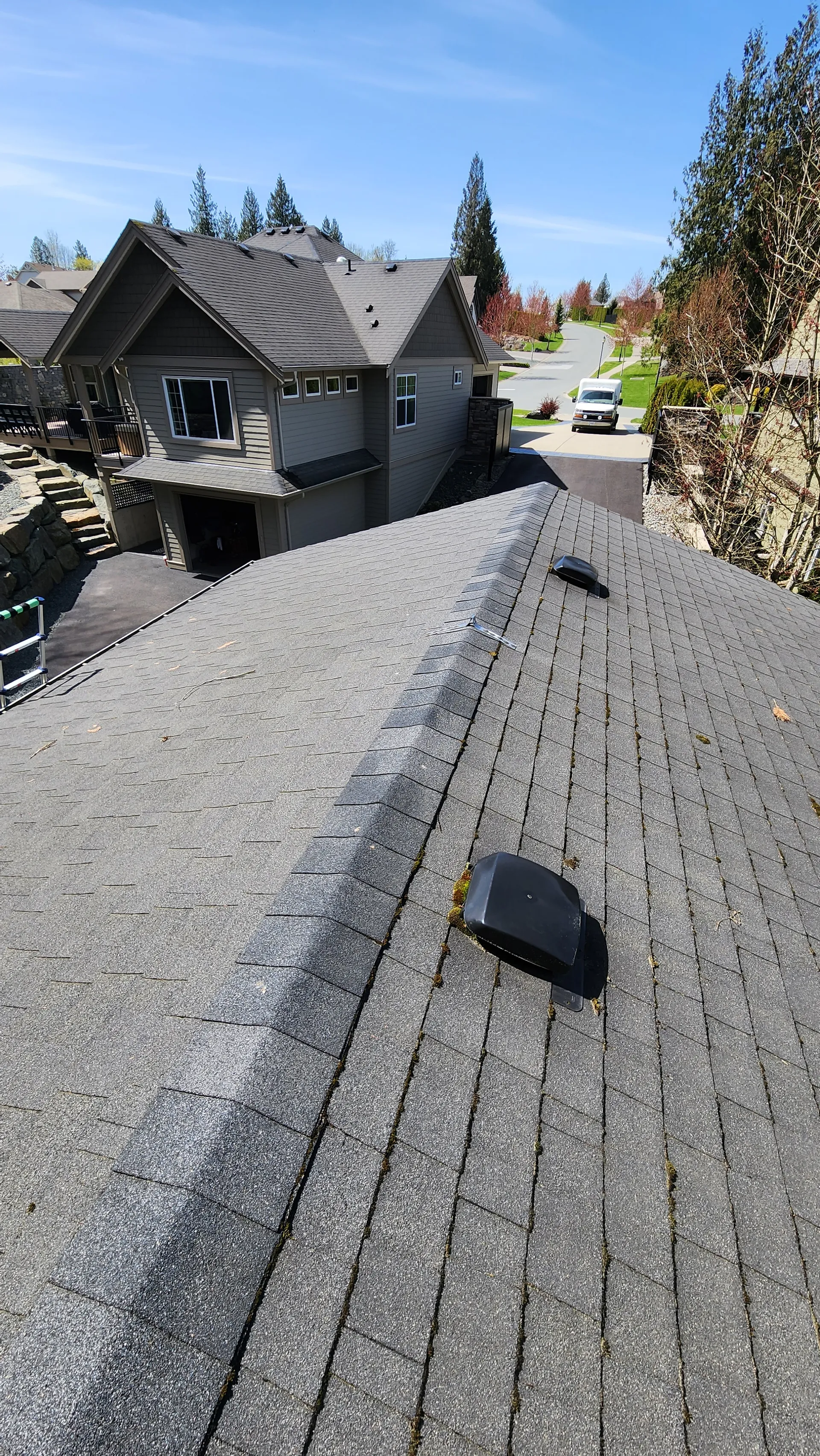
After 500-plus jobs, clear patterns have emerged in what Fraser Valley homeowners gravitate toward. Here is our real breakdown from 2024 and 2025 installs.
Dual Black — About 30 Percent of Our Work
This is consistently the top request in Chilliwack, Abbotsford, and the newer subdivisions around Agassiz. Deep black with subtle charcoal dimension. It reads as premium, modern, and bold from the street. It pairs beautifully with white, light gray, or cream siding.
The trade-off is real, though. Black absorbs the most heat of any color, so ventilation needs to be dialed in. It also shows pollen and dust more than mid-tones during dry summer weeks. For homes surrounded by heavy tree cover with limited sun exposure, it is an excellent choice because the heat penalty is minimal and the bold contrast stands out even in shade.
Weathered Wood — About 25 Percent
The most versatile color we install. This warm brown blend with gray and tan highlights works on nearly every home style — ranchers, two-storey, craftsman, split-level. It hides moss staining remarkably well, which is a major advantage in our wet climate. If a customer is torn and cannot decide, this is our default recommendation because it almost never looks wrong.
Driftwood — About 20 Percent
A lighter option with white, gray, and charcoal tones. Popular on modern farmhouse builds and homes with dark exteriors. It reflects more heat than the darker options and gives small homes a larger appearance from the road. The downside is that organic staining shows sooner, so plan on periodic cleaning if you have heavy tree shade.
Charcoal — About 15 Percent
The quiet workhorse. Charcoal is a medium-dark neutral gray that almost nobody dislikes. It works with warm or cool exteriors, hides staining well, and has broad buyer appeal for resale. It is a safe, confident choice that never feels boring. Many of our repeat customers — people whose first roof we did in 2026 or 2022 — request Charcoal again for investment properties or family members' homes.
Everything Else — About 10 Percent
The remaining installs are split among Autumn Brown, Desert Tan, Pewter Gray, and occasional specialty orders. These are not bad choices — they are simply more situational. A customer with a specific stone facade or a heritage-style home may land on Autumn Brown and be thrilled with it. The key is that these picks require more careful coordination with the rest of the exterior.
How We Help You Choose On-Site
We do not ask you to pick a color from a tiny swatch in a brochure. Here is our process:
- We bring full-size sample boards to your property. Each board is roughly 30 by 45 centimetres — large enough to see the real pattern and depth of the shingle blend. Tiny swatches distort colors and make everything look flatter than it actually is on a full roof.
- We hold samples at roof height against your fascia. You step back to the curb or across the street. This replicates the actual viewing angle you will see every day. Colors look noticeably different at elevation compared to holding them in your lap.
- We ask you to check in different light. Morning sun, afternoon sun, and overcast. If you can only be home once, we leave the samples with you for 24 hours so you can see the full cycle. Colors that look warm and rich at noon can look flat and muddy at dusk.
- We drive the neighbourhood with you. We point out existing roofs in the colors you are considering. Seeing a full roof in Dual Black three streets over tells you more than any sample board can.
This process takes maybe 30 minutes. It has saved dozens of our customers from making a 25-year regret.
Common Mistakes We See
Exact-Matching Roof to Siding
This is the most common error. Homeowners think matching means coordinating, but an exact match creates a monochromatic, flat look with zero depth. Your roof should be two to three shades darker or lighter than your siding — enough contrast to define the roofline without clashing.
Choosing Pure White or Near-White
In a region with this much rainfall and tree coverage, a white roof will show every streak, every bit of algae, every fallen leaf stain. It will look pristine for one season and then require constant maintenance. We actively steer customers away from this in the Fraser Valley unless they commit to annual soft-washing.
Picking from a Phone Screen
Screen brightness, colour calibration, and display settings make digital colour previews unreliable. We have had customers arrive at consultations absolutely certain they wanted Estate Gray based on the manufacturer website, only to realize the physical sample looked nothing like what their phone showed. Always decide from physical samples in natural light.
Ignoring Resale for Personal Taste
Your roof lasts 25 to 30 years. If you plan to sell within that window, unusual colours — bright red, forest green, terracotta blends — narrow your buyer pool significantly. Neutral colours like Charcoal, Weathered Wood, and Driftwood consistently appear in real estate listing photography as selling points. Bold colours get flagged as "will need to be replaced" in buyer feedback.
A Note on Metal Roofing Colors
Everything above applies primarily to asphalt shingles, which account for about 85 percent of our residential work. Metal roofing has its own color considerations. Metal panels come in a wider range of solid colours and generally hold their colour longer due to factory-applied coatings. However, the same principles apply: complement your exterior, consider stain visibility, and think about resale. Our asphalt vs. metal comparison guide covers the full picture.
Our Recommendation for Most Fraser Valley Homes
If you want a safe, confident choice that will look right on day one and still look right in 2050:
- Weathered Wood if your home has warm tones. It pairs with everything, hides stains, and has strong resale appeal.
- Charcoal if your home has cool tones. Universally flattering, low-maintenance appearance, and the broadest buyer appeal of any single colour.
- Dual Black if you want a modern, bold statement and your ventilation is solid. Just know that pollen shows more in dry months.
Johnny and I bring colour samples to every estimate, free of charge. We will hold them up to your roof, walk you through the options, and give you our honest opinion based on what we have seen work on hundreds of homes like yours. No pressure, no upsell — just straight talk about what will look best on your house.
Frequently Asked Questions
What is the best roof shingle color for Fraser Valley weather?
Mid-tone blends like Weathered Wood or Driftwood perform best here. They resist visible moss staining, moderate heat absorption during summer, and complement the region's green, forested surroundings. Roughly half of our customers across 500-plus installs pick one of these two.
Do dark shingles make my house hotter in summer?
Yes, dark shingles absorb more solar energy and can raise attic temperature by 5 to 10 degrees Celsius on peak summer days. In the Fraser Valley, where July highs regularly exceed 35 degrees, adequate ridge and soffit ventilation is essential if you choose Dual Black or Charcoal. With proper ventilation, the interior comfort difference is minimal.
Will a lighter roof color show moss and algae faster?
Lighter colours make green and black organic staining more obvious sooner. The moss is not worse on light shingles — it just shows earlier. If you prefer a light roof, plan for periodic soft-wash cleaning every two to three years to keep it looking sharp.
Does roof color affect my home's resale value?
Neutral, widely appealing colours like Charcoal, Weathered Wood, and Driftwood consistently perform best for resale. Bold or unconventional choices narrow the pool of interested buyers. If you plan to sell within 10 years, stick to neutrals.
Can Fraser Roofing Ltd. bring shingle samples to my house?
Absolutely. We bring full-size IKO Cambridge sample boards to your property so you can hold them against your siding in natural light. No charge, no obligation. Call (778) 860-4747 to schedule a sample visit anywhere in the Fraser Valley.
Need Expert Help With Your Roof?
Kory & Johnny have completed 500+ roofs across the Fraser Valley since 2026. Free inspections, honest estimates, no pressure.
(778) 860-4747Serving Hope, Agassiz, Chilliwack, Rosedale, Abbotsford & the entire Fraser Valley
Ready to see colours on your home? Call (778) 860-4747 and we will bring full-size samples to your door — free, no strings attached.