Moss & Algae Removal: Fraser Valley Homeowner's Guide
Safe removal methods, prevention strategies, and when to call a professional
Last updated: February 2026
Why Fraser Valley Is Ground Zero for Roof Moss

If you live anywhere between Hope and Abbotsford, moss on your roof is not a matter of if but when. Fraser Valley receives over 170 cm of rainfall annually. Our mild year-round temperatures (5-25 degrees Celsius), persistent cloud cover, and high humidity create conditions that moss and algae thrive in. At Fraser Roofing Ltd., we have treated moss on hundreds of roofs since 2026 across Agassiz, Chilliwack, Harrison, Hope, and Abbotsford. We know exactly how this climate punishes shingles and what actually works to stop it.
Kory Peters and Johnny Peters -- Red Seal certified Boilermakers who founded Fraser Roofing Ltd. -- have seen the full spectrum of moss damage on Fraser Valley roofs. From light green fuzz on a five-year-old roof in Rosedale to thick, carpet-like growth lifting shingles on a twenty-year-old home in Harrison Hot Springs. This guide shares what we have learned from 500+ roofing projects.
Moss vs. Algae: Knowing Which You Have
Moss -- The Real Threat
Moss is the thick, green, spongy growth that clumps on shingles and feels like a damp carpet. Unlike algae, moss develops actual root structures (rhizoids) that dig into shingle edges, prying them upward and creating gaps where water infiltrates. In Fraser Valley's wet climate, moss acts like a sponge that never fully dries out, keeping your shingles and decking saturated for months at a time.
The damage moss causes:
- Shingle lifting -- roots wedge under edges, breaking the seal strip bond and creating water entry points
- Moisture retention -- keeps shingles wet 24/7 during fall and winter, accelerating granule loss and mat deterioration
- Drainage blockage -- thick moss dams water flow, forcing it sideways and under overlapping shingles
- Structural loading -- saturated moss adds significant weight, particularly on low-slope sections
- Lifespan reduction -- unchecked moss shortens roof life by 30-50%
Algae -- Mostly Cosmetic
Algae (Gloeocapsa magma) shows up as dark black or greenish-black streaks running down your roof. It is a thin, flat organism that feeds on the limestone filler in shingle granules. While ugly, algae does not lift shingles or hold moisture the way moss does.
What algae actually does:
- Reduces curb appeal -- makes a good roof look neglected and old
- Decreases reflectivity -- dark streaks absorb more heat, potentially raising attic temperatures
- Slowly consumes granules -- over many years, can reduce granule density in affected areas
Bottom line: moss requires action. Algae is worth treating but is not an emergency.
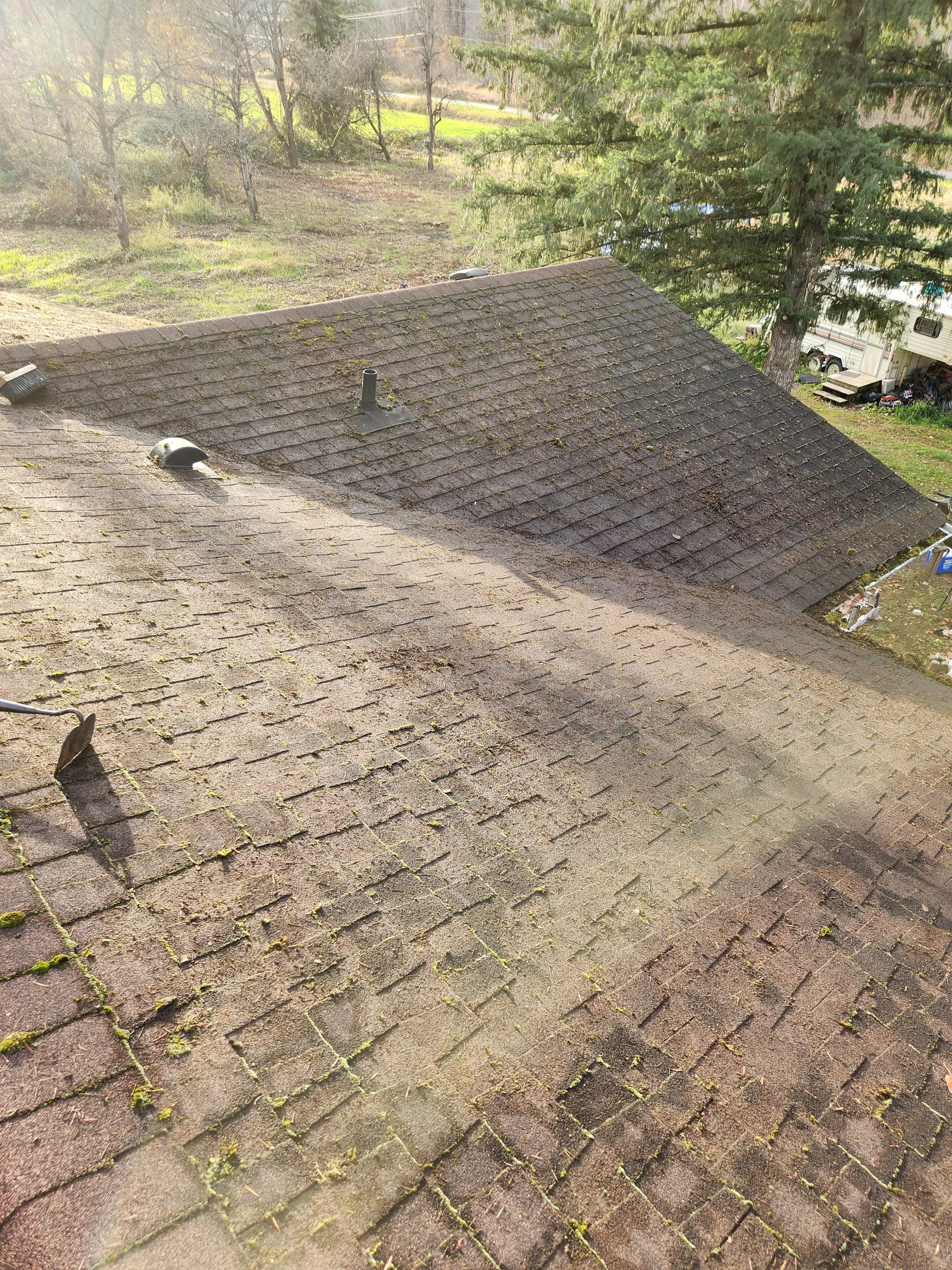
Why Your Roof Is Growing Moss Right Now
We get asked this constantly. Here is exactly what is happening on your roof and why some homes are worse than others.
Climate Factors Specific to Fraser Valley
- Rainfall volume -- 170+ cm annually, with some eastern valley areas (Hope, Agassiz) receiving even more due to orographic lift from the Cascades
- Temperature range -- moss grows actively between 5-25 degrees Celsius, which covers 9-10 months in Fraser Valley
- Humidity -- river fog from the Fraser, morning dew, and persistent overcast skies keep relative humidity above 70% most days
- Limited UV -- overcast conditions reduce the ultraviolet radiation that naturally inhibits moss growth
Roof-Specific Risk Factors
- North-facing slopes -- receive minimal direct sunlight and stay damp far longer than south-facing sections; almost always the first to develop moss
- Tree canopy -- overhanging trees block sunlight, drop organic debris that feeds moss, and keep the roof surface in perpetual shade
- Low-slope sections -- water drains slowly, giving moss more time to establish
- Shingle age -- older shingles have rougher surfaces from granule loss, giving moss roots better grip
- Valley and transition areas -- where different roof planes meet, debris accumulates and moss establishes first
Moss Removal Methods -- What Works, What Destroys Your Roof
Professional Soft Wash -- The Only Method We Recommend
Soft washing is the gold standard for moss removal. It kills moss at the root level without damaging shingle surfaces, and it is the only method that does not void manufacturer warranties.
How soft wash works:
- Chemical application -- a moss-killing solution (typically sodium hypochlorite or zinc sulfate based) is applied at low pressure across the entire roof surface
- Dwell time -- the solution sits for 15-30 minutes, penetrating moss root structures and killing the organism
- Low-pressure rinse -- a gentle rinse removes loose debris without blasting granules
- Natural shedding -- over the next 2-4 weeks, dead moss turns brown and washes away with rain
Why professionals get better results:
- Access to commercial-grade solutions with proper concentration ratios
- Calibrated low-pressure equipment that cleans without damaging
- Fall protection and safety equipment for working on wet, slippery surfaces
- Experience identifying shingle damage hidden beneath moss growth
Cost range: $1-2 per square foot. Typical Fraser Valley home (2,500 sq ft): $2,500-4,000.
Manual Scraping -- Why We Advise Against It
Scraping or brushing moss off by hand is tempting for DIY homeowners, but it creates more problems than it solves.
- Granule loss -- even soft-bristle brushes dislodge protective granules, exposing the asphalt mat beneath
- Root survival -- scraping removes the visible moss but leaves roots intact; regrowth begins within weeks
- Safety hazard -- wet moss on a sloped roof is extraordinarily slippery, and falls from residential roofs cause serious injuries every year in BC
- Shingle tearing -- aggressive scraping can catch shingle edges and tear them, creating immediate leak points
If you absolutely must do it yourself, use only a soft-bristle brush, stroke downward with the grain of the shingles (never upward), and wear a proper safety harness anchored to a ridge bracket.
Pressure Washing -- Never, Under Any Circumstances
Pressure washing your roof is the single most destructive maintenance mistake a homeowner can make.
- Granule destruction -- high-pressure water strips protective granules down to bare asphalt mat in seconds
- Warranty voided -- every major shingle manufacturer (GAF, IKO, Owens Corning, CertainTeed) explicitly prohibits pressure washing
- Water forced under shingles -- high-pressure spray drives water beneath shingle overlaps and into the roof deck, causing leaks and rot
- Fiberglass mat damage -- the reinforcing mat tears under pressure, compromising structural integrity
- 50%+ lifespan reduction -- a pressure-washed roof can fail 10-15 years earlier than its rated lifespan
We have replaced roofs that were only 8 years old because someone pressure washed them. The repair cost far exceeds professional moss removal.
Algae Treatment
DIY Bleach Solution (For Minor Algae Streaks)
- Mix: equal parts household bleach (sodium hypochlorite) and water in a pump sprayer
- Apply: spray directly on black streaks, working from ridge to eave
- Wait: 15-20 minutes (do not let it dry -- work on overcast days)
- Rinse: low-pressure garden hose from ridge downward
Safety precautions:
- Wear chemical-resistant gloves and splash-proof eye protection
- Cover landscaping plants with tarps and rinse them thoroughly afterward
- Never mix bleach with ammonia, acids, or other cleaning chemicals
- Avoid hot, sunny days -- rapid evaporation reduces effectiveness and concentrates chemicals
Professional Algae Treatment
For widespread algae coverage, professional treatment uses stronger concentrations with better coverage equipment. Cost: $500-1,000 for a typical Fraser Valley home. Results are more uniform and longer-lasting than DIY approaches.
Prevention -- Stopping Moss Before It Starts
Zinc Strips: The Best Long-Term Investment
Zinc strips are the single most effective moss prevention method we install. Here is how they work and why we recommend them on every Fraser Valley roof.
How zinc strips work:
- Thin zinc metal strips are installed horizontally just below the ridge cap
- Each time it rains, water dissolves trace amounts of zinc from the strip surface
- Zinc ions flow down the roof face, creating an environment hostile to moss and algae growth
- Effective coverage extends 10-15 feet below each strip
Installation details:
- Placement: directly below ridge cap, one strip per 10-15 feet of roof width
- Materials cost: $50-150 for a typical home
- Professional installation: $200-400
- Total investment: $250-550
- Lifespan: 10-15 years before replacement needed
- Effectiveness: reduces moss regrowth by 80-90%
We install zinc strips during every re-roof project and offer standalone installations for existing roofs. For a 15-year investment under $550, zinc strips are the best value in moss prevention.
Copper Strips: Premium Alternative
- Same principle as zinc but with copper ions
- Longer lifespan: 20+ years
- Higher cost: $5-8 per linear foot installed
- Worth considering for premium homes or areas with extreme moss pressure
Algae-Resistant Shingles
If you are planning a re-roof, algae-resistant shingles with embedded copper granules are worth the modest upgrade cost.
- GAF StainGuard Plus -- 10-year algae protection warranty
- IKO ArmourZone -- 10-year algae protection warranty
- Owens Corning StreakGuard -- 10-year algae protection warranty
- CertainTeed StreakFighter -- 15-year algae protection warranty
Upgrade cost: $50-100 per square ($500-1,000 total for a typical roof). These shingles are effective against algae but less effective against moss, so zinc strips remain important even with algae-resistant shingles.
Tree Management
- Trim branches back 6-10 feet from the roof surface to maximize sunlight exposure
- Remove overhanging limbs that drop leaves, needles, and debris onto the roof
- Clear dead branches that could fall and damage shingles during winter storms
- Consider selective thinning to increase airflow and light penetration without removing entire trees
Regular Maintenance Schedule
- Heavy shade / north-facing: professional cleaning every 1-2 years
- Moderate shade / mixed exposure: every 2-3 years
- Full sun / south-facing: every 3-5 years or as visible growth appears
Regular cleaning when moss is thin is faster, cheaper, and far less damaging to shingles than waiting until heavy buildup requires aggressive treatment.
Cost Breakdown: Fraser Valley Pricing (2026)
Moss Removal
- Small roof (1,500 sq ft): $1,500-2,500 professional soft wash
- Medium roof (2,500 sq ft): $2,500-4,000 professional soft wash
- Large roof (4,000 sq ft): $4,000-6,000 professional soft wash
- DIY materials only: $180-480 (moss killer, pump sprayer, safety gear) plus significant personal risk
Prevention Investment
- Zinc strips (installed): $250-550, lasts 10-15 years
- Copper strips (installed): $400-800, lasts 20+ years
- Algae-resistant shingle upgrade: $500-1,000 additional during re-roof
- Tree trimming: $200-600 per session (arborist recommended for large trees)
When Moss Damage Means Roof Replacement
Not every mossy roof needs replacement. Here is how we evaluate damage levels during inspections.
Signs of Serious Moss Damage
- Lifted shingle edges -- moss roots have broken the seal strip bond and curled edges upward
- Bare granule patches -- dark spots where moss consumed or displaced protective granules
- Cracked or brittle shingles -- constant moisture exposure has deteriorated the asphalt and fiberglass mat
- Soft or spongy decking -- pressing on the roof surface reveals rot underneath, indicating prolonged water infiltration
- Active interior leaks -- water stains on ceilings or walls, especially after heavy rain
Our Decision Framework
- Light moss, no shingle damage -- clean with soft wash, install zinc strips, monitor annually
- Heavy moss, localized damage -- clean, repair or replace damaged shingle sections, add prevention measures
- Heavy moss, widespread damage or deck rot -- full roof replacement is the only lasting solution
We give honest assessments. If your roof can be saved with cleaning and targeted repairs, that is what we recommend. We have seen too many homeowners told they need a full replacement when professional moss removal and prevention would have extended their roof's life by another decade.
Why Fraser Valley Homeowners Trust Fraser Roofing Ltd.
Kory Peters and Johnny Peters founded Fraser Roofing Ltd. in 2026 because Fraser Valley deserved a roofing company that gives straight answers. Both are Red Seal certified Boilermakers who bring precision trade skills to every roof. With over 500 completed projects across the valley, we understand how our specific climate -- from the heavy rainfall in Hope and Agassiz to the river fog in Chilliwack and the wind exposure in Abbotsford -- affects moss growth patterns on local roofs.
We offer professional soft-wash moss removal, zinc strip installation, and complete re-roofing with algae-resistant shingles. Every job starts with an honest inspection and a clear explanation of what your roof actually needs.
Related Guides
Need Expert Help With Your Roof?
Kory & Johnny have completed 500+ roofs across the Fraser Valley since 2026. Free inspections, honest estimates, no pressure.
(778) 860-4747Serving Hope, Agassiz, Chilliwack, Rosedale, Abbotsford & the entire Fraser Valley
Moss taking over your roof? Call (778) 860-4747 for an honest assessment from Fraser Roofing Ltd..