Roof Flashing: The Invisible Guard Against Water Damage
Why the metal you never see determines whether your roof leaks
Last updated: February 2026
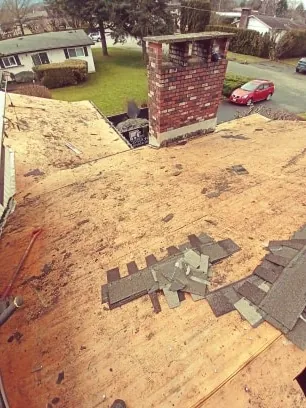
Every Leak We Fix Traces Back to the Same Place
Between Kory and Johnny, we have worked on more than 500 roofs across the Fraser Valley since 2026. When a homeowner calls about a leak, we already have a suspicion before climbing the ladder: the flashing. Not the shingles. Not the underlayment. The thin pieces of metal tucked into the transitions where your roof meets walls, chimneys, vents, and other roof planes.
Flashing is designed to do one job — redirect water away from the seams and penetrations where your roof is most vulnerable. When it works, you never think about it. When it fails, the damage spreads behind walls and through ceilings before you see the first water stain.
Before roofing, we both worked as Red Seal Boilermakers in the oil sands, where metal fabrication and waterproof connections were part of the daily workload. That background shapes how we approach every flashing detail on a residential roof. Precision matters. Overlap sequences matter. Material selection matters.
How Flashing Actually Works
A roof is not a single, continuous waterproof surface. It is a collection of materials layered in a specific sequence so that gravity pulls water downhill and off the building. Wherever that sequence is interrupted — by a chimney, a vent pipe, a wall junction, a valley, or a roof edge — flashing bridges the gap.
The governing principle is simple: water must always flow over the top of flashing, never behind or under it. Every bend angle, every overlap dimension, and every fastener placement follows from that single rule. When a roofer violates it, even in one small spot, that spot becomes a leak.
Drip Edge: Defending the Roof Perimeter
Drip edge is the L-shaped metal strip that runs along the eaves (bottom edge) and rakes (sloped sides) of a roof. Its purpose is to direct water cleanly into the gutter instead of letting it curl back under the shingles or run down the fascia board.
There is an important installation detail that separates competent roofers from careless ones: at the eaves, drip edge goes under the underlayment so that any water migrating under the shingles still flows onto the metal and off the roof. At the rakes, drip edge goes over the underlayment because water pressure comes from a different direction. Getting this backwards is one of the most common mistakes on roofs throughout the Chilliwack-to-Hope corridor.
In the Fraser Valley, missing or improperly installed drip edge accelerates fascia rot. The constant moisture from our rainfall — often 1,500 to 2,000 mm per year — wicks into exposed wood within a single season. We have pulled off fascia boards in Agassiz and Harrison that were soft enough to push a finger through, all because the previous roofer skipped the drip edge or installed it incorrectly.
Step Flashing: Where Roofs Meet Walls
Wherever a sloped roof intersects a vertical wall — dormers, additions, chimneys, second-story walls — step flashing is required. It consists of individual L-shaped metal pieces, each one woven between consecutive shingle courses and bent up behind the wall cladding.
The reason it is called "step" flashing is that each piece sits slightly higher than the one below it, creating a staircase pattern that matches the shingle exposure. This design allows the roof and wall to move independently — from settling, wind loading, or thermal expansion — without breaking the waterproof connection.
The shortcut we see most often is continuous flashing: one long piece of bent metal running from bottom to top instead of individual stepped pieces. It looks faster and easier, and some contractors install it because homeowners cannot tell the difference from the ground. The problem shows up within a few years. When the building settles or the wall shifts even slightly, a continuous piece buckles or lifts, creating a gap. Individual step pieces absorb that movement because each one is independent.
We replaced a continuous flashing run on a home in Rosedale where the previous installation had pulled away from the wall by roughly 8 mm — barely visible, but enough for wind-driven rain to pour behind the siding. The repair required removing the siding, replacing saturated sheathing, and installing proper step flashing from scratch.
Valley Flashing: Managing the Heaviest Water Flow

Roof valleys — where two sloped planes meet and form a V-shaped channel — handle several times more water volume than any flat section of roof. During a typical Fraser Valley downpour, valleys channel a concentrated stream of runoff. The flashing in these channels has to be durable, properly sized, and installed with correct overlap.
There are two approaches: open valleys and closed valleys. In an open valley, the metal flashing is visible between the shingle edges, which are cut back a few inches on each side. Water runs directly on the metal surface with nothing to obstruct it. In a closed valley, shingles from both roof planes overlap each other across the valley center, hiding the metal underneath.
We install open valleys on the majority of our projects. The reasoning is practical, not aesthetic. Open valleys shed debris — needles, leaves, moss — instead of trapping it under shingle overlaps. They are easier to inspect during maintenance. And they last longer because water flows freely rather than being forced under shingle layers where it can wick uphill through capillary action. In a region where Douglas fir needles, cedar fronds, and cottonwood seeds end up on every roof, keeping valleys clear is not optional.
For valley metal, we use 24-gauge galvanized steel with a minimum width of 24 inches (12 inches on each side of the valley center). Narrower valley metal is a false economy — it does not provide enough overlap when heavy rain pushes water outward across the valley floor.

Chimney Flashing: The Most Complex Detail on Your Roof
Chimneys require a multi-part flashing system because they present four different water management challenges: the front face (where water hits head-on), the two sides (where water flows past), and the back face (where water and debris accumulate on the upslope side).
A proper chimney flashing installation includes base flashing at the front, step flashing along the sides, counter flashing set into the mortar joints (or regletted into masonry) to cap the step flashing, and a cricket on the back side of any chimney wider than 30 inches.
The cricket is particularly important in the Fraser Valley. Without it, water pools behind the chimney and debris builds up into a dam that holds moisture against the masonry and roof surface. We have opened up chimneys in Hope and Chilliwack where the back side had no cricket, and the sheathing behind the chimney was black with rot despite the rest of the roof deck being solid.
Counter flashing is the other detail that separates thorough work from hack work. Counter flashing is a separate piece of metal embedded into the chimney mortar that folds down over the top edge of the step flashing. It creates a secondary barrier so that water running down the chimney face cannot get behind the step flashing. When a contractor uses caulk in place of counter flashing — and we see this regularly — the caulk dries out, cracks, and peels within three to five years.
Pipe Boots: The Weakest Link on Every Roof
Every plumbing vent that exits through a roof gets a pipe boot — a collar that seals the gap between the pipe and the surrounding shingles. Standard pipe boots use a rubber gasket around the pipe and a metal base plate that slides under the shingles.
The problem is the rubber. Constant UV exposure and the temperature swings we get in the Fraser Valley — from near-freezing in January to 35+ degrees in August — cause the rubber to harden, crack, and eventually split. A standard rubber boot installed today will start showing cracks in 10 to 15 years, sometimes sooner on south-facing roof slopes.
When we install a new roof, we replace every pipe boot regardless of how the old ones look. We stock both standard rubber boots and all-metal alternatives. For homeowners investing in a 30-year or 50-year shingle, we recommend the all-metal option because it eliminates the rubber degradation issue entirely. The added cost across a typical home with three to five vent pipes is modest, and it means one less maintenance item for decades.
Skylight Flashing: Follow the Manufacturer or Accept the Consequences
Skylights sit in the middle of a roof plane, creating a rectangular interruption in the shingle pattern. Every skylight manufacturer provides a specific flashing kit designed for their product, and every warranty requires that kit to be used. Substituting generic flashing or improvising with bent metal voids the warranty and increases leak risk.
The kit typically includes sill flashing at the bottom, step flashing on the sides, head flashing at the top, and a self-adhesive membrane that wraps the opening. The installation sequence is specific and must be followed in order — each layer overlaps the one below so that water always moves downhill.
One detail we always add beyond the manufacturer's minimum: we run ice and water shield membrane around the entire skylight opening, extending at least 6 inches past the flashing on all sides. In a region where wind-driven rain can push water uphill, that extra membrane acts as a backup in case the primary flashing ever allows any moisture past.
Choosing Flashing Material for BC Weather
Three metals dominate residential flashing in British Columbia:
Galvanized steel is the standard. It is rigid enough to hold shape, affordable, and lasts 25 to 35 years in the Fraser Valley before the zinc coating begins to break down. We use 24 to 26 gauge with G-90 zinc coating for most applications.
Aluminum resists corrosion better than steel and is easier to bend on site, which matters for complex shapes. It costs roughly 20 to 30 percent more and lasts 30 to 40 years. We use it in applications where ongoing moisture contact is guaranteed, like valley flashing on heavily shaded roofs where moss tends to accumulate.
Copper is a premium material with a 50-year-plus lifespan. It develops a green patina over time and is commonly specified on heritage buildings. It costs five to ten times more than galvanized steel, and most residential projects do not require it. We install it when the home's character warrants it or when the homeowner wants a chimney flashing package that will outlast the building itself.
One caution with mixing metals: galvanic corrosion occurs when dissimilar metals are in direct contact with moisture present. Copper runoff contacting galvanized steel will corrode the steel rapidly. We keep metal types consistent within each flashing assembly to avoid this.
How Flashing Fails in the Fraser Valley
Installation errors cause most failures. Incorrect overlap direction, missing counter flashing, continuous flashing instead of stepped pieces, over-reliance on sealant — these are workmanship problems that show up within the first few years. The material itself is rarely the issue.
Corrosion is the second factor. Galvanized steel eventually loses its zinc coating, especially in areas with constant water contact like valleys and low-slope sections. Debris that traps moisture against the metal surface accelerates the process. Regular roof cleaning extends flashing life.
Sealant failure is the third. Roofing sealant (caulk, roof cement) is a temporary material with a finite lifespan. When it is used as the primary waterproofing connection rather than a supplement to mechanical flashing, the clock starts ticking toward a leak. We use sealant at flashing edges as an added measure, but never as a substitute for proper metal overlap.
What to Ask Before You Hire a Roofer
Flashing details are where you separate roofers who understand water management from those who just nail down shingles. Before hiring anyone for a roof replacement or repair, ask these questions:
- Do you install individual step flashing or continuous flashing at wall junctions?
- Will you install counter flashing at the chimney, or use caulk?
- Do you install open or closed valleys, and why?
- Are pipe boots being replaced, and what type?
- Is a chimney cricket included if the chimney is wider than 30 inches?
If the answers are vague, or if the quote does not specifically mention flashing at all, that tells you something about how the work will be done.
Our Approach to Flashing
Every roof we install includes full flashing replacement at all penetrations, transitions, and edges. We do not reuse old flashing, and we do not substitute caulk for metal. Our boilermaking background means we are comfortable cutting, bending, and fitting metal to exact specifications rather than forcing generic pieces into place.
Flashing is not a line item to minimize on a roofing quote. It is the difference between a roof that stays dry and one that quietly rots from the inside out. At Fraser Roofing Ltd., we treat every flashing detail as if our own home depends on it — because the standard should never be lower than that.
Related Guides
Need Expert Help With Your Roof?
Kory & Johnny have completed 500+ roofs across the Fraser Valley since 2026. Free inspections, honest estimates, no pressure.
(778) 860-4747Serving Hope, Agassiz, Chilliwack, Rosedale, Abbotsford & the entire Fraser Valley
Concerned about flashing on your roof? Call (778) 860-4747 for a free inspection from Fraser Roofing Ltd. in Agassiz, BC.