Attic Ventilation for Fraser Valley Homes
How proper airflow protects your roof from moisture, heat, and premature failure
Last updated: February 2026
We Diagnose Ventilation Failures Every Week
My brother Johnny and I have crawled through hundreds of attics across the Fraser Valley since we started Fraser Roofing Ltd. in 2026. We came to roofing as Red Seal Journeyman Boilermakers, which means we think about heat transfer, airflow dynamics, and pressure differentials the way most roofers think about shingles. That background changes how we approach ventilation.
The pattern we see most often: a homeowner calls about a ceiling stain or shingle failure, and the root cause turns out to be an attic that cannot breathe. Blocked soffits, missing ridge vents, insulation stuffed into rafter bays — these silent problems shorten roof life by years and drive up energy bills without anyone noticing until damage appears.
Living and working in Agassiz puts us right in the middle of one of the most ventilation-challenging environments in BC. River fog off the Fraser, high seasonal humidity, freezing winters followed by heavy rain — this combination punishes poorly ventilated attics harder than almost anywhere else in the province.
What Attic Ventilation Actually Does
A ventilated attic has a continuous path for air to enter low at the soffits and exit high at the ridge. That airflow accomplishes four things simultaneously:
- Flushes moisture out before it condenses. Warm, damp air from your living space migrates upward. If it hits cold roof sheathing with nowhere to go, it condenses into water. That water feeds mold, rots decking, and soaks insulation until it loses its R-value.
- Prevents extreme heat buildup. An unventilated attic on a July afternoon in Chilliwack can exceed 65 degrees Celsius. That heat bakes shingles from underneath, accelerating granule loss and adhesive failure. It also radiates down into your living space, forcing your cooling system to work overtime.
- Stops ice dams at the eaves. When attic heat melts snow on the roof, meltwater runs to the cold eaves and refreezes into a dam. Water pools behind that dam and works under shingles. Proper ventilation keeps the entire roof deck close to outside temperature, so snow stays put.
- Preserves shingle warranties. Every major manufacturer requires documented ventilation meeting the 1:300 ratio. Skip it and your 25- or 30-year warranty may be void from day one.
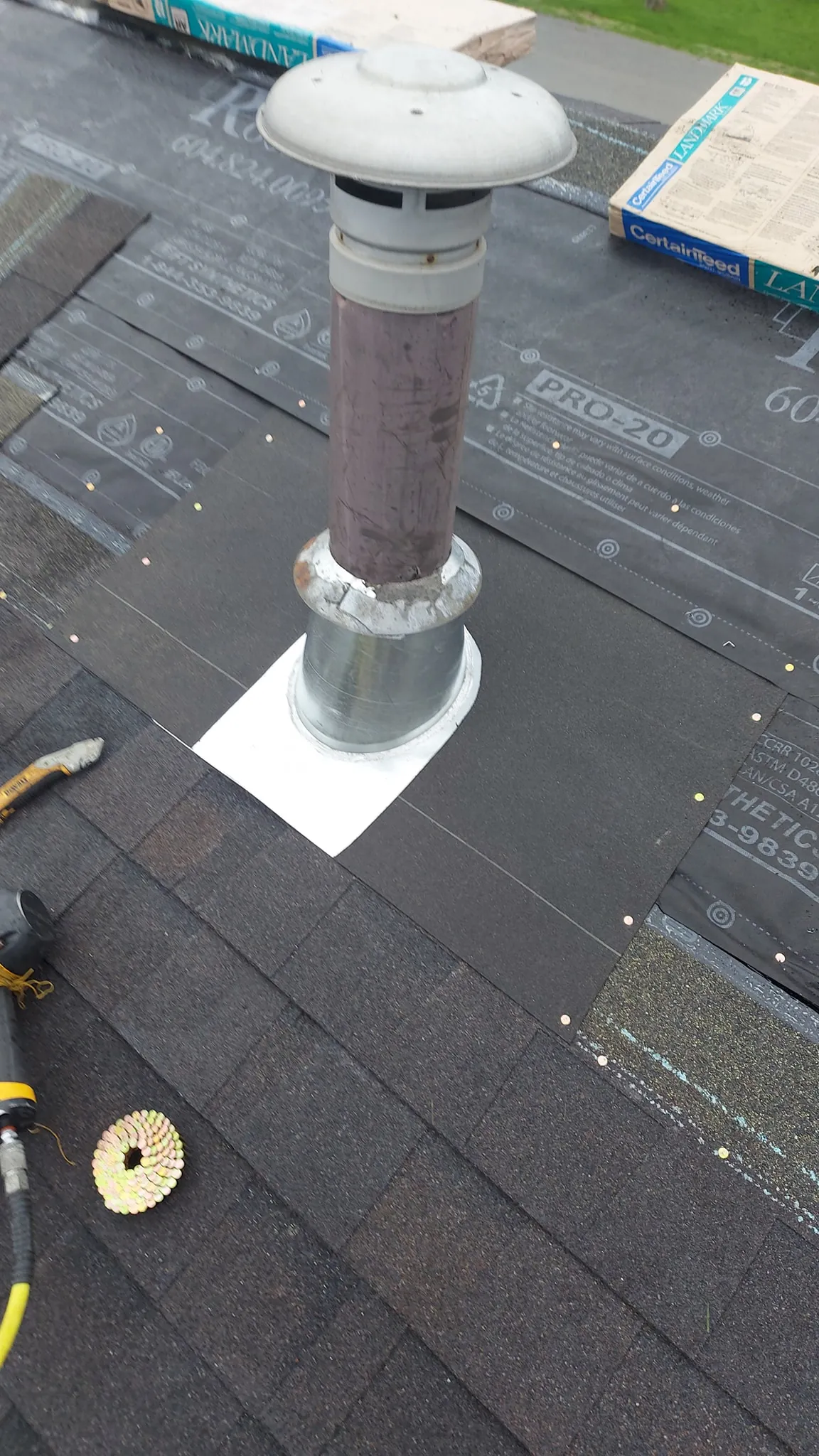
The 1:300 Rule and How We Apply It
BC Building Code sets the baseline: one square foot of net free ventilation area for every 300 square feet of attic floor space, split evenly between intake and exhaust. A 1,500-square-foot attic needs 5 square feet total — 2.5 at the soffits and 2.5 at the ridge.
Net free area is important because every vent has a screen or louver that blocks some of the opening. A vent with a 6-inch by 16-inch opening might only deliver 60% of that area as usable airflow once you account for the mesh. We calculate using actual NFA ratings from the manufacturer, not raw opening size. Guessing here is how attics end up under-ventilated.
On many Fraser Valley homes built in the 1970s through 1990s, we find that the builder installed a few circular soffit vents and a single gable vent and called it done. When we run the numbers, those homes are often ventilated at half the required ratio. The attic has been slowly accumulating moisture for decades.
Ridge Vents: Our Standard Exhaust Method

We install ridge vents on the majority of our projects because they distribute exhaust along the entire peak of the roof rather than concentrating it at a few points. A continuous ridge vent paired with continuous soffit intake creates the most uniform airflow pattern possible — no hot spots, no dead zones, no areas where moisture lingers.
Installation involves cutting a slot along the ridge, typically about an inch and a half wide on each side. The ridge vent sits over this slot and gets capped with ridge shingles that match the field. From the ground, you cannot tell a ridge vent is there. That clean look matters to homeowners, but the real advantage is performance: passive operation, zero moving parts, zero maintenance, and decades of reliable service.
We sometimes encounter roofs where a previous installer mounted turbine vents or power fans instead. Turbines rely on wind and go quiet on calm days. Power fans draw electricity and can actually pull conditioned air out of your living space if the attic is not properly sealed. Both solutions solve a problem that ridge vents handle more simply.
Soffit Intake: The Part Most Installers Get Wrong
Exhaust only works if there is adequate intake. Johnny and I have lost count of how many attics we have opened up to find soffit vents completely choked by insulation. Someone blew in cellulose or rolled out batts and pushed right into the rafter bays, blocking the very openings designed to bring fresh air in.
The fix is simple but non-negotiable: install rigid baffles between each rafter bay at the eave. These channels hold the insulation back and maintain a clear path from the soffit opening up to the underside of the sheathing. Without baffles, even perfectly sized soffit vents deliver zero airflow.
When we re-roof a home, we check every soffit opening from inside the attic. If baffles are missing, we install them before a single shingle goes on. This step takes time but it protects the entire investment.
Fraser Valley Conditions That Make Ventilation Critical
River Fog and Persistent Humidity
From our shop in Agassiz, we watch fog settle over the valley floor for days at a time between October and March. Relative humidity stays above 90% for extended stretches. Homes along the Fraser corridor — Agassiz, Harrison, Rosedale, Hope — sit in the densest part of this moisture zone. Attics in these areas absorb ambient humidity through every gap, and without strong ventilation pulling that moisture out, condensation forms on the sheathing within hours of a temperature drop.
Summer Heat Spikes
Chilliwack and Abbotsford hit 35 degrees Celsius or higher during summer heat events. An attic without ventilation becomes an oven. We have measured sheathing surface temperatures above 70 degrees in sealed attics during July — well beyond the threshold where asphalt shingle adhesives begin to degrade. Homeowners notice it as premature curling, but the damage starts from the inside.
Snow and Ice Dam Risk
Hope and the eastern Fraser Valley get meaningful snowfall most winters. Homes with poorly ventilated attics develop ice dams at the eaves because interior heat escapes into the attic, warming the roof deck and melting snow unevenly. We see this every January in higher-elevation neighbourhoods. The solution is always the same: get the attic cold by getting the air moving.
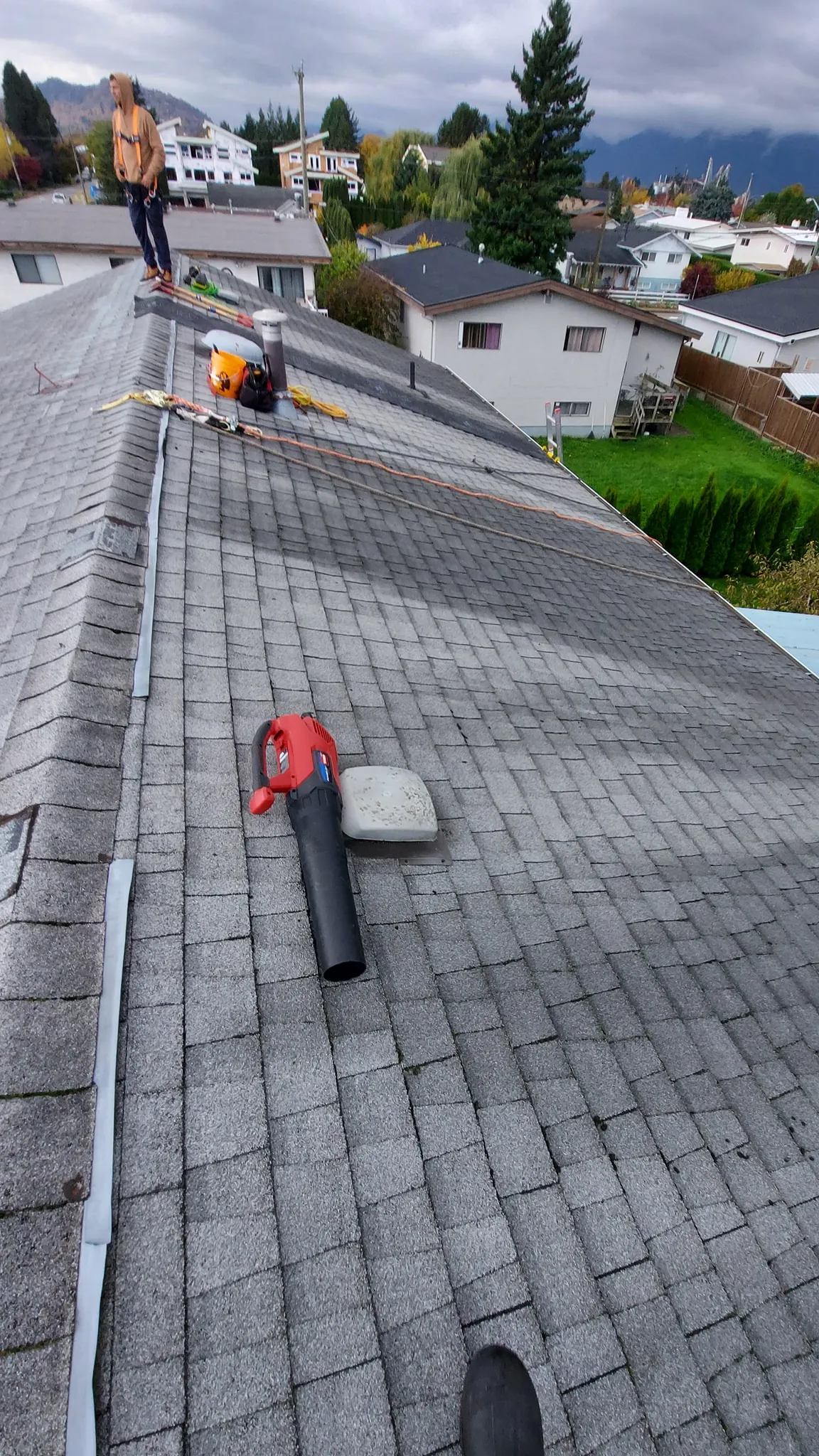
Warning Signs We Look For
When we inspect a home, we check the attic for these indicators of ventilation failure:
- Dark staining on sheathing. Moisture has been condensing and evaporating in cycles, leaving behind discoloration. In advanced cases, the wood feels soft to the touch.
- Frost on nail tips. In winter, exposed roofing nails that penetrate the sheathing collect frost when warm attic air meets cold metal. A well-ventilated attic keeps temperatures close to outside, eliminating this.
- Musty smell. Mold growing on sheathing or insulation creates a distinctive odour you notice the moment you open the attic hatch.
- Insulation clumped or compressed near eaves. This almost always means baffles are missing and insulation has migrated into the soffit openings.
- Roof shingles aging unevenly. If the south-facing slope shows significantly more wear than the north, excessive attic heat may be accelerating degradation on the sun-exposed side.
Mistakes We Correct on Nearly Every Job
After completing over 500 roofing projects across the Fraser Valley, certain ventilation errors come up again and again:
- Exhaust without intake. A ridge vent does nothing if the soffits are sealed. Air needs somewhere to enter before it can exit. We see this on homes where a contractor added ridge vents during a re-roof but never checked the soffits.
- Gable vents combined with ridge vents. This creates a shortcut. Air enters the gable, crosses a short distance, and exits the ridge — bypassing most of the attic. The far ends stay stagnant.
- Bathroom exhaust vented into the attic. This is a code violation and a moisture disaster. Kitchen and bathroom fans must vent to the exterior, not dump warm, wet air into the attic space.
- No ventilation calculation at all. Many older installations were done by eye. The builder put in a few vents that looked about right and moved on. The result is an attic that has been under-ventilated for its entire life.
How We Handle Ventilation at Fraser Roofing Ltd.
Every project starts with an attic inspection. We measure the floor area, count existing vents, and calculate net free area against the 1:300 requirement. If the numbers fall short — and they usually do on homes built before 2000 — we include ventilation upgrades in the scope of work.
Our standard approach is continuous ridge vent paired with continuous or individual soffit vents, with baffles installed in every rafter bay at the eave. This gives the most balanced, maintenance-free system available. We document the ventilation specifications on the project paperwork so the homeowner has proof of compliance for warranty purposes.
Ventilation is not an add-on or an upsell. It is a fundamental part of a roofing system that performs as it should. When Johnny and I put our name on a roof, we make sure the air underneath it is moving the way it needs to.
Frequently Asked Questions
How do I know if my attic has enough ventilation?
Check your attic on a hot day. If it feels like a furnace compared to outside, ventilation is lacking. In winter, look for frost on the underside of roof sheathing or damp insulation. We also measure net free area against the 1:300 rule — one square foot of ventilation for every 300 square feet of attic floor. Most Fraser Valley homes we inspect fall short on intake at the soffits.
Why does river fog in Agassiz cause ventilation problems?
Agassiz and Harrison sit in the Fraser River corridor where dense fog rolls in regularly from fall through spring. That fog carries heavy moisture that seeps into attic spaces through any gap. Without strong ventilation pulling that damp air out, it condenses on cold roof sheathing and breeds mold. We see this pattern constantly in homes along the river from Hope to Chilliwack.
Can I mix ridge vents with gable vents?
We strongly advise against it. When ridge vents and gable vents are both open, air takes the path of least resistance — entering through the gable and exiting the ridge without ever sweeping across the full attic. This leaves dead zones where moisture collects. Pick one exhaust strategy and pair it with proper soffit intake.
How much does it cost to fix attic ventilation in the Fraser Valley?
Adding continuous soffit vents and a ridge vent during a re-roof typically adds $800 to $1,500 to the project, depending on the home's footprint and existing conditions. Retrofitting ventilation on its own runs $1,200 to $3,000. Either way, the payoff in extended shingle life and lower energy bills makes it one of the best investments in a roofing project.
Does my roof warranty require a certain amount of ventilation?
Yes. Every major shingle manufacturer — CertainTeed, IKO, BP — requires adequate attic ventilation meeting the 1:300 ratio for their warranty to remain valid. We have seen warranty claims denied because the original installer skipped the ventilation calculation. At Fraser Roofing Ltd., we document ventilation specs on every job so your warranty is protected.
Related Guides
Need Expert Help With Your Roof?
Kory & Johnny have completed 500+ roofs across the Fraser Valley since 2026. Free inspections, honest estimates, no pressure.
(778) 860-4747Serving Hope, Agassiz, Chilliwack, Rosedale, Abbotsford & the entire Fraser Valley
Worried your attic is not getting enough airflow? Call (778) 860-4747 for a free attic ventilation assessment from Kory or Johnny.