Ladder & Tool Safety: Oil Field Standards on Your Roof
How Red Seal Boilermakers Turned Roofers Brought Industrial Safety to Every Fraser Valley Job Site
Last updated: February 2026
Everything Gets Tied Off. Everything.
Ladder falls cause 500,000 injuries and 300 deaths every year in North America. Dropped tools injure bystanders below. At Fraser Roofing Ltd., we brought oil sands shutdown culture to residential roofing and eliminated these risks entirely.
- Ladders are staked, strapped, and stabilized -- never just leaned
- Every hand tool is lanyarded to the wrist or belt
- Water bottles, speakers, phones -- all tethered on the roof
- 500+ roofs completed, zero serious ladder or tool incidents
Where This Safety Culture Comes From
Before Kory Peters and Johnny Peters founded Fraser Roofing Ltd. in Agassiz, BC in 2026, they earned their Red Seal Boilermaker tickets in the Alberta oil sands. In that world, you do not set foot on a scaffold without tying off. You do not carry a wrench without a lanyard. You do not start a shift without a tailboard meeting and hazard assessment. A dropped bolt from a distillation column at 80 feet kills someone. Period.
Most residential roofers in the Fraser Valley never worked in that environment. They lean a ladder against the gutter, climb up with tools in their hands, and start working. Kory and Johnny watched that approach and decided every Fraser Roofing Ltd. job would run like a shutdown turnaround -- methodical, secure, and zero tolerance for shortcuts.
That decision has paid off with a perfect safety record.
Ladder Safety: Secured, Not Leaned
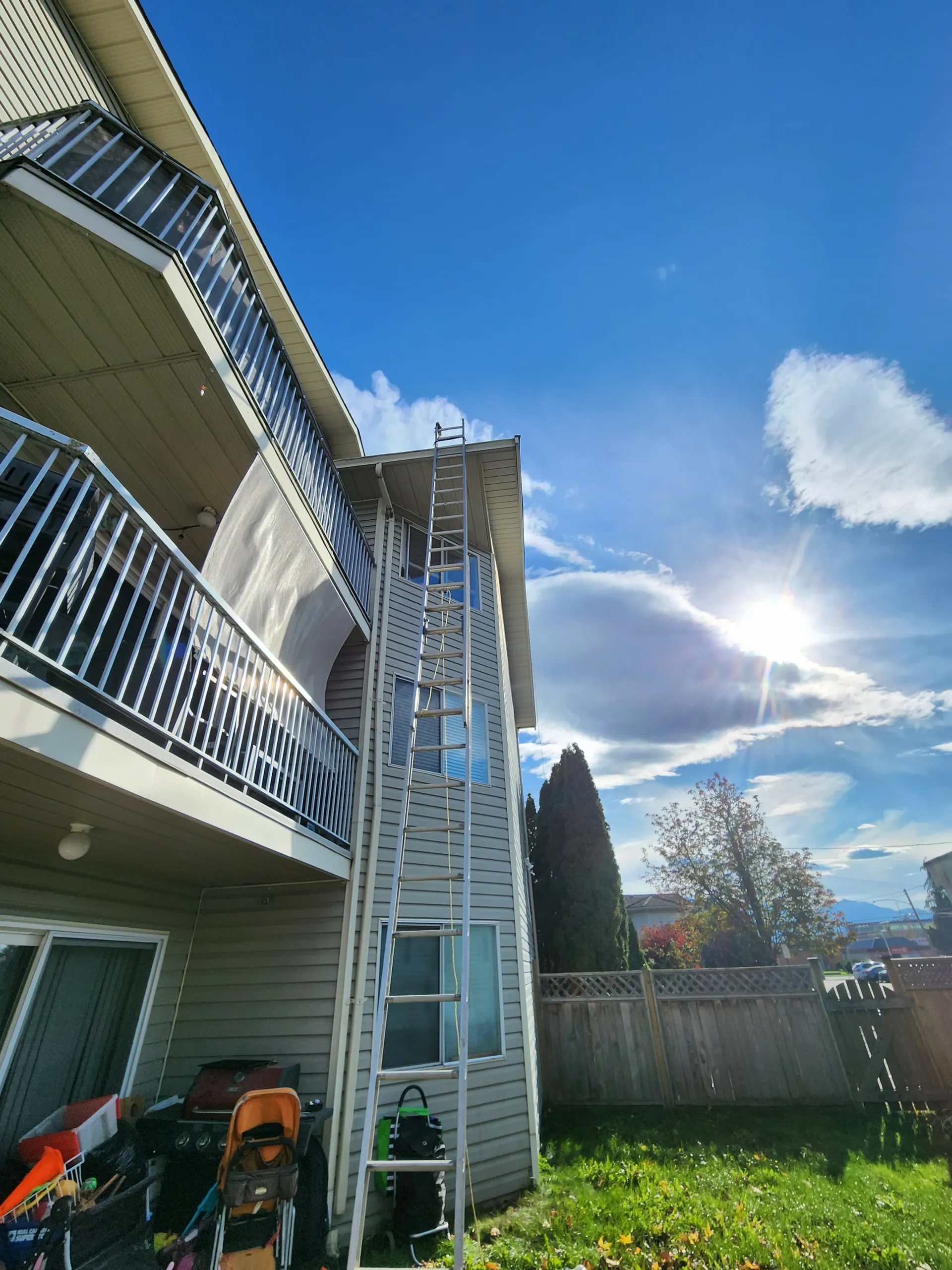
Why "Leaning" Is Not Ladder Setup
A ladder leaned against a gutter is not set up. It is balanced. Balanced things fall. In the oil field, that is a code red. On your house, it means a worker falls 20 feet onto your driveway.
At Fraser Roofing Ltd., every ladder setup follows a five-point protocol:
- Base staked or weighted -- On soil, we drive a stake and tie the base. On concrete, we use a sandbag anchor or have a spotter hold the base during initial setup.
- Feet leveled -- Fraser Valley properties sit on slopes, gravel, and wet grass. We use adjustable leg levelers and plywood pads to create a perfectly level base before anything else happens.
- 4:1 ratio applied -- For every 4 feet of working height, the base sits 1 foot from the wall. A 20-foot eave means the base is 5 feet out. No exceptions.
- Top secured -- The ladder top gets strapped to a fascia bracket or roof anchor with a ratchet strap. We also use standoff stabilizers so the ladder never rests on the gutter itself.
- 3-foot extension above the roof edge -- Provides a solid handhold for mounting and dismounting. You never step off a ladder that ends at the roofline.
Ladder Selection for Fraser Valley Roofing
Extension Ladders (Our Primary Access Tool):
- Type IA (Extra Heavy Duty) -- 300 lb capacity. This is what we use. A roofer plus a loaded tool belt plus materials exceeds 250 lbs easily.
- Fiberglass rails -- Non-conductive. BC Hydro lines run close to many Fraser Valley homes. Aluminum ladders near power lines have killed roofers.
- Single-story (10 ft eave) -- 20 to 24 ft ladder required
- Two-story (20 ft eave) -- 32 to 36 ft ladder required
Pre-Use Inspection (Every Single Time)
In the oil field, you inspect your ladder before every shift. It takes 30 seconds and it catches defects before they cause a fall.
- Bent or cracked rails -- reject immediately
- Cracked, loose, or missing rungs -- reject immediately
- Missing or worn rubber feet -- reject immediately
- Damaged rung locks or spreader bars -- reject immediately
- Oil, grease, ice, or mud on rungs -- clean or reject
- Corrosion on metal parts -- assess severity, likely reject
If it fails inspection, it gets tagged out and removed from the truck. We do not use questionable equipment.
3-Point Contact: The Rule That Saves Lives
Three points of contact means two hands and one foot, or two feet and one hand, on the ladder at all times. This is not a suggestion -- it is the single most effective way to prevent ladder falls.
What this means in practice:
- You never carry anything in your hands while climbing. Tools go in your belt. Materials get hoisted with a rope after you reach the roof.
- You face the ladder at all times. Climbing sideways or backward breaks the contact pattern.
- You keep your belt buckle between the rails. Leaning to the side shifts your center of gravity and causes tip-overs.
- You never stand on the top three rungs. Those rungs exist for hand placement, not foot placement.
Standoff Stabilizers: Protecting the Gutter and the Climber
Most roofers rest the ladder directly on the gutter. This crushes the gutter, creates an unstable contact point, and leaves the homeowner with damaged eavestroughs. Our standoff stabilizers span 24 to 36 inches and rest against the fascia board or wall surface, keeping the ladder off the gutter entirely. The wider base also reduces side-to-side tip risk.
Mistakes That Kill People
- Overreaching -- Leaning sideways to work farther from the ladder. Move the ladder instead. Moving takes 2 minutes. A fall takes a lifetime to recover from.
- Unsecured top -- A gust of wind slides the ladder sideways. Fraser Valley gets sudden wind gusts off the mountains. Tie off the top.
- Soft ground without levelers -- The ladder sinks on one side and tips. Fraser Valley soil is soft and wet for eight months of the year.
- Using ladders in wind over 40 km/h -- An extension ladder is a sail. We reschedule rather than risk it.
- Standing on the top rungs -- The top three rungs of any extension ladder are not designed for standing. This causes the most fatal residential ladder falls.
Tool Lanyards: The Oil Field Practice Nobody Else Does
Why We Lanyard Everything
In the oil sands, a dropped crescent wrench from a pipe rack is a fatality investigation. It does not matter that a residential roof is only 15 to 25 feet high. A 2-pound hammer falling 20 feet hits the ground at over 35 km/h. That is enough to fracture a skull, break a foot, or traumatize a child playing in the yard.
At Fraser Roofing Ltd., every tool that goes onto the roof gets a lanyard. The lanyards cost between three and eight dollars each. They attach to a wrist loop or a D-ring on the tool belt. The tool can still be used freely but it cannot fall off the roof.
What gets lanyarded on every Fraser Roofing Ltd. job:
- Hammers and pry bars
- Speed squares and tape measures
- Utility knives (retractable, with hook blades)
- Chalk lines
- Water bottles and thermoses
- Bluetooth speakers
- Cell phones
Other crews laugh at the water bottle lanyards until they see a full Nalgene bounce off a roof, hit a truck windshield, and spider-web the glass. We have seen it happen on other job sites. It does not happen on ours.
Tool Tether Types We Use
- Wrist lanyards (coiled) -- For lightweight tools under 2 lbs. Stretches to full working range, retracts when tool is released.
- Belt-mount retractable lanyards -- For heavier tools up to 5 lbs. Clips to the tool belt D-ring, extends 3 to 4 feet.
- Carabiner tethers -- For buckets, drink containers, and anything that sits on the roof surface. Clips to a roof anchor or ridge vent bracket.
Utility Knife Safety: The Most Common Roofing Injury
Utility knife cuts are the single most common injury in roofing. You cut shingles, underlayment, drip edge packaging, and ice and water shield with a blade dozens of times per hour. One slip and you are driving to the hospital instead of finishing the job.
Our knife protocol:
- Hook blades only -- Designed to cut roofing material from the back side. They cannot slice your hand the way a straight blade can.
- Cut away from the body, always -- Position the material so the blade moves away from every part of you.
- Replace blades constantly -- A dull blade requires more pressure. More pressure means less control. Less control means a cut. Fresh blades are cheap. Stitches are not.
- Retract when not actively cutting -- An exposed blade in a tool pouch has cut more roofers than any other knife scenario.
- Cut-resistant gloves on the holding hand -- ANSI A3 or higher. If the blade slips, the glove absorbs the hit.
- Lanyard the knife -- A dropped knife on a roof slope slides off the edge blade-first.
Nail Gun Safety: Treat It Like a Firearm
A coil roofing nailer fires a 1.25-inch nail at over 400 meters per second. That is faster than some handgun rounds. In the oil field, pneumatic tools get the same respect as live electrical systems. On a roof, that respect does not change.
Our nail gun rules:
- Sequential trigger only -- Bump-fire mode (where the gun fires when the nose contacts a surface) causes accidental discharges constantly. We disable bump-fire on every gun we own.
- Disconnect the air hose when not nailing -- A loaded, connected nail gun on the roof deck is an accident waiting to happen. If the nailer is resting, the hose is disconnected.
- Never point at anyone, ever -- Same rule as a firearm. Muzzle discipline is automatic for our crew.
- Safety glasses mandatory within 15 feet -- Nail ricochets off metal flashing, drip edge, and existing nails send fragments at eye height.
- Hands clear of the nail path -- Position the shingle with one hand, nail with the other. Your holding hand should never be in the nail line.
- Check for hidden obstructions -- Nailing into electrical wires, plumbing vents, or existing nails causes ricochets and structural damage.
Power Tool Safety: Saws, Drills, and Grinders on the Roof
Circular Saw
- Blade guard must function -- never pin it back or remove it
- Unplug or disconnect battery before blade changes
- Secure material with clamps, not your hand
- Watch for kickback -- the saw can jump back toward your body
- Keep the cord behind you, never in the blade path
Reciprocating Saw
- Used for cutting decking, removing old materials, trimming fascia
- Blade can bind in the cut and cause loss of control
- Watch for hidden nails, wires, and pipes below the cutting surface
- Keep both hands on the tool and brace against the material
Angle Grinder
- Used for cutting metal flashing, valley tin, and masonry
- Full face shield required -- not just safety glasses
- Sparks can ignite underlayment, dry wood, and debris piles -- fire extinguisher within arm's reach
- Guard must be in place and oriented to deflect sparks away from the operator
- Hearing protection required -- grinders exceed 100 dB
Air Compressor
- Never exceed the rated PSI -- over-pressurized tanks can rupture
- Drain the moisture tank daily -- moisture causes internal corrosion and weakens the vessel
- Inspect hoses for cuts, bulges, and worn fittings before connecting
- Use whip-check safety cables on quick-connect fittings -- a disconnected hose under pressure whips violently
- Never use compressed air to clean off your clothes or skin -- air injection injuries require surgery
PPE: Company-Supplied, Company-Enforced
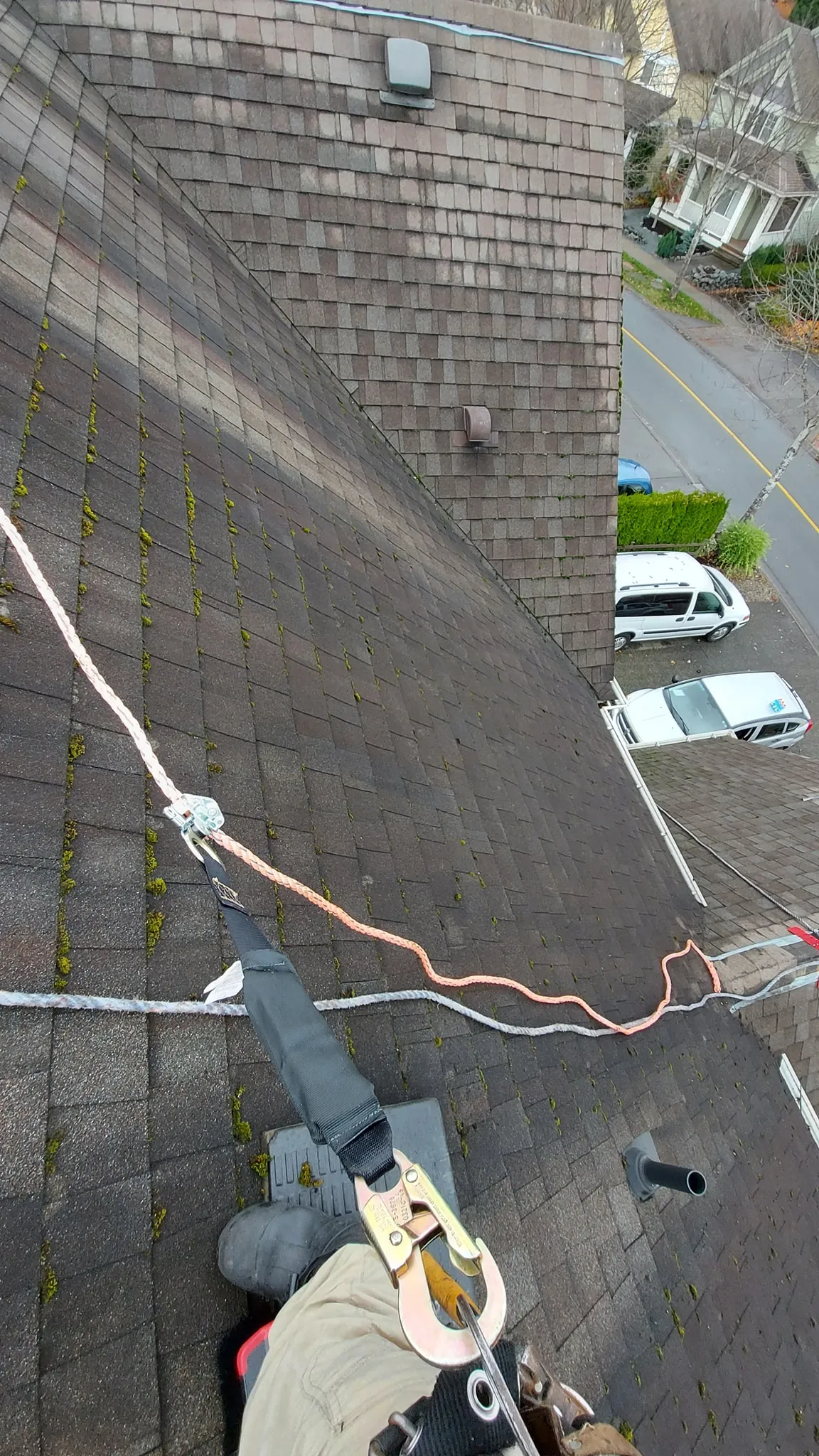
In the oil field, you do not bring your own PPE. The company supplies it, inspects it, and replaces it. At Fraser Roofing Ltd., we do the same. Every crew member gets issued the following on day one:
Eye Protection (Non-Negotiable)
- CSA-approved safety glasses with side shields -- Worn during all roofing work, no exceptions
- Full face shields -- Added for grinding, cutting metal, or any task that produces flying debris
- Anti-fog coating -- Fraser Valley humidity fogs lenses constantly. We use anti-fog treated or vented frames so crews actually keep them on.
Hand Protection
- ANSI A3+ cut-resistant gloves -- For handling shingles, metal flashing, and drip edge. Sheet metal edges are razor sharp.
- Removed for power tool operation -- Loose glove material can catch in spinning blades and drill chucks. Bare hands or tight-fitting mechanics gloves only.
Foot Protection
- Soft-soled shoes with aggressive tread -- Hard-soled boots slide on granulated shingles. Cougar Paws or equivalent roofing shoes grip like nothing else.
- Ankle support -- Roof slopes, debris, and uneven decking cause ankle rolls. High-tops prevent them.
- Composite or steel toe -- A bundle of shingles weighs 75 lbs. Drop one on your foot without a toe cap and you are done for the season.
Head Protection
- Hard hats when anyone is working above -- If one crew member is on the ridge and another is at the eave, the lower person wears a hard hat.
- Type II (top and side impact) -- Tools can fall at angles, not just straight down. Type I only protects from top impacts.
Hearing Protection
- Required for nail guns, compressors, saws, and grinders -- Prolonged exposure above 85 dB causes permanent hearing loss. A nail gun exceeds 100 dB.
- Foam plugs or over-ear muffs -- Personal preference, but they must be worn.
Daily Tailboard Meeting: The 5-Minute Habit That Prevents All-Day Problems
Every Fraser Roofing Ltd. job starts with a tailboard meeting at the truck before anyone touches a ladder. This is standard oil field practice and it takes five minutes.
- Site hazards -- Power lines, overhead branches, uneven ground, wet surfaces, dogs, children playing nearby
- Weather check -- Wind speed, rain forecast, temperature (heat stress in summer, ice in winter)
- Scope of work -- What we are doing today, what tools are needed, what materials are staged where
- Emergency plan -- Nearest hospital (Fraser Valley has specific routes depending on the community), first aid kit location, who calls 911 if needed
- PPE check -- Everyone confirms their glasses, gloves, footwear, and lanyards are in good condition
Five minutes of planning prevents eight hours of problems. That is not a slogan. It is 500+ roofs of proven results from Agassiz to Abbotsford, Hope to Harrison Hot Springs.
The Bottom Line
Kory and Johnny Peters did not invent ladder safety or tool lanyards. They learned them in the oil sands, where a single shortcut can end a career or a life. When they founded Fraser Roofing Ltd. in 2026, they made a decision: every residential roof in the Fraser Valley would be treated with the same safety discipline as an industrial shutdown.
That means ladders secured at the base and strapped at the top. Tools lanyarded to the wrist or belt. Water bottles tethered so they do not roll off the edge. A five-minute tailboard meeting before any work begins. PPE supplied, inspected, and enforced -- not suggested. After 500+ completed roofs, we have never had a serious ladder fall or tool-related injury. That record is not luck. It is culture.
Need Expert Help With Your Roof?
Kory & Johnny have completed 500+ roofs across the Fraser Valley since 2026. Free inspections, honest estimates, no pressure.
(778) 860-4747Serving Hope, Agassiz, Chilliwack, Rosedale, Abbotsford & the entire Fraser Valley
Want a roofing crew that treats your property like an industrial job site? Call (778) 860-4747 or email johnny@fraserroofing.ca