Fall Protection for Roofing: Oil Field Standards on Every Fraser Valley Roof
How Two Red Seal Boilermakers Brought Industrial Safety Culture to Residential Roofing
Last updated: February 2026
Falls Are the Leading Cause of Death in Roofing
A 12-foot fall onto concrete generates roughly 12,000 lbs of impact force on a human body. That is three times the force needed to fracture a skull. There is no such thing as a "safe" height to fall from.
- WorkSafeBC mandates fall protection at 10 feet or on slopes steeper than 4:12
- Falls from as low as 6 feet can cause traumatic brain injuries, spinal fractures, and death
- Over 300 roofers die from falls every year across North America
- Fraser Roofing Ltd. has completed 500+ roofs with zero fall incidents
Where Our Safety Standards Come From
Before Kory and Johnny Peters ever set foot on a residential roof, they spent years working as Red Seal Boilermakers in the Alberta oil sands. On those industrial sites, the safety culture is absolute. Every person wears a harness. Every tool is on a lanyard. Every ladder is tied off at three points. Water bottles, radios, even portable speakers get clipped to a retractable tether because a 2-pound object dropped from 100 feet hits the ground with the force of a bowling ball.
When they founded Fraser Roofing Ltd. in 2026 in Agassiz, BC, they did not water down those standards for residential work. The attitude on a Fraser Valley bungalow is the same as it was on a refinery tower: everything gets tied off, every time, no exceptions.
That decision shapes every part of how the crew operates. It adds a few minutes to setup on each job. It means carrying more equipment in the trucks. And it means that after 500+ completed roofs across the Fraser Valley, nobody on the crew has ever been injured by a fall.
What WorkSafeBC Requires vs. What We Actually Do
WorkSafeBC Minimums for British Columbia
- Fall protection required at 10 feet (3 metres) or higher
- Fall protection required on roofs with a slope of 4:12 or steeper, regardless of height
- Travel restraint systems permitted on roofs flatter than 4:12
- Written fall protection plan required on every job site
- Rescue plan must be in place before any elevated work begins
Fraser Roofing Ltd. Standards (Exceed Minimums)
- Fall protection on every roof steeper than 6:12, even if the eave height is under 10 feet
- SRLs instead of basic lanyards to limit free fall to under 2 feet
- Roof anchors bolted into trusses, never clipped to sheathing, vents, or gutters
- Tool lanyards on every hand tool to eliminate dropped-object hazards
- Ladder tie-offs at the top so the ladder cannot kick out, even in wind
- Verbal confirmation protocol before anyone steps onto the roof, the anchor, SRL, and harness are checked by a second crew member
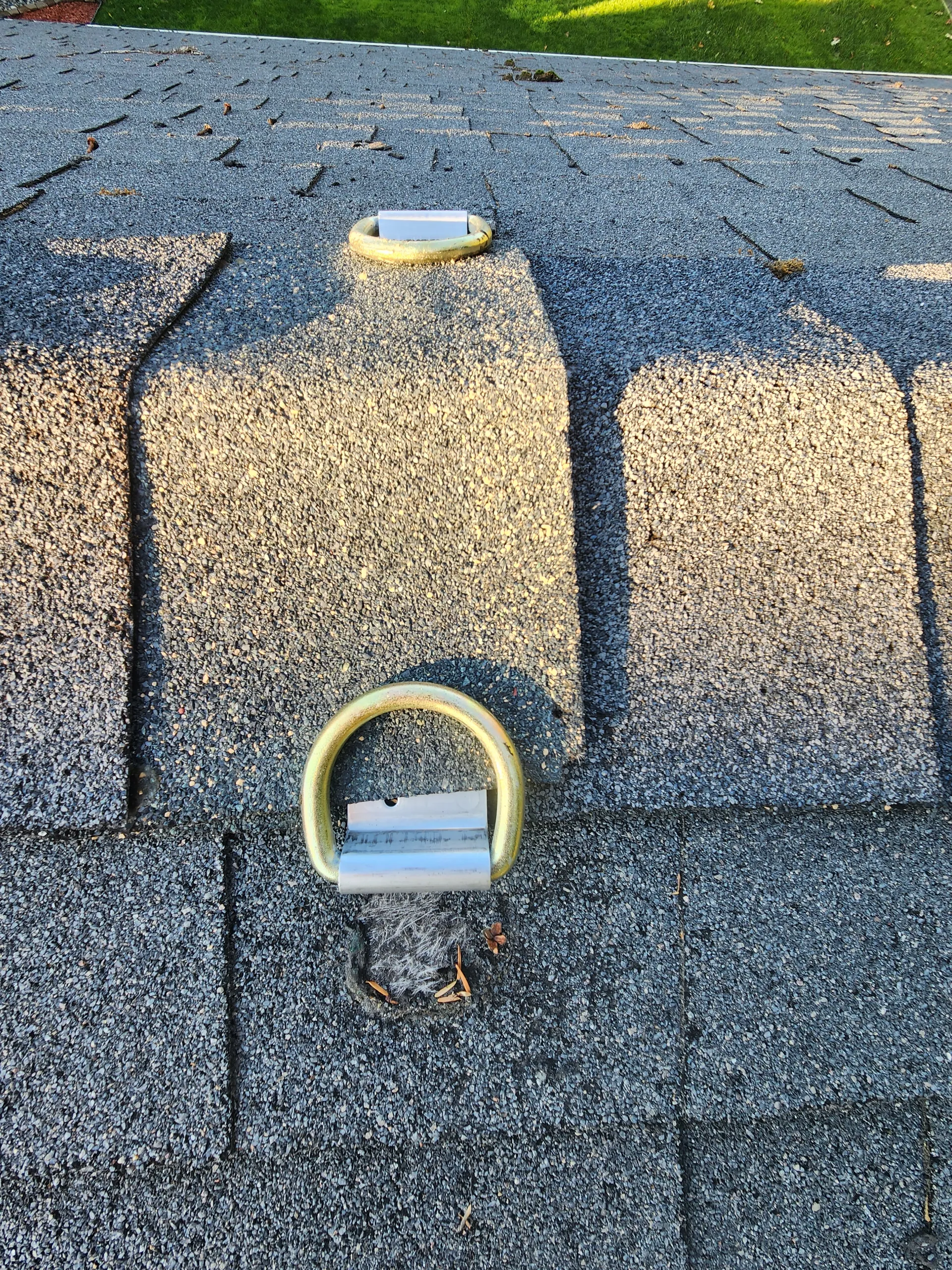
Roof Anchors: The Foundation of Every Fall Protection System
A fall protection system is only as strong as what it is attached to. The anchor point is the single most critical component, and it is the one most commonly done wrong by contractors who treat safety as a checkbox rather than a discipline.
How We Install Roof Anchors
- Locate the trusses: Before any anchor goes in, we locate the structural trusses or rafters below the deck. Anchors bolted into sheathing alone will rip out under load.
- Lag bolt into trusses: We use rated roof anchors with 3/8" or 1/2" lag bolts driven through the decking and into the truss chord. Each anchor is rated to 5,000 lbs per attached worker.
- Position for coverage: Anchors are placed so the SRL reach covers the entire work zone. On large roofs, multiple anchors go in. The goal is that no worker ever has to unclip and reclip while moving across the roof.
- Seal after removal: When the job is done and the anchor comes out, we seal the bolt holes with polyurethane roofing sealant and patch the shingle. No anchor penetration ever becomes a leak point.
What Should Never Be Used as an Anchor
- Plumbing vents: PVC or ABS pipe will snap under any meaningful load
- Gutters: Aluminum gutters will tear away from the fascia
- HVAC units: Not structurally rated and will shift or topple
- Chimney caps: Mortar joints crack under lateral force
- Ridge cap nails: Too shallow and too small to hold
In the oil sands, Kory and Johnny saw anchor points rated for tens of thousands of pounds, inspected by engineers, and load-tested annually. Residential roofing does not have that infrastructure, which makes proper truss-bolted anchors even more important. There is no engineer checking your work on a house roof. You have to get it right yourself.
Self-Retracting Lifelines: Why We Chose SRLs Over Lanyards
Most roofing crews in the Fraser Valley use 6-foot shock-absorbing lanyards. Those lanyards meet the minimum legal requirement. They also allow up to 6 feet of free fall before the shock absorber even begins to engage, and the total arrest distance can be 9.5 feet from the anchor point.
On a typical two-storey house with an eave height of 18 to 22 feet, a 6-foot lanyard with full deployment means the worker's feet are within inches of the ground, if not below grade. The math does not work on most residential structures.
The Fall Clearance Math
Standard 6-foot lanyard clearance calculation:
- Free fall distance: 6 feet
- Shock absorber deployment: 3.5 feet
- Worker height below D-ring: 5 feet
- Safety margin: 3 feet
- Total clearance needed: 17.5 to 18.5 feet
SRL clearance calculation:
- Free fall distance: 2 feet (SRL locks almost instantly)
- Deceleration distance: 3.5 feet
- Worker height below D-ring: 5 feet
- Safety margin: 3 feet
- Total clearance needed: 13.5 to 14.5 feet
That 4-foot difference is the difference between a safe arrest and a ground impact. SRLs cost $300 to $600 more than a basic lanyard, and we consider that the most important equipment investment on any job site.
Tool Lanyards and the Dropped-Object Problem
On an oil sands site, dropped-object prevention is taken as seriously as fall prevention. A 3-pound hammer dropped from 25 feet generates over 75 foot-pounds of impact energy at ground level. That is enough to fracture a skull through a hard hat.
Residential roofing crews rarely think about this. Tools get set on the roof, slide down the slope, and land in the yard, the driveway, or on someone walking by. At Fraser Roofing Ltd., every hand tool carried onto a roof is attached to the worker's harness or tool belt with a rated retractable tool lanyard. Hammers, pry bars, utility knives, chalk lines, tape measures, all of it.
The crew ties off personal items too. Water bottles, phones, portable speakers. In the oil sands, Kory once watched a 1-litre water bottle fall 150 feet from scaffolding and punch through a sheet of plywood. After that, the rule became simple: if it is on your body and you are above grade, it is tethered. That rule followed him to roofing.
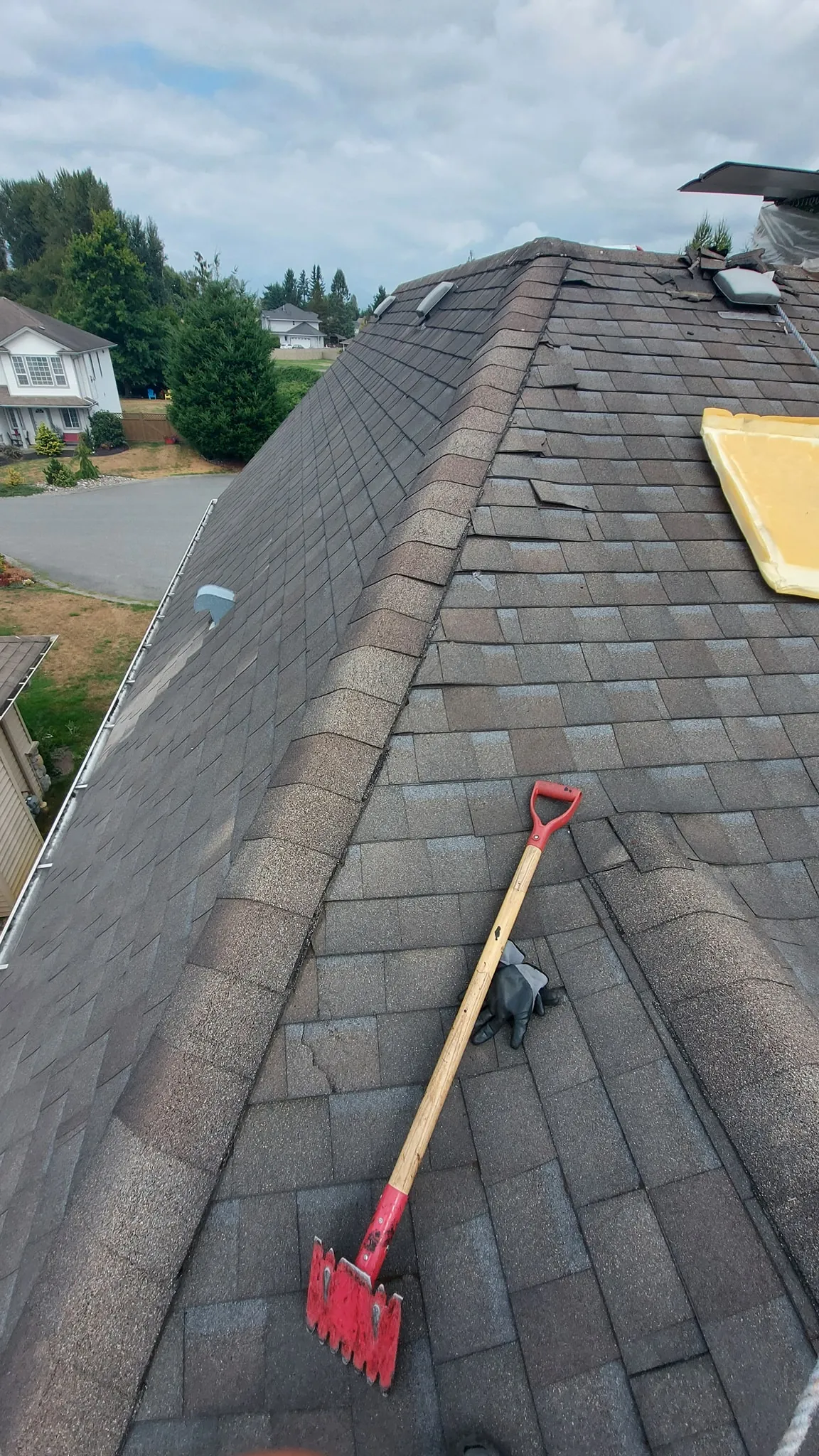
Ladder Tie-Offs: The Overlooked Hazard
More roofing injuries happen during ladder access than during work on the roof itself. A ladder that is not secured at the top can kick out sideways, slide backward, or be caught by a gust of wind. In the Fraser Valley, where weather shifts quickly and winds can pick up without warning, an unsecured ladder is a serious hazard.
How We Secure Every Ladder
- Top tie-off: The ladder is secured to a structural element at the top, either the fascia, a gutter bracket reinforced to the rafter tails, or a dedicated ladder hook over the ridge
- Base stability: The base is placed on firm, level ground with rubber feet engaged. On soft ground, we use a plywood pad
- 3-point contact: Two hands and one foot, or two feet and one hand, at all times while climbing
- 3-foot extension: The ladder extends at least 3 feet above the roof edge to provide a handhold during transition
- Angle check: The base is set at a 4:1 ratio. For every 4 feet of height, the base is 1 foot from the wall
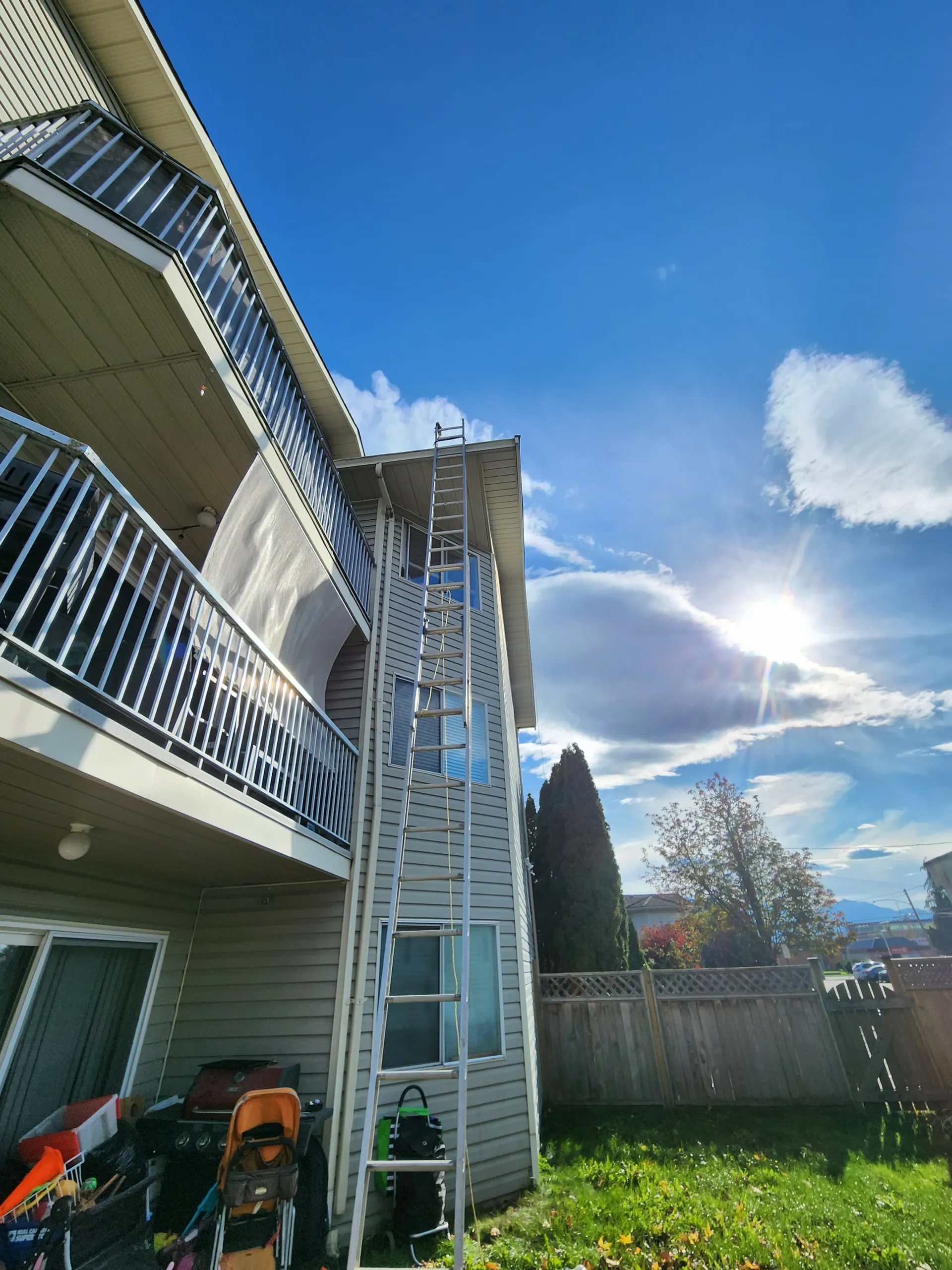
Harness Selection and Daily Inspection
The harness is the last line of defense between a worker and the ground. A poorly fitted or damaged harness can fail during a fall or cause injuries during arrest even if it holds. On oil sands sites, harness inspection is a documented daily ritual. We brought that same discipline to our roofing operations.
What We Check Before Every Shift
- Webbing: Look for cuts, fraying, chemical damage, UV degradation, or heat damage from contact with hot surfaces
- Stitching: All load-bearing seams checked for broken threads or pulled stitches
- D-ring: The dorsal D-ring is inspected for cracks, bending, or corrosion. Any deformation means the harness is retired
- Buckles and adjusters: All buckles must click and lock. Adjusters must hold position under load without slipping
- Labels: The manufacturer's label must be legible. If it is worn off, you cannot verify the harness is within its service life
Proper Harness Fit
- Dorsal D-ring sits between the shoulder blades, not at the neck or lower back
- Leg straps are snug against the upper thigh with no more than a fist's width of slack
- Chest strap is centred and holds the shoulder straps in position
- No twisted or kinked straps anywhere on the harness
- The harness allows full range of motion for roofing tasks without binding
A harness that has arrested a fall is immediately retired, no exceptions. The webbing stretches during arrest and the shock absorber deploys. Even if the harness looks fine, its energy-absorbing capacity has been consumed.
Suspension Trauma: The Clock Starts Immediately
When a fall protection system works correctly, the worker does not hit the ground. But they are now hanging in mid-air, suspended by leg straps that compress the femoral arteries. Blood pools in the lower legs. Within minutes, the brain and vital organs begin losing circulation. This is suspension trauma, sometimes called harness hang syndrome, and it can be fatal in as little as 15 minutes.
In the oil sands, rescue from suspension is practiced regularly because the consequences of slow response at height are well documented. On residential roofs, the rescue distances are shorter, but the urgency is the same.
Our Rescue Protocol
- Call 911 immediately while beginning self-rescue or assisted rescue
- Lower the worker to the ground or roof using the SRL's lowering function or a separate rescue line
- Do not leave the worker hanging while waiting for emergency services. Every minute in suspension increases the risk
- Suspension relief straps: Each crew member carries suspension relief straps attached to their harness. These loops allow the worker to stand in the harness, taking pressure off the femoral arteries and buying critical time
- Once lowered, do not lay the worker flat immediately. Keep them in a seated or recovery position to prevent reflow syndrome, where pooled blood carrying metabolic waste suddenly floods the heart
Working Steep Pitches in the Fraser Valley
Many Fraser Valley homes, especially older farmhouses around Agassiz, Harrison, and Rosedale, have steep roof pitches of 8:12, 10:12, or even 12:12. These roofs are common because the steep pitch sheds the heavy rainfall the valley receives. But they also mean that standing on the surface without support is essentially standing on a ramp steep enough to slide a loaded wheelbarrow.
Steep Roof Protocols
- Roof brackets and scaffold planks: On any pitch steeper than 6:12, we install roof brackets nailed through the deck into trusses and lay 2x10 planks across them to create level work platforms
- Multiple anchor points: Steep pitches mean the worker's body weight constantly loads the SRL. We place anchors so the pull angle is as vertical as possible to minimize swing-fall distance
- Soft-soled footwear: Cougar Paws or equivalent roofing boots with replaceable grip pads. Hard-soled boots slide on granulated shingles
- Wet roof policy: We do not work on steep roofs when the surface is wet. Morning dew, light rain, or frost on a 10:12 pitch creates ice-rink conditions. The crew stands down until the surface dries, no exceptions
The Cost of Cutting Corners
A full fall protection setup for a two-person roofing crew costs roughly $2,000 to $3,000 in equipment: two harnesses ($150 to $300 each), two SRLs ($400 to $600 each), rated anchors ($50 to $100 each), tool lanyards ($15 to $30 each), and a ladder stabilizer ($80 to $150). That equipment lasts several years with proper inspection and care.
The cost of a single fall injury dwarfs that number. A broken hip from a 15-foot fall runs $40,000 to $80,000 in medical costs, months of lost work, and potential WorkSafeBC penalties that can shut down a roofing company permanently. A fatal fall devastates a family and ends a business.
When Kory and Johnny started Fraser Roofing Ltd. in 2026, they bought fall protection equipment before they bought their first bundle of shingles. The oil sands taught them that safety equipment is not overhead. It is the cost of operating a business where people go home at the end of the day.
What Homeowners Should Look For
When a roofing crew shows up at your Fraser Valley home, you can tell a lot about their safety culture before they touch a single shingle:
- Do they wear harnesses? If the crew walks onto a steep roof without fall protection, that tells you everything about how they run their operation
- Are their tools tethered? Loose tools on a roof are a liability. A hammer in your garden is annoying. A hammer on your child's head is catastrophic
- Is the ladder secured at the top? An unsecured ladder is the most common sign of a crew that treats safety as optional
- Do they have a rescue plan? Ask. If they look confused, they do not have one. WorkSafeBC requires it. So does basic professionalism
At Fraser Roofing Ltd., we do not negotiate on safety. The oil sands taught Kory and Johnny that everything gets tied off, everyone goes home, and there are no acceptable shortcuts. That standard applies to every roof we touch across the Fraser Valley, from Hope to Abbotsford. Call (778) 860-4747 to work with a crew that treats your roof like an industrial job site.
Need Expert Help With Your Roof?
Kory & Johnny have completed 500+ roofs across the Fraser Valley since 2026. Free inspections, honest estimates, no pressure.
(778) 860-4747Serving Hope, Agassiz, Chilliwack, Rosedale, Abbotsford & the entire Fraser Valley
Questions about our fall protection standards? (778) 860-4747 — Kory and Johnny Peters, Agassiz BC