Last November, Johnny and I got a call at six in the morning from a homeowner in Agassiz whose entire north-facing slope had been peeled back overnight. The wind had come screaming down through the Fraser Canyon, hit the house broadside, and ripped forty shingles clean off before the sun came up. We had tarps on that roof by nine. That is the reality of living in one of the windiest corridors in southern BC. Last updated: February 2026.
Why the Fraser Valley Gets Hit Harder Than You Think
Most people associate BC windstorms with the coast, but the Fraser Valley has its own wind machine. The geography creates three distinct wind patterns that slam roofs from Hope to Abbotsford, and understanding them is the first step to protecting your home.
The Three Wind Funnels That Threaten Fraser Valley Roofs
We have repaired over 500 roofs since founding Fraser Roofing Ltd. in 2026, and the wind damage patterns repeat themselves year after year based on geography. Each corridor produces a different kind of wind, and each one attacks roofs differently.
- The Fraser Canyon Funnel: Cold Arctic outflow winds blast down from the interior through the canyon, hitting Agassiz, Harrison, and Hope hardest during winter months. These are dry, sharp gusts that peel shingles like playing cards.
- The Coquihalla Gap: Pacific storms push through the Coquihalla corridor and dump energy into the central valley around Chilliwack and Rosedale. These come with rain, making damage worse because water gets under lifted materials instantly.
- The Valley Squeeze: When Pacific low-pressure systems collide with mountain barriers, wind accelerates across the open farmland between Abbotsford and Chilliwack. Properties without tree shelter on flat agricultural land catch the worst of it.
Environment Canada records show the eastern Fraser Valley (Hope to Agassiz) experiences 15-20% stronger peak wind gusts than Abbotsford during outflow events. This is because the canyon compresses airflow before it hits the open valley.
What Happens to a Roof at 90 km/h: The Physics of Wind Uplift
Here is something most homeowners do not realize: wind does not blow shingles off your roof. It sucks them off. When wind flows over your roofline, it creates negative pressure on the leeward side, exactly like an airplane wing generating lift. That suction force pulls shingles upward. Once a single shingle lifts even a few millimeters, wind gets underneath and the peeling begins.
Johnny and I learned this the hard way on a barn re-roof near Rosedale during our first year. We left a section partially completed overnight, and a 70 km/h gust unzipped everything we had laid that day. We now refuse to leave any edge unsealed at the end of a work day, no matter what. Oil field discipline: you do not leave a job site in a state that cannot survive the night.
- Corners and edges experience 2-3x the wind force compared to the center of your roof
- Ridge caps are especially vulnerable because they sit at the peak where wind accelerates
- Flashing around chimneys, skylights, and plumbing vents act as catch points where wind pries materials loose
- Gutters and fascia boards can detach and take soffit panels with them, exposing the roof deck to rain
- Older roofs with dried-out shingle adhesive strips lose their grip entirely in sustained winds above 80 km/h

The Kory and Johnny Approach to Wind-Proofing
When Johnny and I transitioned from Red Seal boilermaking in the Alberta oil sands to roofing in 2026, we brought one obsession with us: everything gets secured as if it is going to face the worst-case scenario. In the oil fields, if a piece of scaffolding blew loose, people could die. We apply that same mentality to every roof we touch. Our wind-resistant installation methods cost us an extra hour or two per job, but we have never had a callback for wind damage on a roof we installed.
Six-Nail Pattern and Starter Strip Upgrades
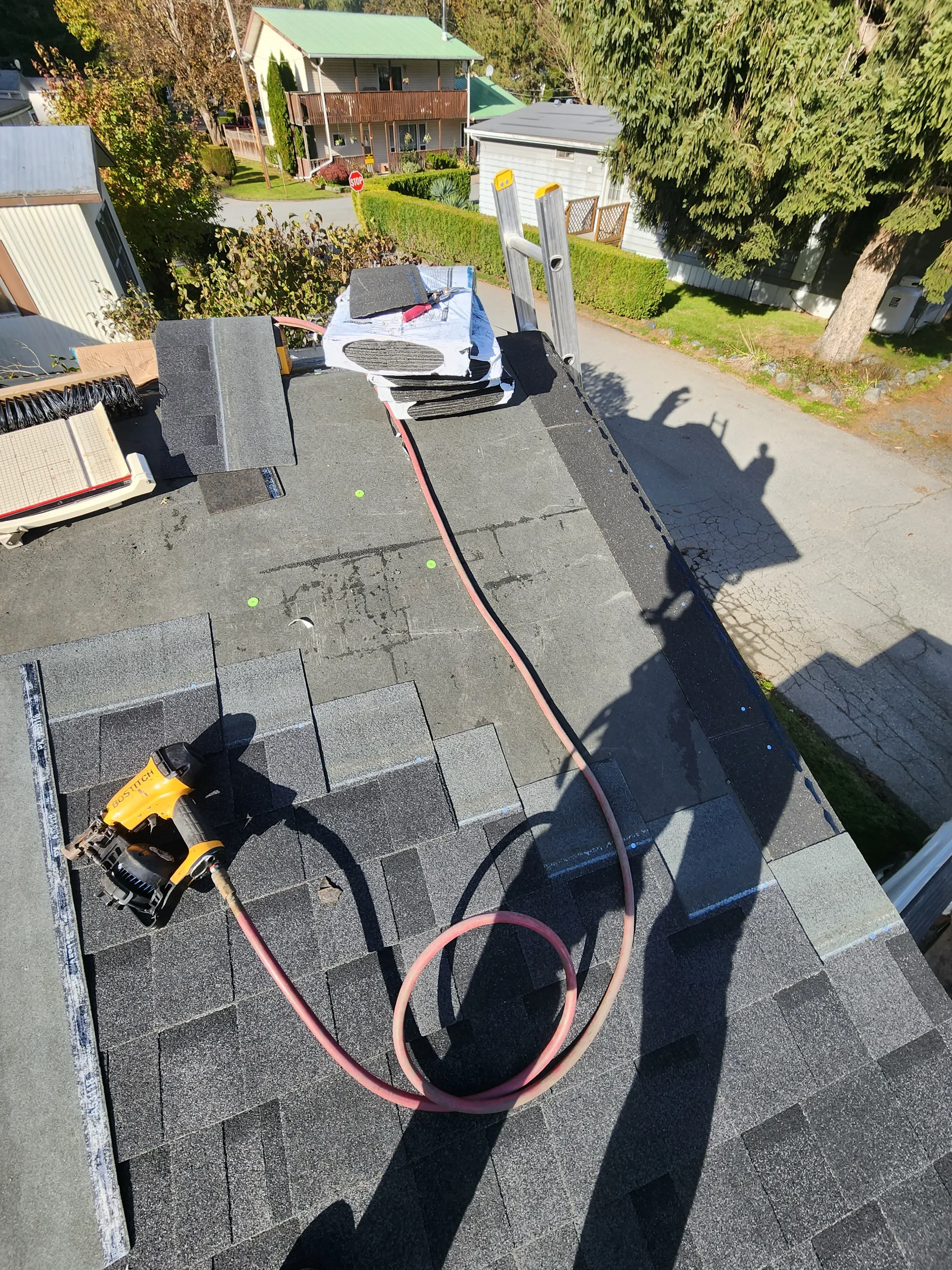
The standard shingle installation uses four nails per shingle. That meets code. But code is a minimum, not a goal. In the Fraser Valley, we install every shingle with six nails, placing the additional fasteners in the high-wind zones at eaves, rakes, and ridges. We also upgrade starter strips along the eaves from the basic self-stick type to mechanically fastened starters with a secondary adhesive bond.
- Six nails per shingle across the entire roof, not just at edges
- High-wind rated starter strips along all eaves and rakes
- Hand-sealed shingle tabs in the top three rows near the ridge
- Roofing cement applied under every ridge cap for double security
- Metal drip edge secured with ring-shank nails at 8-inch centers instead of standard 12-inch
Ask your roofer how many nails they use per shingle. If they say four, ask them to upgrade to six. The material cost is negligible, maybe $50-80 more for an average roof, but the wind resistance improvement is substantial. This is the single cheapest upgrade you can request.
Why We Recommend Metal for High-Exposure Properties
For homes sitting on exposed hillsides in Harrison, ridge-top properties above Agassiz, or farmhouses on open land near Chilliwack, we steer the conversation toward standing seam metal roofing. A properly installed standing seam system withstands sustained winds up to 180 km/h. The concealed clip fastener system allows thermal expansion without creating weak points, and there are no exposed nail heads or adhesive strips to fail.
One of our favorite projects was a hobby farm outside Yale where the owner had replaced shingle roofs on his barn twice in seven years because of canyon winds. We installed standing seam on the barn and the house simultaneously. That was three years and dozens of windstorms ago. Not a single panel has moved.
Tree Management: The Factor Most Homeowners Ignore
The Fraser Valley is full of mature Douglas fir, western red cedar, and bigleaf maple. These trees are beautiful and provide shade, but during windstorms they become battering rams. We have pulled entire limbs out of roof decks, and in one case near Mission, a 60-foot cedar came down across a ridge line and split the roof structure in half.
- Keep all tree limbs trimmed back at least 10 feet from any roof surface
- Dead or dying trees within falling distance should be assessed by a certified arborist
- Deciduous trees drop branches more readily in winter storms than conifers, but conifers bring more weight
- Root systems of trees on slopes above your home can undermine drainage and direct water toward the foundation
- After any windstorm, inspect for branches resting on the roof even if they appear harmless, because trapped moisture beneath them accelerates shingle decay
A tree limb resting on your roof after a storm might look minor, but it can crack shingles, puncture underlayment, and create a moisture trap. Remove debris as soon as it is safe to do so, or call for help. Do not walk on a roof that may have structural damage beneath debris.
Post-Storm Inspection: What We Check and What You Should Check
After a major wind event, do a ground-level walk around your home before calling anyone. You can catch serious problems early without ever leaving the ground.
- Look for shingles, shingle fragments, or flashing pieces on the ground around the house
- Check gutters and downspouts for dents, bending, or separation from fascia
- Look up at the roof edges from the ground for lifted, curled, or missing shingles
- Inspect siding near the roofline for cracks or loosened panels
- Go inside and check ceilings in upper rooms and the attic for water stains, drips, or daylight showing through
If you spot any of these signs, take dated photos from multiple angles and call us at (778) 860-4747. We provide free post-storm visual inspections for homeowners anywhere in the Fraser Valley, from Hope to Abbotsford. We will give you an honest assessment, no pressure, and if you need a full report for insurance we can provide that too.
Insurance and Wind Damage: What Fraser Valley Homeowners Need to Know
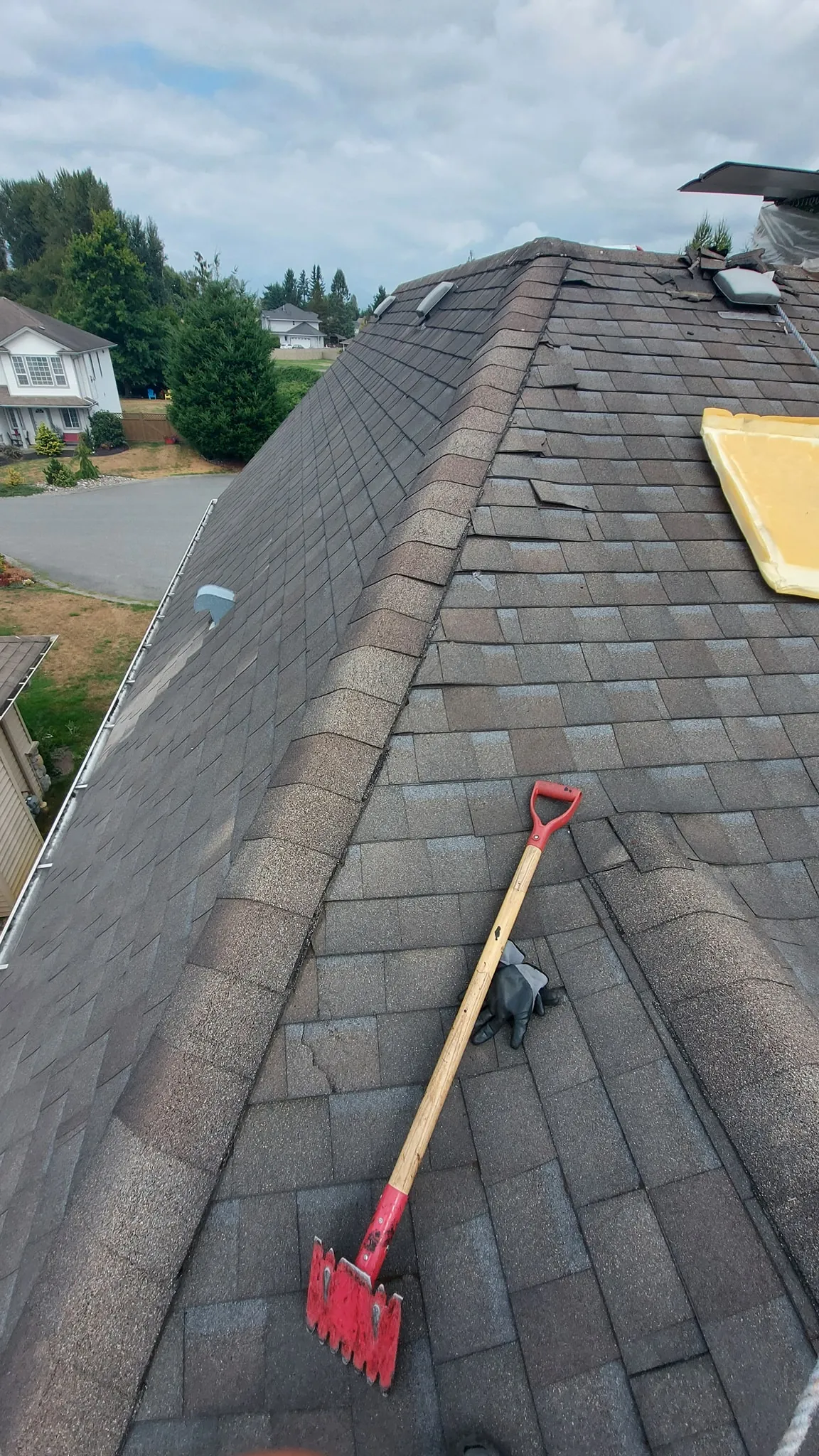
Most homeowner insurance policies in BC cover sudden wind damage. That includes torn shingles, structural damage from fallen trees, and water damage caused by wind-created openings. What they typically will not cover is damage that results from deferred maintenance. If your adjuster finds that the shingles blew off because the adhesive strips had dried out years ago and you never maintained the roof, your claim may be reduced or denied.
- File your claim within 24-48 hours of discovering damage
- Take dated photos and video of all damage before any temporary repairs
- Save every receipt for tarps, buckets, and emergency supplies
- Do not sign any contract with a contractor who shows up uninvited after a storm
- Request a copy of the adjuster's report and compare it against your roofer's inspection
Fraser Roofing Ltd. provides detailed inspection reports with photos, measurements, and material specifications that insurance adjusters accept. We work directly with your adjuster to make the claims process smoother. We have helped dozens of Fraser Valley homeowners get fair settlements.
The Bottom Line From Two Brothers Who Fix These Roofs Every Week
Wind damage is not an if in the Fraser Valley. It is a when. The difference between a roof that survives a 100 km/h gust and one that ends up scattered across your yard comes down to three things: quality materials rated for high wind, installation methods that exceed code minimums, and regular maintenance that keeps adhesive strips and flashing in good condition. Johnny and I built Fraser Roofing Ltd. on the principle that we install every roof as if our own family is sleeping underneath it. That is not a marketing line. Our dad has been on roofs with us. When it is personal, you do not cut corners.
Want to know how your roof would hold up in the next big windstorm? Call Fraser Roofing Ltd. at (778) 860-4747 or email johnny@fraserroofing.ca to schedule a free wind-vulnerability assessment. We serve every community from Hope to Abbotsford across the Fraser Valley.