Johnny and I grew up in the Fraser Valley. We know what October smells like here — wet cedar, river mud, and that heavy grey sky that does not lift until April. We also know what that six-month soaking does to roofs, because we have torn off hundreds of them. After 500+ roofs from Hope to Abbotsford and years running Fraser Roofing Ltd. out of Agassiz, we have learned things about wet-climate roofing that no textbook teaches you. This is the honest version — what actually protects your home when the rain will not stop, and what the brochures leave out.
We Live Under the Same Rain You Do
Our shop is in Agassiz. Every morning from October to March, I drive through river fog so thick the headlights bounce back. The Fraser sits right there, pumping moisture into the air all year. When we quote a roof, we are not guessing about conditions — we are living them. The 1,500mm annual rainfall stat you see online is an average. Agassiz and Hope routinely exceed 1,800mm. That is over five feet of water landing on your roof every single year. Understanding that number is the starting point for everything we do.
The Three Killers: Moisture, Moss, and Missed Ventilation
Dramatic storm damage gets all the attention, but in the Fraser Valley, it is the quiet damage that destroys roofs. We call them the three killers because they work together and they work slowly — slow enough that most homeowners do not notice until the ceiling stains appear.
- Persistent moisture that never lets your roof fully dry — shingles in the valley spend months continuously damp
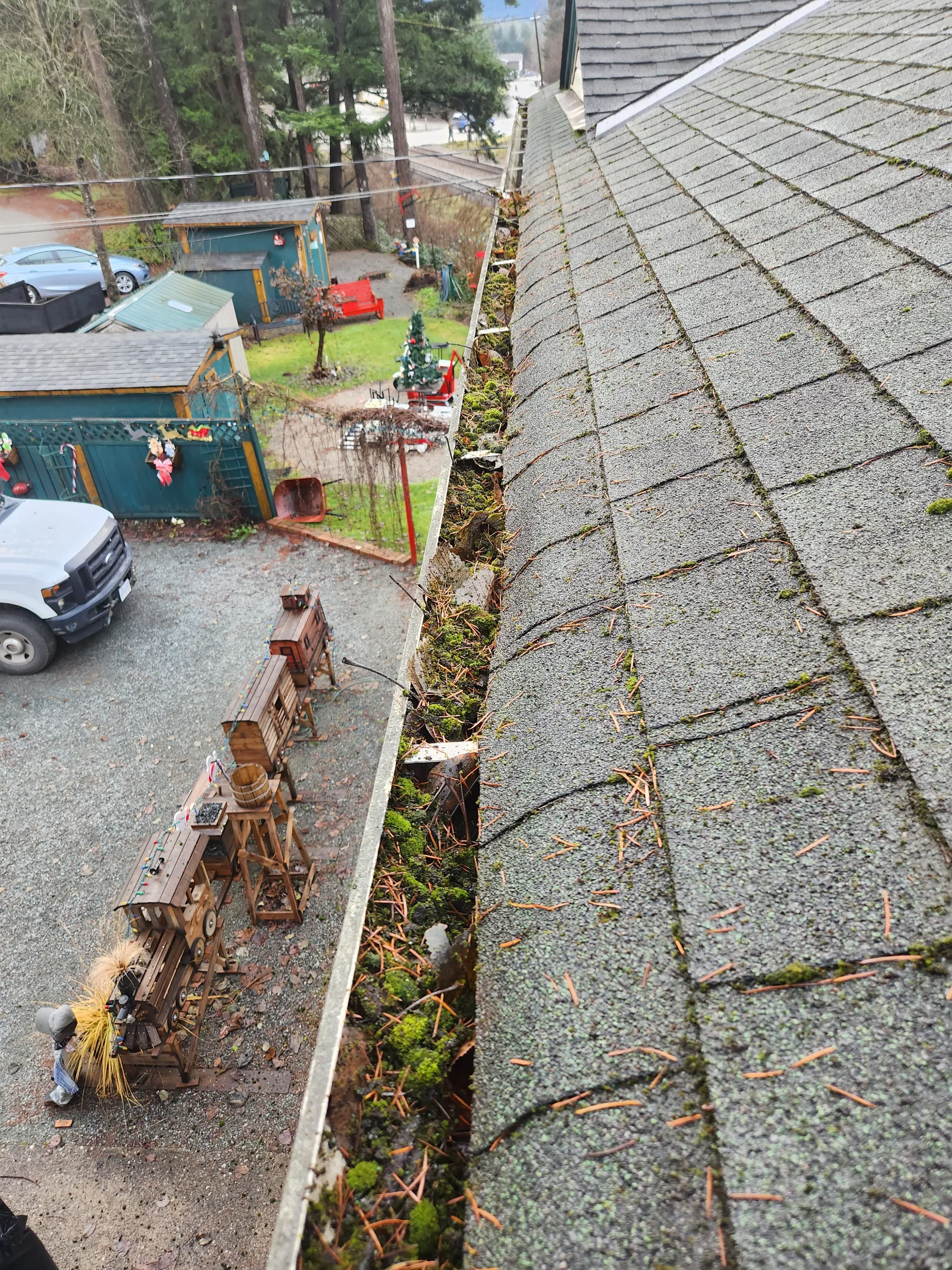
- Moss that takes hold on north-facing slopes and in shaded areas, acting like a wet sponge pressed against your shingles
- Inadequate attic ventilation that traps humid air inside, creating condensation on the underside of your roof deck
- Flashing failure around chimneys and vents where years of expansion and contraction break sealant bonds
- Granule loss accelerated by constant water flow stripping the protective coating from asphalt shingles
We pulled a roof in Rosedale last spring where the homeowner had no idea there was a problem. The sheathing underneath was black with rot — you could push a screwdriver through the plywood. The leak had been developing for three years without a single visible water stain inside. That is how the Fraser Valley kills roofs: quietly.

What Oil Field Safety Taught Us About Waterproofing
Before we started roofing, Johnny and I were Red Seal Journeyman Boilermakers in the Alberta oil sands — Suncor, Syncrude, CNRL Kearl Lake. In the oil fields, a bad weld on a pressure vessel can kill someone. That zero-tolerance standard came with us to roofing. We tie off every tool, every speaker, every water bottle. We do not cut corners on underlayment to save forty dollars. When we install ice and water shield, we run it six feet from the eaves instead of the three-foot code minimum, because we have seen what happens when you stop at three feet in a valley that gets this much rain.
Material Selection: What Actually Survives Here
Not every roofing material handles Fraser Valley conditions equally. After installing roofs in every microclimate from the mountain passes above Hope to the flat farmland around Abbotsford, we have a clear picture of what lasts and what does not.
- Standing seam metal — our top recommendation for longevity, shedding water instantly with zero absorption and 50+ year performance
- Architectural asphalt shingles — solid performer when installed with premium underlayment, proper ventilation, and regular maintenance
- Synthetic underlayment rated for prolonged moisture exposure — we never use felt paper in the valley because it deteriorates too fast
- Zinc ridge strips for long-term moss prevention — a single installation protects for years as rainwater carries zinc ions across the roof surface
- Cedar shakes — they look beautiful, but in our climate they rot in 15 years without intensive annual maintenance
We source materials from local Fraser Valley suppliers like Roofmart in Chilliwack and Pro-Line Building Centre. Buying local means same-day availability when weather windows open up — critical in a region where you might only get three dry days in a row.

The Ventilation Problem Nobody Talks About
I cannot count how many attics I have crawled into around Chilliwack and Agassiz that felt like saunas — in January. When warm, moist air from your living space rises into a poorly ventilated attic, it hits the cold underside of the roof deck and condenses. That condensation drips onto insulation, soaks into rafters, and creates the perfect environment for mold and wood rot. In the Fraser Valley, where outdoor humidity already sits above 80% for most of the year, inadequate ventilation is a death sentence for your roof.
- Every re-roof we do includes a ventilation assessment at no extra charge
- Proper airflow requires balanced intake at soffits and exhaust at the ridge — not just one or the other
- Building code calls for 1 square foot of ventilation per 150 square feet of attic space, but in our climate we often recommend exceeding that
- Ridge vents paired with continuous soffit vents create the most effective airflow pattern
- Bathroom and kitchen exhaust fans must vent outside, not into the attic — we find this mistake on roughly one in five homes
Our Maintenance Protocol for Wet-Climate Roofs
After years of experience and hundreds of roofs, we have developed a maintenance approach specific to Fraser Valley conditions. This is not a generic checklist copied from a national roofing association — it is built from what we have seen fail and what we have seen last.
- Late September gutter clean — before the October rains arrive, clear everything out and check gutter slope for proper drainage
- Early spring debris removal — March is the time to get branches, needles, and leaf buildup off the roof before moss season begins
- Annual moss treatment — apply zinc sulfate or have zinc ridge strips installed for passive year-round prevention
- Flashing inspection every 18 months — sealant around vents, chimneys, and skylights breaks down faster in our wet climate
- Attic check after the first hard freeze — look for frost on the underside of the roof deck, which indicates a ventilation problem
August is the best month for roof work in the Fraser Valley. The weather is stable, sealants cure properly, and you get ahead of the fall rains. If you need any repair or replacement done, book it for August if you can. Call Fraser Roofing Ltd. at (778) 860-4747 to schedule.
When a Repair Will Not Cut It Anymore
Homeowners ask us this constantly: can you just patch it? Sometimes the answer is yes. But in the Fraser Valley, roofs reach a tipping point faster than in drier regions. When granule loss exposes the fiberglass mat underneath, when moss has lifted shingles across multiple slopes, when the attic smells damp even in summer — patching is just buying time you do not have. We will always give you an honest assessment. If a repair makes sense, we will tell you. If your roof is past the point of return, we will tell you that too. We would rather lose a sale than put our name on work we know will fail.
Last updated: February 2026. Written by Kory Peters, co-founder of Fraser Roofing Ltd., based in Chilliwack, BC. Serving the Fraser Valley from Hope to Abbotsford — (778) 860-4747 — johnny@fraserroofing.ca.