I am going to tell you something most roofing companies will not: half of the "seasonal maintenance" advice you read online is written by people who have never stood on a roof in January fog with ice forming on the drip edge. Johnny and I live in Agassiz. We built Fraser Roofing Ltd. here in 2026 because this is home. We maintain our own roofs, our families' roofs, and after 500+ jobs from Hope to Abbotsford, we have learned what actually matters season by season — and what is just noise. Last updated: February 2026.
Why Generic Maintenance Calendars Fail in the Fraser Valley
Most roof maintenance guides are written for average Canadian climates — places that get 800mm of rain a year and have distinct dry spells. The Fraser Valley gets nearly double that. Agassiz and Hope regularly exceed 1,800mm. Our "dry season" is maybe ten weeks long. The standard advice to "inspect in spring and clean gutters in fall" is dangerously incomplete for a climate where your roof spends six straight months under constant moisture assault. What follows is the actual routine Johnny and I follow. Not the brochure version — the real one.
March Through May: The Damage Report
Spring in the valley is not really spring — it is the tail end of five months of rain. By March, your roof has been taking a beating since October. This is when we assess what winter did. Not from the roof — from the ground with binoculars, and from the attic with a flashlight.
- Walk the perimeter of your house looking up — scan for lifted, cracked, or missing shingles along the edges and ridgeline
- Check every downspout by running a hose down it — blockages from winter debris can cause catastrophic backups in the next rain
- Climb into the attic on a dry day and shine a flashlight at the underside of the roof deck — any daylight means a problem, and dark staining means moisture is already there
- Inspect the base of chimneys and all vent boots from ground level — flashing failure is the number one cause of leaks we see on Fraser Valley homes
- Trim any branches that are within two metres of the roof surface — branches trap moisture and drop debris directly into valleys where water concentrates
I learned the attic trick from my dad. He used to say if you want to know the truth about a roof, do not look at the shingles — look underneath. Every spring, Johnny and I check our own attics before we check anyone else's. It takes ten minutes and it tells you everything.
The Moss Question: April Is Your Window
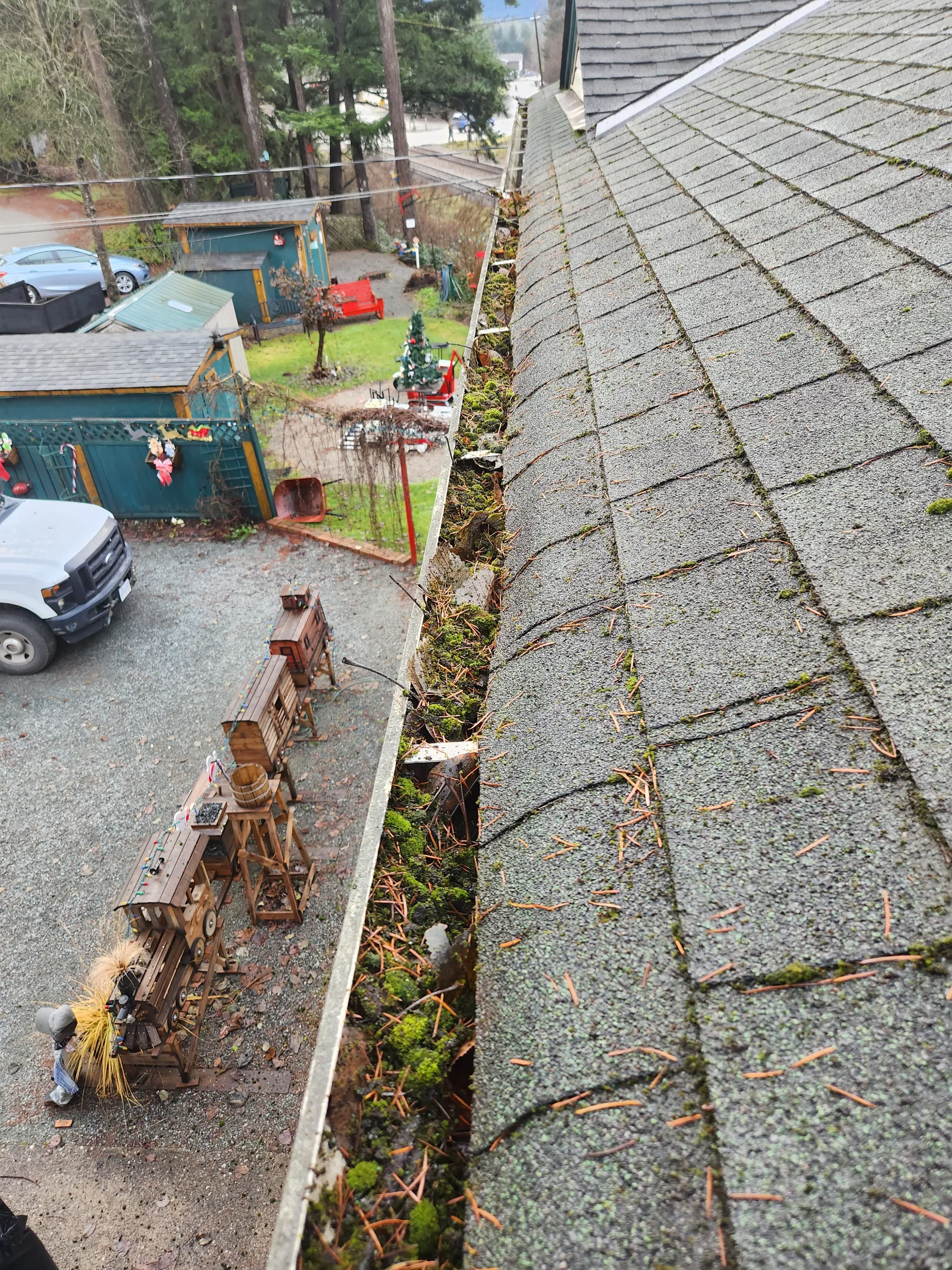
By April, you can see exactly where moss took hold over winter. North-facing slopes and areas under tree canopy are always the worst. I have seen moss mats two inches thick on roofs in Harrison that the homeowner did not even notice because they never walked around that side of the house. Here is the thing — you cannot just power-wash it. Pressure washing strips granules off asphalt shingles and voids most manufacturer warranties. Soft wash with a zinc-based solution is the right call. After cleaning, install zinc strips along the ridge. When it rains, zinc ions wash down and create an inhospitable surface for moss regrowth. One installation lasts years.

June Through August: The Only Dry Window
Summer is everything in the Fraser Valley. It is the only time we can tear off, install underlayment that bonds properly, and let sealant strips activate in the heat. If you need a roof replacement, this is when it has to happen. We start booking summer jobs in March because by May, our schedule is packed. Every roofer in the valley is racing the same clock.
- Schedule your professional inspection for June or early July — this gives time to plan and quote any needed repairs before the ideal install window
- Any shingle repairs should be done by mid-August — sealant strips on new shingles need warm temperatures to bond before fall rain
- Check attic ventilation while it is warm — a properly vented attic should not be more than 10-15 degrees warmer than outside air
- This is the best time for a full gutter flush and seal check on all gutter joints and end caps
- If you have been considering metal roofing, summer is the time — standing seam panels need precise installation and dry conditions for sealant
Here is a timing secret from years of Fraser Valley roofing: the last two weeks of July are statistically the driest in our region. If you are planning a tear-off and re-roof, that is the golden window. We check Environment Canada forecasts daily and never tear off more square footage than we can waterproof the same day — a discipline we brought from the oil sands where weather changes kill timelines.
What Oil Field Discipline Taught Us About Summer Roof Work
Before roofing, Johnny and I were Red Seal Journeyman Boilermakers in the Alberta oil sands — Suncor, Syncrude, MEG Energy, CNRL Kearl Lake. Up there, every task has a procedure. Every step is documented. You do not skip steps because you are tired or because the foreman is pushing. That mindset is how we approach summer roof work. We do not cut corners in July because the weather is nice. We install ice and water shield up the valleys even when code does not require it that far. We tie off every time we step on a roof, even a single-storey bungalow. "Mountain goat on it" is what we say — move with purpose and precision, always anchored.
September and October: Battening Down
The first real rain usually lands in late September, and once it starts, it does not stop until March. This is your last chance to address anything before six months of relentless moisture. I treat October like a countdown.
- Full gutter and downspout cleanout — every inch, every corner, every elbow joint where debris hides
- Seal any exposed nail heads on flashing with high-quality roofing caulk — we use Geocel or equivalent, never cheap silicone that fails in one season
- Re-secure any loose ridge cap shingles — wind-driven rain in the valley comes sideways, and a lifted ridge cap is a direct water entry point
- Check your attic ventilation baffles are clear — soffit vents clogged with insulation create the condensation problems that rot sheathing from the inside
- Walk the perimeter one more time and photograph anything questionable — if it leaks in December, you will have documentation for insurance and for your roofer in spring
- If you own a tarp, store one accessible — not buried in the garage. When a branch comes through your roof at 2am in November, you need that tarp immediately
Last October a homeowner in Chilliwack called us about a leak that started during the first big rain. Turned out a single lifted shingle tab along the eave had been sitting there all summer. Five minutes with a caulk gun in August would have prevented a $2,400 repair bill in November. The lesson: do your fall prep before the rain, not after the first leak.

November Through February: Survival Mode
I am going to be blunt: winter is not the time for roof work in the Fraser Valley. Wet shingles are slippery. Cold asphalt is brittle — you step on a shingle at minus three degrees and it cracks. Ice forms on drip edges overnight and melts by noon, creating micro-freeze-thaw cycles that work sealant loose. Our job in winter is to keep you safe and document anything that needs attention when spring comes.
- Do not go on the roof — full stop. Not to clear snow, not to look at a shingle, not for any reason. Falls from residential roofs are one of the leading causes of injury in BC
- After major wind events, walk the yard and look for shingle debris or flashing pieces on the ground — this tells you damage occurred without climbing up
- If snow accumulates past 30cm and you have a low-slope section, call a professional — snow load on a low-pitch roof can exceed structural capacity
- Monitor your ceilings weekly — water stains, bubbling paint, or musty smells are early leak indicators
- If you see ice forming along the eaves and icicles hanging from the gutter, you may have an ice dam forming — this is usually a ventilation issue, not a roof issue
- Keep dated photos of any storm damage for insurance claims — adjusters want proof that damage was weather-caused, not neglect
We handle emergency calls all winter across the Fraser Valley — Hope to Abbotsford. If a tree comes through your roof or a major leak opens up, call us at (778) 860-4747. We will get a tarp on it when conditions are safe. But honest talk: permanent repairs wait for dry weather. Anyone who tells you they can do a proper roof repair in January rain is selling you something that will not hold.
The Real Cost of Skipping Maintenance
I have seen it too many times. A homeowner skips the fall gutter clean, skips the spring inspection for three years running, and then calls us in November with water coming through the ceiling. By that point, the underlayment is compromised, the sheathing is soft, and what could have been a $400 flashing repair is now a $12,000 partial re-roof. The math is not complicated: two hours of your time twice a year, or a five-figure repair bill. Every single time we show up to a catastrophic leak, the homeowner says the same thing — "I kept meaning to get someone up there."
Our Maintenance Promise to Fraser Valley Homeowners
At Fraser Roofing Ltd., we do not just install roofs and disappear. We built this company in Agassiz because we live here. Kory and Johnny Peters — that is us. We answer the phone, we show up, and we treat every roof like it is our own family's. If you want a professional set of eyes on your roof before the season changes, give us a call at (778) 860-4747 or email johnny@fraserroofing.ca. We serve the entire Fraser Valley from Hope to Abbotsford, and our inspections are thorough — you will get photos, honest assessment, and zero pressure. That is how we were raised, and that is how we run this business.