The Science of Roofing Materials
Molecular Composition, Degradation Mechanisms & Real-World Performance in BC's Climate
Last updated: February 2026
Why Two Red Seal Boilermakers Care About Material Science
Before Kory Peters and Johnny Peters founded Fraser Roofing Ltd. in 2026, they spent years as Red Seal Boilermakers working with pressure vessels, high-temperature alloys, and industrial coatings. That background gave them something most roofers lack: a deep understanding of how materials behave at the molecular level under stress, heat, and moisture. When they transitioned to residential roofing in the Fraser Valley, they brought that industrial material science mindset with them.
After 500+ roofs completed across the Fraser Valley — from Agassiz to Abbotsford — they have seen firsthand how material choices made at the molecular level determine whether a roof lasts 15 years or 50. This guide breaks down the science behind every major roofing material so Fraser Valley homeowners can make informed decisions.
Asphalt Shingles: Hydrocarbon Chemistry in Four Layers
Layer 1 — Fiberglass Mat (Structural Core)
The foundation of every modern asphalt shingle is a fiberglass mat: woven glass fibres bonded with thermosetting resin. Fiberglass replaced organic felt (paper and rag) in the 1980s because it delivers 10x higher tensile strength, 30% weight reduction, complete rot resistance, and Class A fire rating. From a material science perspective, glass fibres are inorganic silicates — they do not absorb water, do not support biological growth, and maintain dimensional stability across wide temperature ranges.
Layer 2 — Asphalt Coating (Waterproofing Matrix)
The waterproofing layer is petroleum-derived bitumen — a complex mixture of hydrocarbons ranging from C5H8 to C35H72. Three molecular families work together:
- Asphaltenes (heavy molecules): Provide structural durability and hardness
- Resins (medium molecules): Create adhesion between layers
- Oils (light molecules): Maintain flexibility and workability
Over time, UV radiation drives off the light oil fraction first. This is why old shingles become brittle and crack — the molecular balance between hard asphaltenes and flexible oils has shifted. In the Fraser Valley, where summer UV intensity can push roof surface temperatures above 70 degrees Celsius, this process accelerates on south-facing slopes.
Layer 3 — Ceramic Granules (UV Shield)
Crushed basalt or granite rock coated with ceramic minerals forms the protective outer layer. These granules block 95%+ of UV radiation from reaching the asphalt binder. Without granules, exposed asphalt degrades in just 2 to 3 years. The ceramic coating determines colour and provides additional fire resistance. Granule loss is the single most reliable indicator of shingle aging — once 30% or more are gone, the shingle enters accelerated decline.
Layer 4 — Thermoplastic Adhesive Strip
The bottom adhesive strip is a thermoplastic compound that activates under solar heat. After installation, the sun warms the adhesive to its activation temperature (typically 15 to 25 degrees Celsius sustained), bonding each shingle to the one below. This creates a continuous wind-resistant surface. In the Fraser Valley, full adhesive activation typically takes 2 to 4 weeks during spring or summer installation. Winter installations may not fully seal until warmer weather arrives.
How Fraser Valley Climate Degrades Asphalt Shingles
Four degradation mechanisms work simultaneously on every asphalt roof in BC:
UV Photodegradation: UV photons carry 3 to 4 eV of energy — enough to break C-C bonds (3.6 eV threshold) in the asphalt binder. This process starts on day one and accelerates after 15 to 20 years as granule loss exposes more asphalt surface area.
Thermal Cycling: Fraser Valley roofs experience daily surface temperature swings of 30 to 50 degrees Celsius in summer, and seasonal extremes from -20 degrees Celsius to +70 degrees Celsius. The fiberglass mat and asphalt coating expand at different rates, creating internal shear stress that produces micro-cracks over thousands of cycles.
Granule Erosion: Foot traffic, hail impacts, wind abrasion, and simple aging cause 10 to 20% granule loss over a 25-year lifespan under normal conditions. Heavy moss growth (common on north-facing Fraser Valley roofs) mechanically lifts granules, accelerating the process.
Moisture Infiltration: Once micro-cracks form, water enters the asphalt matrix. During freezing events, water expands by 9% — widening cracks further. Biological growth (moss, algae, lichens) holds moisture against the surface, creating a continuous wet environment that accelerates hydrolysis of the asphalt binder.
Metal Roofing: Metallurgy, Galvanization & Coating Science
Steel Panel Composition
A standing seam steel roof panel is a multi-layer engineered system, not a single material. From inside out: cold-rolled steel base (24 to 26 gauge, 0.018 to 0.024 inches thick), galvanized zinc coating (G-90 specification at 0.90 oz/ft2 per side), epoxy or polyester primer, and exterior paint finish.
As former boilermakers, Kory and Johnny understand galvanic corrosion from industrial pressure vessel work. The same electrochemistry that protects industrial tanks protects your roof. Zinc sits higher on the electrochemical series than iron, so it corrodes preferentially — sacrificing itself to protect the steel substrate. The resulting zinc oxide (ZnO) layer is stable and self-healing: even scratches through the zinc quickly re-oxidize to maintain the protective barrier.
Kynar 500 (PVDF) vs. Acrylic Paint Systems
The paint finish on metal roofing determines colour longevity and aesthetic performance for decades. The two main options represent fundamentally different chemistry:
Kynar 500 (PVDF) uses 70% polyvinylidene fluoride resin blended with 30% acrylic. The carbon-fluorine bonds in PVDF are the strongest in organic chemistry, giving Kynar 500 exceptional UV resistance, chalk resistance (colour retention for 30+ years), and chemical resistance against acid rain and salt spray. Manufacturers back Kynar 500 with 30 to 40 year colour warranties. The premium is 30 to 50% over acrylic.
Acrylic paint uses acrylic polymer resin with carbon-hydrogen bonds that UV radiation breaks down more readily. Colour fading becomes visible within 10 to 15 years, and chalking is common. Warranties typically cover 10 to 20 years. For a budget-conscious project where aesthetics are secondary, acrylic is adequate. For a roof expected to last 50+ years, Kynar 500 is the only rational choice.
Aluminum: Self-Healing Corrosion Resistance
Aluminum roofing uses a completely different corrosion strategy than steel. When exposed to air, aluminum instantly forms aluminum oxide (Al2O3) — an extremely hard, stable oxide layer that prevents further corrosion. Unlike iron oxide (rust), which is porous and flakes off to expose fresh metal, aluminum oxide is dense and self-healing. Any scratch immediately re-oxidizes.
This makes aluminum ideal for coastal or high-moisture environments. The trade-offs are significant though: aluminum is softer (dents more easily from hail or branch impacts), costs 30 to 50% more than equivalent steel, and has twice the thermal expansion coefficient — meaning it moves more with temperature changes, requiring careful fastener engineering.
Underlayment: Polymer Science That Protects the Deck
Why Traditional Felt Paper Fails
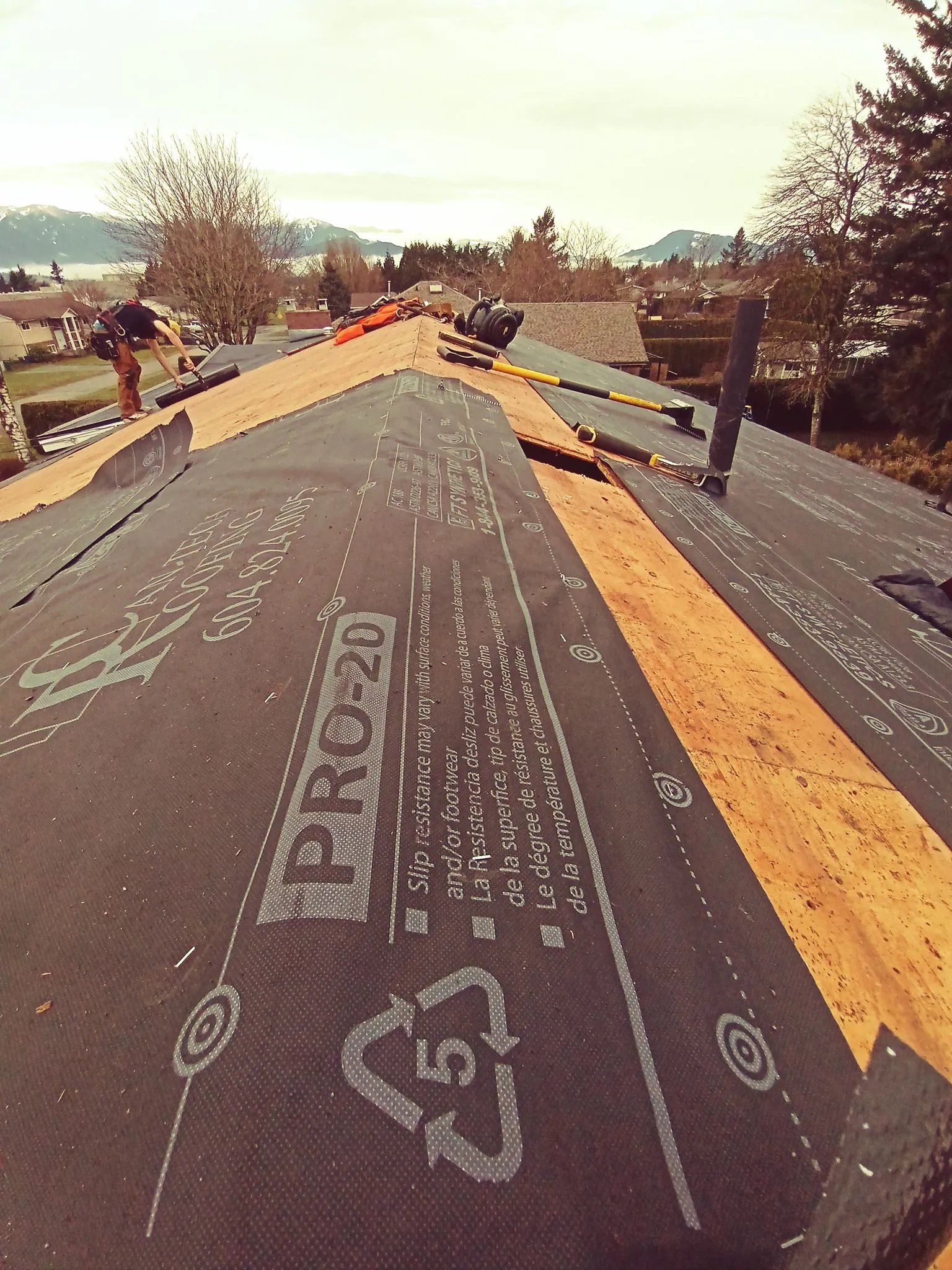
Number 15 and Number 30 felt paper (15 to 30 lbs per 100 sq ft) uses recycled paper or rag fibres saturated with asphalt. The fundamental problem is organic: those fibres absorb water. Once wet, felt swells, distorts, and eventually rots. Exposed to direct UV, felt breaks down in 6 to 12 weeks. Even under shingles, its functional lifespan is only 5 to 10 years — far shorter than the roofing above it.
Synthetic Underlayment: Polypropylene Engineering
Synthetic underlayment uses woven or spunbond polypropylene or polyethylene — polymers that are inherently waterproof, rot-proof, and UV-resistant. The performance differences are dramatic: 5 to 10x higher tear resistance, 6 to 12 months of UV exposure tolerance, 30+ year lifespan under roofing, and 50% less weight for easier handling.
At Fraser Roofing Ltd., we exclusively use synthetic underlayment on every project. The polymer science is simply superior, and the cost difference is minimal relative to total project value.
Ice and Water Shield: Self-Sealing Adhesive Technology
Ice and water shield is a three-layer membrane: polyethylene film on top, rubberized asphalt adhesive in the middle, and silicone-coated release paper on the bottom. The critical innovation is the self-sealing rubberized asphalt layer.
When a roofing nail penetrates the membrane, the viscoelastic rubberized asphalt flows around the nail shank under a combination of gravity, compression, and thermal activation. This creates a waterproof gasket around every penetration point. The process works better in warm weather — which is why professional installation timing matters in British Columbia. At eaves, valleys, and around roof penetrations where ice dams and wind-driven rain create the highest infiltration risk, this self-sealing technology provides critical secondary waterproofing.
Sealants and Adhesives: Choosing the Right Chemistry
Asphalt-Based Roofing Cement
Traditional roofing cement (asphalt plus mineral fillers plus solvents) cures by solvent evaporation. It is inexpensive and widely available, but its limitations are significant: UV radiation causes hardening and cracking within 5 to 10 years, it becomes brittle in cold weather and soft in heat, and it provides no structural flexibility. For permanent applications, it is increasingly obsolete.
Polyurethane Sealant: The Professional Standard
Polyurethane sealant is formed by the reaction of polyol with isocyanate, curing through exposure to atmospheric moisture. It bonds to metal, wood, masonry, and most roofing materials with excellent adhesion. Unlike asphalt cement, polyurethane remains flexible over its 20 to 30 year lifespan, accommodating thermal movement without cracking. It also resists UV degradation far better than asphalt-based products.
The Three Enemies of Every Roof in the Fraser Valley
Every roofing material in the Fraser Valley faces the same three degradation forces:
UV Radiation breaks chemical bonds. UV photons carry 3 to 4 electron-volts of energy — enough to crack the C-C bonds that hold asphalt polymers together. Granules, PVDF coatings, and aluminum oxide all serve as UV shields, but no protection is permanent. Every material has a UV degradation timeline.
Thermal Cycling creates mechanical stress. Materials expand when heated and contract when cooled. When different materials in a roofing assembly expand at different rates, the resulting shear stress produces fatigue cracks, loosened fasteners, and failed seals. The Fraser Valley's combination of hot summer days and cold winter nights produces aggressive thermal cycling.
Water attacks through multiple mechanisms. Hydrolysis breaks chemical bonds directly. Freeze-thaw cycles (water expanding 9% when frozen) mechanically widen cracks. Biological organisms — moss, algae, bacteria, and lichens — hold moisture against surfaces and produce acidic metabolic byproducts that accelerate chemical degradation.
Why Material Science Knowledge Matters for Your Roof
Understanding what your roof is made of at the molecular level is not academic trivia. It directly informs decisions about material selection, maintenance timing, and repair priorities. A homeowner who understands that granule loss accelerates UV degradation will inspect their shingles differently. A homeowner who understands galvanic protection will appreciate why proper fastener selection (matching metals) prevents premature corrosion at connection points.
Kory and Johnny Peters bring Red Seal Boilermaker material science expertise to every Fraser Roofing Ltd. project. After 500+ Fraser Valley roofs since 2026, they select materials based on chemistry, metallurgy, and polymer science — not marketing claims. That is what separates a roof that lasts from a roof that merely looks good on installation day.
Questions about roofing materials for your Fraser Valley home? Call (778) 860-4747 or email johnny@fraserroofing.ca
Need Expert Help With Your Roof?
Kory & Johnny have completed 500+ roofs across the Fraser Valley since 2026. Free inspections, honest estimates, no pressure.
(778) 860-4747Serving Hope, Agassiz, Chilliwack, Rosedale, Abbotsford & the entire Fraser Valley
Frequently Asked Questions
Why do asphalt shingles lose granules over time?
Asphalt shingle granules are bonded to the petroleum-based bitumen layer with ceramic coatings. Over time, UV radiation breaks C-C and C-H bonds in the asphalt binder, causing it to harden and lose elasticity. Thermal cycling (daily temperature swings of 10-45 degrees Celsius on Fraser Valley roofs) creates expansion and contraction stress that loosens granules from the increasingly brittle substrate. Once 30 percent or more of granules are lost, UV degradation accelerates exponentially and the shingle approaches end of life.
What makes Kynar 500 metal roofing paint superior to acrylic?
Kynar 500 uses polyvinylidene fluoride (PVDF) resin, which contains carbon-fluorine bonds — the strongest bonds in organic chemistry. These bonds resist UV photon energy far better than the carbon-hydrogen bonds in acrylic paint systems. In practice, Kynar 500 retains colour integrity for 30 to 40 years with minimal chalking, while acrylic typically fades within 10 to 15 years. For Fraser Valley homeowners investing in a 50-plus year metal roof, the 30 to 50 percent cost premium for Kynar 500 pays for itself many times over.
How does galvanized steel protect against corrosion in BC's wet climate?
Galvanized steel uses sacrificial zinc coating (typically G-90 specification at 0.90 oz per square foot per side). Zinc sits higher on the electrochemical series than iron, so it corrodes preferentially — forming a stable zinc oxide layer that shields the base steel. In the Fraser Valley's wet, mild climate, G-90 galvanization typically lasts 30 to 50 years before the zinc is consumed. This is why galvanized standing seam panels outlast uncoated steel by decades.
Why is synthetic underlayment better than traditional felt paper?
Traditional felt paper uses organic fibres (recycled paper or rags) saturated with asphalt. These fibres absorb water, swell, and eventually rot — giving felt a lifespan of only 5 to 10 years under shingles. Synthetic underlayment uses woven or spunbond polypropylene, a polymer that does not absorb water at all. It resists tearing at 5 to 10 times the tensile strength of felt, withstands UV exposure for 6 to 12 months (versus 6 to 12 weeks for felt), and lasts 30-plus years beneath your roofing.
How does ice and water shield self-seal around nail penetrations?
Ice and water shield uses a rubberized asphalt adhesive layer beneath a polyethylene film. When a roofing nail penetrates the membrane, the viscoelastic rubberized asphalt flows around the nail shank under gravity and thermal activation, forming a waterproof gasket. This self-sealing property is critical at eaves, valleys, and around penetrations where ice dams or wind-driven rain create the highest risk of water infiltration. The adhesive activates better in warm weather, which is why professional roofers in BC prefer to install it during mild conditions.