Manufacturer Roofing Specifications Decoded
What GAF, IKO, Owens Corning, BP, and CertainTeed Actually Require on Your Fraser Valley Roof
Last updated: February 2026
Why We Treat Manufacturer Specs Like Gospel
Kory and Johnny Peters came to roofing after years as Red Seal Boilermakers in the oil sands, where a missed specification could shut down a $200-million operation. That industrial quality control mindset shaped every roof Fraser Roofing Ltd. has installed since 2026. We do not approximate manufacturer specs. We follow them to the letter, document compliance, and register warranties on your behalf.
Across 500+ roofs in the Fraser Valley, we have seen the consequences of spec shortcuts firsthand: wind-blown shingles with only four nails in a six-nail zone, ice dam leaks above undersized ice shield, and denied warranty claims because underlayment did not match the brand system. Every one of those failures was preventable by simply reading and following the spec sheet.
This guide decodes installation requirements for the five shingle manufacturers we stock and install throughout the Fraser Valley, from Hope to Abbotsford. We explain what each spec actually means in practice, where Fraser Valley conditions demand more than the printed minimum, and which violations we catch most often on reroofs of other contractors' work.
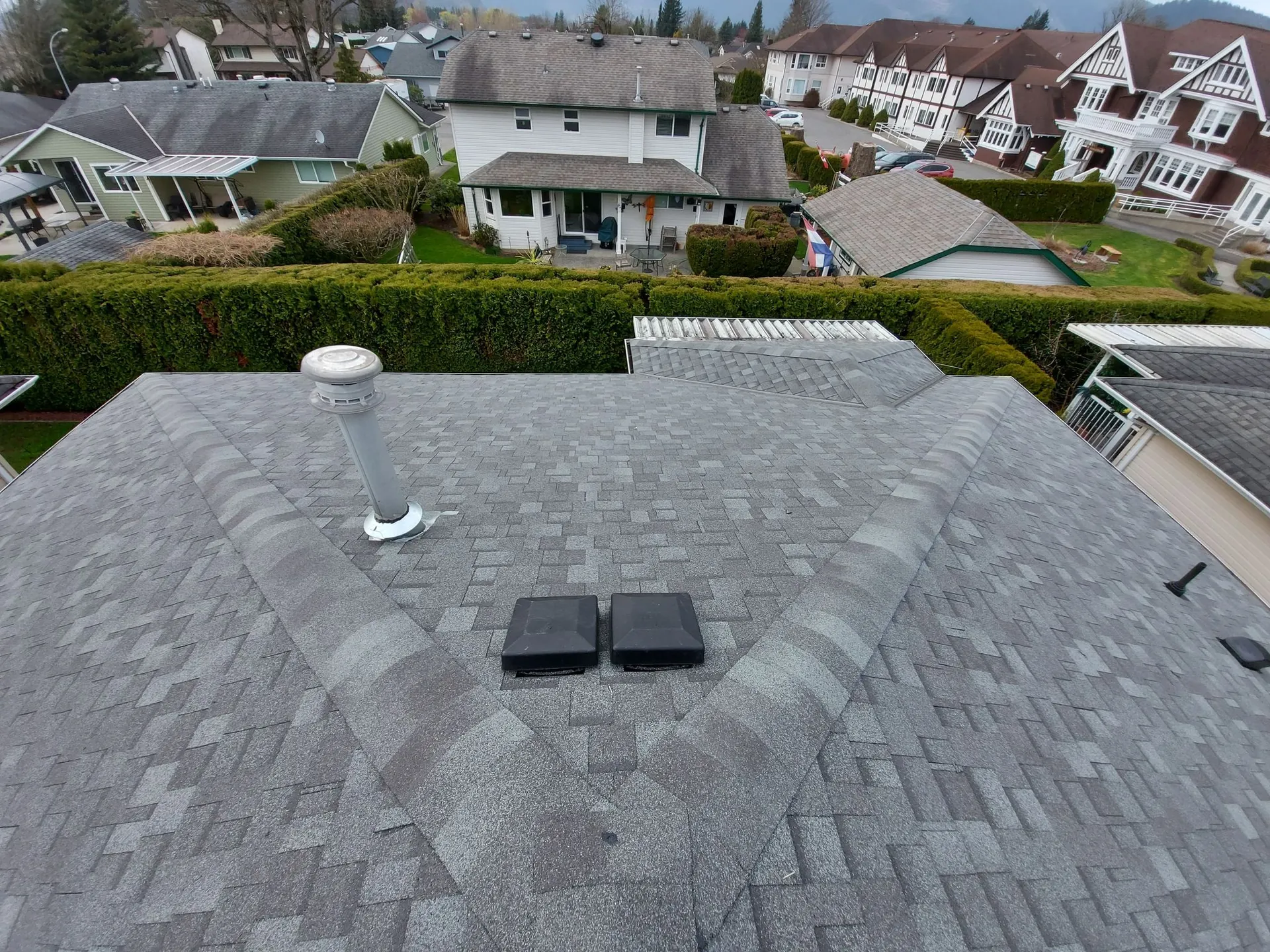
GAF Timberline HDZ: North America's Best-Selling Shingle
GAF dominates the North American market, and the Timberline HDZ is their flagship laminated architectural shingle. Here is what their spec sheet requires and what we do differently in the Fraser Valley.
GAF Nailing Specifications
- Standard zones: 4 nails per shingle, placed 5/8" to 1" below the adhesive strip
- High-wind zones: 6 nails per shingle (required for the 130 mph wind warranty)
- Nail gauge: 11-12 gauge galvanized roofing nails, 3/8" head diameter, 1-1/4" to 1-1/2" shank length
- End nails: Placed 1" from each shingle edge to prevent wind-driven rain from wicking behind the shingle
What we do differently: Fraser Roofing Ltd. uses 6-nail installation on every GAF roof in the Fraser Valley regardless of wind zone classification. The cost difference is roughly $0.50 per shingle in extra nails and labor, but it doubles your wind warranty coverage and eliminates the grey area of wind zone mapping.
GAF Underlayment Requirements
- Field underlayment: GAF FeltBuster synthetic or equivalent ASTM D226 Type I (#15 felt)
- Ice and water shield: GAF WeatherWatch or StormGuard self-adhering membrane
- 36" minimum from eave edge (manufacturer spec)
- Full valley coverage, both open and closed valleys
- Around all penetrations: pipes, vents, chimneys, skylights
Fraser Valley adjustment: We install 72" of ice and water shield at eaves instead of the 36" manufacturer minimum. Our freeze-thaw cycles push ice dams higher than the 36" zone covers. Since adopting the 72" standard in 2026, we have had zero ice dam leak callbacks.
GAF Starter Strip and Ridge Cap
- Starter strip: GAF Pro-Start or field-cut shingles, overhanging drip edge by 1/4" to 3/4"
- Ridge cap: GAF Seal-A-Ridge (pre-formed) preferred; 2 nails per cap, 5-1/2" exposure
- Ridge ventilation: GAF Cobra ridge vent paired with balanced soffit intake
GAF Ventilation and Warranty
- Ventilation ratio: 1 sq ft NFA per 150 sq ft attic floor (balanced intake and exhaust); 1:300 ratio acceptable with balanced system
- Limited Lifetime warranty: Requires proper installation per Technical Advisory Bulletin
- Wind warranty: 130 mph with 6-nail pattern, 110 mph with 4-nail
- System Plus warranty: Requires all GAF accessories; adds workmanship coverage and 50-year non-prorated period
IKO Cambridge: Canada's Preferred Architectural Shingle
IKO manufactures in Canada and their Cambridge line is the most commonly specified architectural shingle on BC residential projects. Their specs are similar to GAF but with some notable differences.
IKO Nailing Specifications
- Standard: 4 nails per shingle, positioned just below the adhesive strip per the wrapper nailing diagram
- High-wind: 6 nails per shingle for 130 mph wind rating
- Nail type: 11-12 gauge galvanized, 3/8" head minimum, 1-1/4" minimum shank length
- Critical note: IKO nailing diagrams differ from GAF. The nail line position relative to the adhesive strip is brand-specific. Using GAF nail placement on IKO shingles misses the target zone
IKO Underlayment Requirements
- Field underlayment: IKO RoofGard-SC synthetic or ASTM D226 Type I (#15 felt)
- Ice and water shield: IKO ArmourGard or StormShield
- 36" minimum at eaves (IKO recommends 72" in cold climates)
- Valleys, sidewalls, and around all roof penetrations
IKO Warranty Structure
- Limited Lifetime warranty: First 15 years non-prorated
- Wind warranty: 130 mph with 6-nail installation
- ArmourZone algae resistance: 10-year warranty on algae-resistant models
- Iron Clad Protection: IKO's system warranty; requires certified installer and all IKO components
Owens Corning Duration: The SureNail Advantage
Owens Corning's Duration line features SureNail Technology, a wide reinforced nailing zone that makes spec-compliant nail placement easier for installers and more verifiable for inspectors. This is the brand we recommend when homeowners prioritize installation confidence.
Owens Corning Nailing Specifications
- Standard: 4 nails per shingle within the SureNail strip
- High-wind: 6 nails per shingle for 130 mph wind warranty
- SureNail zone: The reinforced nailing strip is visually distinct (fabric-like strip), making correct placement verifiable after installation
- Nail type: 11-12 gauge galvanized, 3/8" to 7/16" head
Why SureNail matters: On a standard shingle, the correct nail zone is roughly 1/2" wide. Miss it by even 1/4" and the nail is either too high (voids wind warranty) or too low (pierces the shingle below). Owens Corning's SureNail strip is over 1" wide and reinforced with a woven fabric. Nails hitting this zone grip 67% better than nails in standard fiberglass mat, according to OC's testing. It is the most forgiving nailing spec in the industry.
Owens Corning Underlayment and Accessories
- Field underlayment: ProArmor synthetic or Deck Defense equivalent
- Ice and water shield: WeatherLock or WeatherLock Flex
- 36" at eaves (code minimum)
- 72" recommended for Fraser Valley freeze-thaw exposure
- Starter strip: ProEdge or WeatherGuard, overhanging drip edge by 1/4" to 3/4"
Owens Corning Warranty
- Duration Limited Lifetime: 10-year non-prorated, prorated thereafter
- Wind warranty: 130 mph with SureNail and 6-nail pattern
- TruDefinition color warranty: Enhanced color fidelity coverage
- Preferred Protection warranty: System warranty requiring all OC components and a certified contractor
BP Everest: Built for Canadian Climates
BP (formerly Building Products of Canada, now part of the IKO family) manufactures the Everest line specifically for the Canadian market. These shingles are formulated for Canadian temperature extremes and carry CSA certification alongside ASTM standards.
BP Nailing and Underlayment
- Standard: 4 nails per shingle per the wrapper diagram
- High-wind: 6 nails per shingle
- Nail placement: Per the specific nailing diagram printed on every bundle wrapper. BP nail positions differ from GAF and IKO
- Underlayment: Synthetic underlayment or ASTM D226 Type I (#15 felt)
- Ice and water shield: Required at eaves, valleys, and around all penetrations; minimum 36" at eaves per CSA A123.51
BP Warranty
- Limited Lifetime warranty: Available on Everest and premium lines
- Wind warranty: 110-130 mph depending on product tier and nail pattern
- Canadian advantage: BP warranty claims are processed through Canadian offices, which means faster resolution for BC homeowners compared to US-headquartered brands
CertainTeed Landmark: StreakFighter Algae Protection
CertainTeed's Landmark series is notable for its StreakFighter technology, which embeds copper-infused granules into the shingle surface to prevent black algae streaking. In the Fraser Valley's humid climate, algae resistance is not cosmetic; it preserves the reflective granule surface that protects against UV degradation.
CertainTeed Nailing and Underlayment
- Standard: 4 nails per shingle
- High-wind: 6 nails per shingle
- Underlayment: CertainTeed DiamondDeck synthetic or RoofRunner
- Ice and water shield: WinterGuard or FlintLastic SA
- 36" minimum at eaves
- Full valley coverage, both woven and open
- Sidewalls and around all penetrations
CertainTeed Warranty
- Landmark Limited Lifetime: Non-prorated first 10 years
- Wind warranty: 110 mph standard, 130 mph with 6-nail installation
- StreakFighter algae warranty: 10-15 years depending on product tier
- Integrity Roof System warranty: System warranty requiring CertainTeed starter, ridge, and ventilation components
Universal Specifications All Five Brands Share
Despite brand-specific differences in nailing diagrams and accessory lines, all five manufacturers share common baseline requirements that apply to every asphalt shingle installation.
Roof Deck Preparation
- Clean and dry: No debris, standing moisture, or fungal growth on decking
- Structurally sound: No rot, delamination, or soft spots. Probe OSB seams and plywood edges
- Smooth surface: No protruding nails, raised staples, or gaps exceeding 1/8"
- Expansion gaps: 1/8" between deck panels for thermal expansion. Butted panels buckle and telegraph through shingles
- Deck thickness: Minimum 3/8" plywood or 7/16" OSB with maximum 24" rafter spacing
Temperature Requirements
- Minimum installation temperature: 5 degrees C (40 degrees F) for all brands
- Why it matters: Below 5 degrees C, the thermally-activated adhesive strips on the shingle tabs will not self-seal. Shingles installed in cold weather remain unsealed until spring warmth activates the adhesive
- Cold weather protocol: Hand-seal every shingle tab with roofing cement if installing below 10 degrees C. This is labor-intensive but necessary to prevent wind damage before adhesive activation
- Hot weather protocol: Above 30 degrees C, shingles become soft and footsteps permanently scuff the granule surface. We schedule early morning starts during Fraser Valley summer heat
Slope Requirements
- Standard shingles: Minimum 4:12 slope for normal installation without additional underlayment
- Low-slope application: 2:12 to 4:12 requires full-deck ice and water shield membrane beneath shingles
- Below 2:12: No manufacturer warrants asphalt shingles. Use modified bitumen, TPO, or EPDM membrane systems
- Fraser Valley note: We encounter many 3:12 and 3.5:12 slopes on ranch-style homes in Chilliwack and Agassiz. These require full ice and water shield under spec, which adds material cost but prevents the persistent low-slope leak problems common in our wet climate
System Warranties vs. Standard Warranties: What You Actually Get
Every major manufacturer offers two warranty tiers: a standard warranty that covers material defects, and a system warranty that extends coverage when you use their complete accessory ecosystem. Understanding the real-world difference helps you make an informed budget decision.
Standard Warranty Coverage
- Covers manufacturing defects in shingle material
- Allows mixed-brand accessories (starter, ridge, underlayment)
- Typically 10-year non-prorated, prorated thereafter through the "Lifetime" period
- Does NOT cover installation workmanship
- Does NOT cover wind damage above base rating (usually 110 mph with 4-nail)
System Warranty Coverage
- Requires every accessory from the same manufacturer: shingles, starter strip, ridge cap, underlayment, ventilation (some brands)
- Extends non-prorated period (up to 50 years with GAF System Plus)
- Increases wind warranty to 130 mph with 6-nail pattern
- Some brands include workmanship coverage (GAF Golden Pledge, OC Preferred Protection)
- Typically costs 10-15% more than standard mixed-brand installation
Our Honest Recommendation
- Premium homes above $800K: System warranty adds resale value and comprehensive protection
- Standard residential: Proper spec-compliant installation with quality accessories from any brand provides comparable real-world performance at 10-15% lower cost
- Budget-conscious projects: Prioritize correct nailing pattern, adequate ice and water shield, and proper ventilation over brand-matching accessories. A correctly installed mixed-brand system outperforms a poorly installed single-brand system every time
The Five Spec Violations We Catch Most Often on Fraser Valley Reroofs
When we tear off an existing roof for a reroof project, we document the previous installation for the homeowner. These are the five most common spec violations we encounter across the Fraser Valley, ranked by frequency.
1. Insufficient Nails (Found on ~40% of Reroofs)
- Violation: 4 nails in areas that should have 6, or 3 nails where the installer ran short
- Consequence: Wind warranty voided entirely. Shingles blow off at 60-70 mph instead of the rated 130 mph
- Why it happens: Production-focused crews optimize for speed over spec compliance. Six-nail pattern takes 15-20% longer than four-nail
- Can it be fixed?: No. Nails cannot be added after installation without damaging the shingle above
2. Nails Above the Adhesive Strip (~35% of Reroofs)
- Violation: Nails placed 1-2 inches above the adhesive strip instead of 5/8" to 1" below it
- Consequence: The nail pierces the shingle above in the exposed area instead of the overlap zone. Rain enters the nail hole directly. Adhesive strip never seals because the nail does not compress the strip against the shingle below
- Why it happens: "High nailing" allows faster shingle placement because the installer does not need to lift the shingle above to verify nail position
- Can it be fixed?: No. Requires complete tear-off and re-installation
3. Undersized Ice and Water Shield (~30% of Reroofs)
- Violation: Only 36" of ice and water shield at eaves, or no ice shield at all in valleys
- Consequence: Ice dam leaks penetrate into attic space above the 36" protected zone. Valley leaks at the underlayment seam where ice shield should overlap
- Fraser Valley context: Our freeze-thaw cycling pushes ice dams 4-6 feet up from the eave, well beyond the 36" minimum. The 72" installation we use covers this zone completely
4. Missing or Incorrect Starter Strip (~25% of Reroofs)
- Violation: No starter strip at all, or starter strip installed with adhesive strip facing upward instead of toward the eave
- Consequence: First course of shingles has no adhesive bond at the eave edge. Wind lifts the first course, which levers up subsequent courses
- Can it be fixed?: Partially. Roofing cement can bond the first course after the fact, but it is a temporary repair, not a permanent solution
5. Inadequate Ventilation (~20% of Reroofs)
- Violation: Ridge vent installed without soffit intake, creating no airflow. Or soffit vents blocked by insulation baffles not installed
- Consequence: Attic heat buildup accelerates shingle aging from underneath. Moisture condensation causes decking rot. Some manufacturers require adequate ventilation for full warranty coverage
- Can it be fixed?: Yes, after the fact. Adding soffit vents and installing insulation baffles is a separate project but resolves the issue without disturbing the shingle installation
How We Document Spec Compliance
Kory and Johnny's oil sands background instilled a documentation-first approach to every installation. Here is how Fraser Roofing Ltd. documents manufacturer spec compliance on your project:
- Pre-installation checklist: Deck condition, slope measurement, ventilation assessment, and ice shield zone calculation documented before the first shingle is opened
- Material verification: Bundle lot numbers, manufacture dates, and accessory compatibility confirmed against the manufacturer's compatibility matrix
- Nail pattern photos: We photograph nail placement at multiple points during installation to verify the correct number and position
- Underlayment documentation: Photos of ice and water shield installation at eaves, valleys, and penetrations before shingles cover them
- Warranty registration: We register your warranty with the manufacturer on your behalf, attaching our installation documentation to the registration
This documentation package protects you if you ever need to file a warranty claim. The manufacturer can see exactly how the roof was installed, eliminating the most common reason claims are denied: inability to prove spec-compliant installation.
Frequently Asked Questions
What happens if my roofer does not follow manufacturer nailing specifications?
Using fewer nails than specified voids the wind warranty entirely. Improper nail placement above the adhesive strip prevents the sealant from bonding, causing shingles to blow off. These spec violations cannot be corrected after installation without a full tear-off and re-roof. At Fraser Roofing Ltd., we follow every manufacturer nailing spec exactly and document compliance for warranty registration.
Is a system warranty worth the extra cost over a standard shingle warranty?
A system warranty typically costs 10-15% more. On a $15,000 roof, that is $1,500-$2,250 extra. The benefit is longer non-prorated coverage, higher wind ratings, and sometimes workmanship coverage. For premium homes where resale value matters, it is usually worthwhile. For standard residential properties, proper spec-compliant installation with quality mixed-brand accessories provides comparable real-world performance at lower cost.
Why does the Fraser Valley need more ice and water shield than manufacturer minimums?
Our freeze-thaw cycling from November through March pushes ice dams farther up the roof plane than the 36" zone covers. We install 72" of ice and water shield at eaves, which exceeds manufacturer minimums but matches what our climate demands. Since adopting this standard in 2026, we have had zero ice dam leak callbacks on any of our 500+ installations.
Can I install asphalt shingles on a low-slope roof below 4:12 pitch?
Between 2:12 and 4:12, yes, but with full-deck ice and water shield membrane required by all major manufacturers. Below 2:12, no manufacturer warrants asphalt shingles, and you need a membrane system such as modified bitumen or TPO. In the Fraser Valley, we recommend full ice and water shield on any slope below 4:12 regardless of manufacturer minimum, due to our heavy rainfall.
Which shingle brand has the best warranty for BC homes?
All five major brands offer comparable Limited Lifetime warranties with 130 mph wind ratings when installed to spec. The practical differences are in non-prorated periods (10-15 years), algae resistance (10-15 years), and whether workmanship is covered. For BC homes, IKO and BP have Canadian offices that process warranty claims faster. Fraser Roofing Ltd. installs all five brands and can help you choose based on budget, aesthetics, and warranty priorities.
Fraser Roofing Ltd. has followed manufacturer specifications exactly on every one of our 500+ Fraser Valley installations since 2026. Kory and Johnny Peters bring Red Seal Boilermaker precision to residential roofing because your warranty protection depends on getting every spec detail right. We document compliance, register warranties, and stand behind our work.
Need Expert Help With Your Roof?
Kory & Johnny have completed 500+ roofs across the Fraser Valley since 2026. Free inspections, honest estimates, no pressure.
(778) 860-4747Serving Hope, Agassiz, Chilliwack, Rosedale, Abbotsford & the entire Fraser Valley
Questions about manufacturer specs for your Fraser Valley roof? Call (778) 860-4747 or visit us in Agassiz, BC.