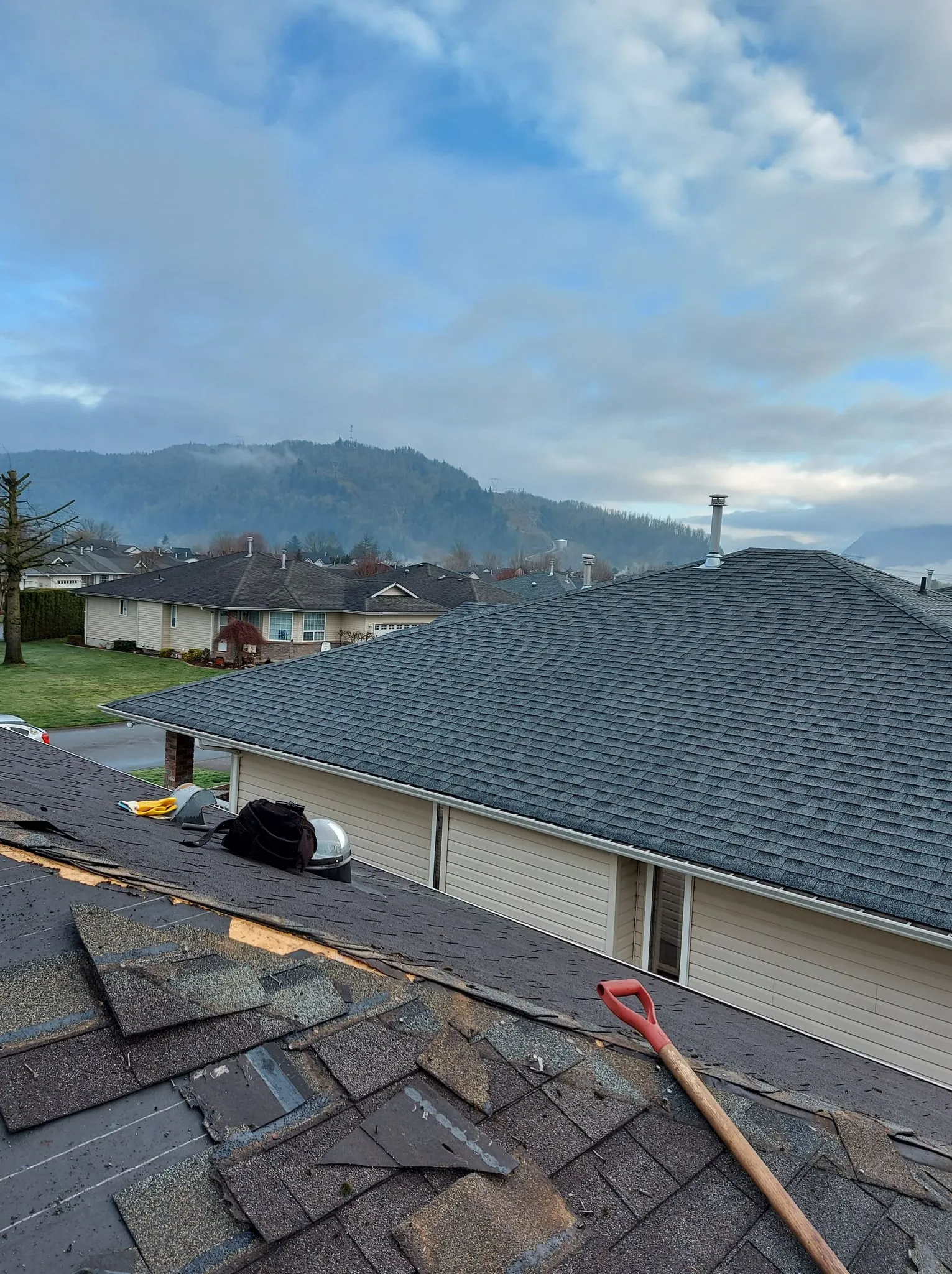
Last November, I got a call at 11 PM from a homeowner in Harrison. A cedar had come down across her ridge line during a Pacific storm, and water was already running down her living room wall. She was panicking. I talked her through exactly what to do over the phone while Johnny and I loaded the truck in Agassiz. We had a tarp over her roof by 1 AM. That conversation — the one where someone is scared and does not know what to do next — is the reason I wrote this guide. Last updated: February 2026.
Do not climb onto a damaged roof. Period. Kory and Johnny use harnesses, roof anchors, and tool lanyards on every single job — oil field safety culture drilled into us from years at Suncor and CNRL Kearl Lake. If we tie off for routine work, you should not be walking on wet, broken shingles in the dark. Everything in this guide can be done from ground level or inside your home.

The First Ten Minutes: Stop the Bleeding
Forget the roof for now. Your first job is protecting what is inside. When Johnny and I arrive at an emergency, the homeowner who already handled the interior damage control saves themselves thousands of dollars compared to the one who spent thirty minutes staring at the ceiling. Here is the order we walk people through on the phone:
- Kill the power to any room where water is near electrical outlets or fixtures — water and electricity is the only thing more dangerous than the leak itself
- Move electronics, documents, and irreplaceable items out of the drip zone first — furniture can dry, your grandmother's photo album cannot
- Grab every bucket, pot, and storage bin in the house and position them under active drips
- If water is pooling on a ceiling and the drywall is bulging, poke a small hole in the center with a screwdriver and let it drain into a bucket — this prevents the entire ceiling from collapsing
- Start recording video on your phone immediately — walk through every room and narrate what you see, including the date and time
Why Fraser Valley Emergencies Hit Different
I have worked roofs from Hope to Abbotsford for five years now, and our region creates emergency conditions that most roofing guides do not account for. The Coquihalla corridor funnels Pacific storms through the valley like a wind tunnel. River fog off the Fraser keeps everything wet for days after the rain stops. And when a November atmospheric river parks itself over Agassiz or Chilliwack, you are not getting a brief downpour — you are getting 48 to 72 hours of continuous rain. A small gap in your flashing that would be fine in the Okanagan becomes a river in our valley.
The Fraser Valley averages over 1,500mm of rain annually, with Hope and areas near Agassiz receiving even more due to mountain-effect precipitation. Our emergency protocols are built specifically for this level of sustained moisture exposure.
Ground-Level Tarp Work That Actually Holds
Most online guides tell you to tarp your roof. What they do not tell you is how to do it when you cannot safely get up there. After hundreds of emergency calls, here is what we have learned actually works for homeowners working alone from the ground:
- Buy the heaviest-duty blue poly tarp you can find — the thin ones from the dollar store will shred in Fraser Valley wind before morning
- If the damage is near an edge or eave, you can often drape the tarp from ground level using a long ladder leaned against the fascia as a guide rail — do not climb the ladder, use it as a tool to position the tarp
- Weight the tarp with sandbags, concrete blocks, or lengths of 2x4 lumber — never nail or screw through a tarp because you are just creating more holes in your roof
- Extend the tarp at least four feet past the damaged area in every direction — water travels sideways under shingles, especially in wind-driven rain
- If you cannot reach the roof at all, focus your effort inside the attic instead — trace the water back to its entry point and redirect it with plastic sheeting into buckets
The Attic Assessment: What to Look for Without Going on the Roof
Your attic tells you more about roof damage than the roof surface does. Grab a flashlight and look up. In daylight, you might see actual light coming through a breach. At night, look for wet spots on the underside of the roof deck, water running along rafters (water travels — the drip on your ceiling might be six feet from the actual hole), and dark staining that indicates older water damage you did not know about. Mark every wet spot with painter's tape so the repair crew can find entry points without guessing.
Mistakes I Have Seen Homeowners Make at 2 AM
Years of emergency calls across the Fraser Valley has shown me every mistake in the book. I am not judging anyone — panic makes people do things they would never do with a clear head. But these mistakes consistently turn a $2,000 repair into a $10,000 nightmare:
- Pulling debris off the roof that is actually plugging the hole — I watched a homeowner in Chilliwack remove a branch and turn a slow drip into a waterfall
- Climbing onto a wet roof at night — this is how people end up in the ER instead of dealing with their roof
- Using a heat gun or torch to dry wood near the leak — wet wood plus open flame in an enclosed attic is a fire waiting to happen
- Signing a contract with the first storm-chaser who knocks on your door — after every major storm, out-of-town contractors flood the valley offering fast fixes at inflated prices with no local accountability
- Waiting days to document damage because they are too overwhelmed — insurance adjusters need time-stamped evidence, and the sooner you document, the stronger your claim
After major storms, unlicensed contractors drive through Fraser Valley neighborhoods knocking on doors. They take deposits, do substandard work (or no work at all), and disappear. Always verify a contractor's WorkSafeBC coverage and ask for local references before signing anything.
Building Your Insurance Claim File From Minute One
Everything you do in the first 24 hours after roof damage sets the foundation for your insurance claim. Johnny handles a lot of our insurance coordination, and the single biggest factor in whether a claim goes smoothly is documentation quality. Here is what he tells every homeowner:
- Video walks the adjuster through the scene better than photos alone — narrate what you see, state the date and time on camera, and film from wide angles before zooming into specific damage
- Photograph the entire roof from the ground, not just the damaged section — adjusters want context for where the damage sits relative to the whole structure
- Save every receipt for tarps, buckets, and any emergency supplies you purchase — these temporary repair costs are typically reimbursable
- Write a timeline of events while your memory is fresh: when the storm started, when you noticed damage, what you did, who you called
- File your claim within 24 to 48 hours — most BC policies require prompt reporting, and delays can complicate or reduce coverage
When to Call Us Versus When to Wait
Not every roof situation is a true emergency. If a few shingles blew off but your roof deck is intact and there is no active water entry, that is an urgent repair but not an emergency — you can wait for a scheduled appointment. But if water is actively entering your home, if structural members are visibly compromised, or if a tree has punctured through your roof, that is when you call (778) 860-4747 and ask about Priority Dispatch. The $500 deposit is fully refundable and credited toward the final repair cost. It moves you to the front of our response queue, and because we are based in Chilliwack, we can reach anywhere from Hope to Abbotsford quickly.
Save our number in your phone now: (778) 860-4747. When water is running down your wall at midnight during a November storm, you do not want to be searching for a roofer on Google. Fraser Roofing Ltd. — Kory and Johnny Peters, based in Chilliwack, serving the entire Fraser Valley.
The Oil Field Discipline Behind Our Emergency Response
Before Johnny and I started Fraser Roofing Ltd. in 2026, we were both Red Seal Journeyman Boilermakers in the Alberta oil sands — Suncor, Syncrude, MEG Energy, CNRL Kearl Lake. In the oil fields, emergency response is not optional. You train for it constantly. Every tool gets tied off. Every person gets harnessed. Every procedure has a checklist. We brought that exact discipline to roofing. When we show up to an emergency at your home, we are not winging it — we run the same systematic assessment process whether it is a Harrison cabin at 1 AM or an Abbotsford strata complex at noon. That consistency is why our emergency repairs hold and why insurance adjusters trust our reports.