Last updated: February 2026
I am going to be straight with you. My brother Johnny and I are Red Seal Boilermakers who spent years in the Alberta oil sands before founding Fraser Roofing Ltd. here in Agassiz. We have completed over 500 roofs across the Fraser Valley. And here is something most roofing companies will never tell you: some roof repairs are genuinely fine to do yourself.
The problem is knowing the line. Cross it, and you are looking at voided warranties, hidden water damage, or a trip to the hospital. In the Fraser Valley — where it rains 200-plus days a year and moss grows on everything — that line is different than it would be in, say, the Okanagan or Ontario. This guide draws on everything we have learned from our 500-plus roofs to give you an honest framework for deciding when to grab your toolbelt and when to call us.
Why the Fraser Valley Changes the DIY Equation
I grew up in this valley. Johnny and I know what the weather does to a roof here, and it is relentless. Agassiz gets roughly 1,600 mm of rain a year. Hope gets even more. Chilliwack, Abbotsford, Harrison, Mission — the entire corridor from the Cascades to the coast is a moisture machine. That matters for DIY because mistakes that might take two years to cause damage in Alberta cause problems in two months here. A shingle you did not seat properly, a dab of caulk where proper flashing was needed, a nail driven in the wrong spot — the rain finds every gap.
In the Fraser Valley, a small roofing mistake lets moisture into the deck within weeks, not years. Our constant rain is unforgiving. If you are unsure about a repair, the safest move is to call for a free assessment before water turns a $300 fix into a $5,000 problem.
Repairs You Can Safely Do Yourself
We genuinely respect handy homeowners. Johnny and I come from a family where you fixed what you could and called for help when you needed it — our dad taught us that. Here is what you can handle on your own with basic tools and reasonable caution.
- Gutter cleaning from a stable ladder — do this every spring and fall at minimum, more if you have heavy tree cover like we see in Harrison and Hope
- Applying zinc-strip moss treatment from ground level with a garden sprayer — our valley grows moss like nowhere else, and catching it early saves your shingles
- Replacing a single cracked or lifted shingle on a low-pitch roof (4:12 or less) — use matching shingles, a flat bar, and roofing nails, then seal the nail heads
- Sealing minor flashing gaps with quality roofing cement — emphasis on minor, if the flashing itself is damaged or pulled away, that is professional territory
- Installing snap-on gutter guards on standard 5-inch gutters — these reduce maintenance and most Fraser Valley homeowners benefit from them
Always work with a buddy, wear non-slip shoes, and never climb on a wet roof. In the Fraser Valley, surfaces stay slick far longer than you expect. If there is any moss on the shingles, treat it as if you are walking on ice.
Repairs That Demand a Professional
This is where our oil field training changed how we think about roofing. In the oil sands, you never improvise on safety. Everything is tied off, every procedure has a protocol, and if you are not certified for a task, you do not touch it. Johnny and I brought that exact discipline to roofing, and here is the work that should only be done by a trained, insured crew.
- Any work on slopes steeper than 6:12 — this includes most two-story homes in Chilliwack and Abbotsford subdivisions, and fall arrest systems are not optional
- Flashing repairs around chimneys, skylights, dormers, and wall transitions — improper flashing is the number one cause of hidden leaks we see across the valley
- Multi-shingle damage from windstorms — if more than three or four shingles are compromised, the underlying deck needs inspection before you cover anything up
- Any structural sagging, soft spots, or bouncy areas on the roof deck — this signals rot or failed sheathing and requires assessment of how far the damage extends
- Work above 10 feet or requiring scaffolding — WorkSafeBC has strict rules about this, and homeowner insurance typically does not cover DIY falls
- Ice dam damage or persistent leaks that keep coming back — these always have an underlying cause that patching will not solve
Falls from residential roofs cause over 150 deaths in North America every year and thousands of serious injuries. Professional roofers use harnesses, anchors, toe boards, and roof brackets for a reason. No repair is worth a broken back. We know this viscerally — safety is not a suggestion in our crew, it is a rule inherited from oil field culture where one mistake could kill you.
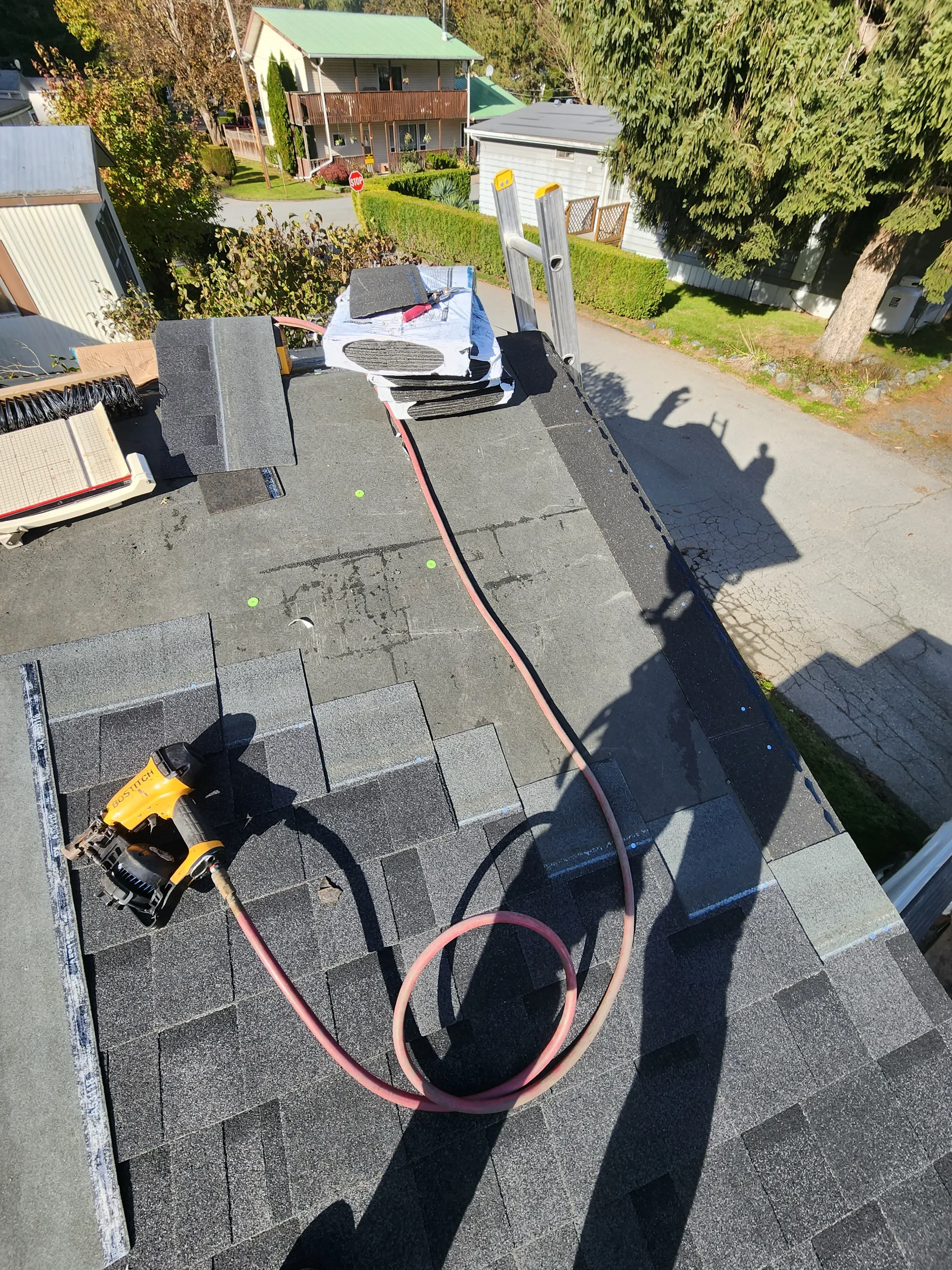
The Hidden Cost of a Bad DIY Repair
Here is the part that keeps me up at night. At least once a month, Johnny and I get called to a home where a well-meaning homeowner tried a roof repair and made things worse. I am not saying this to scare you into calling us — I am saying it because I have seen the aftermath too many times.
A homeowner in Chilliwack tarped over storm damage last winter and thought they sealed it well. Three months later, we pulled back that tarp and found the entire section of roof deck had rotted through. The moisture had been trapped between the tarp and the deck, accelerating the damage. What would have been a $1,200 repair turned into $6,500 worth of deck replacement and re-roofing.

- Voided manufacturer warranties — most shingle manufacturers require professional installation and will deny claims if they find DIY work
- Hidden moisture migration — you fix what you can see, but water travels along rafters and sheathing before dripping where you finally notice it
- Mold and attic contamination — in our humid climate, trapped moisture breeds mold within weeks, and remediation costs $3,000 to $10,000
- Compounding damage — a patch that seems fine today can fail silently, and every storm pushes more water into the structure
- Insurance claim denial — your homeowner insurance may not cover damage resulting from unlicensed repair work
The math is simple: a bad DIY repair in BC typically costs $2,000 to $8,000 to undo and redo properly. That is two to five times what the professional repair would have cost. We have seen it enough times that we built a free photo assessment into our process — text or email us a picture and we will tell you honestly whether it is something you can handle or something you should leave to us.
The Safety Line We Draw on Every Job
Johnny and I almost quit on our first day of roofing. I wrote about this in our story — we were terrified, the pitch was steep, the wind was blowing, and neither of us had proper fall protection. We came from the oil sands where everything is tied off, every procedure follows a written protocol. That first roof felt like lawless chaos in comparison.
We decided right then that if we were going to do this, we were going to do it the oil field way. Every person on our crew wears a harness. Every job has anchor points. We use roof brackets and toe boards on steep pitches. We carry fall arrest kits in every truck. This is not a marketing gimmick — it is how we were trained to work, and it is why we have never had a fall-related injury.
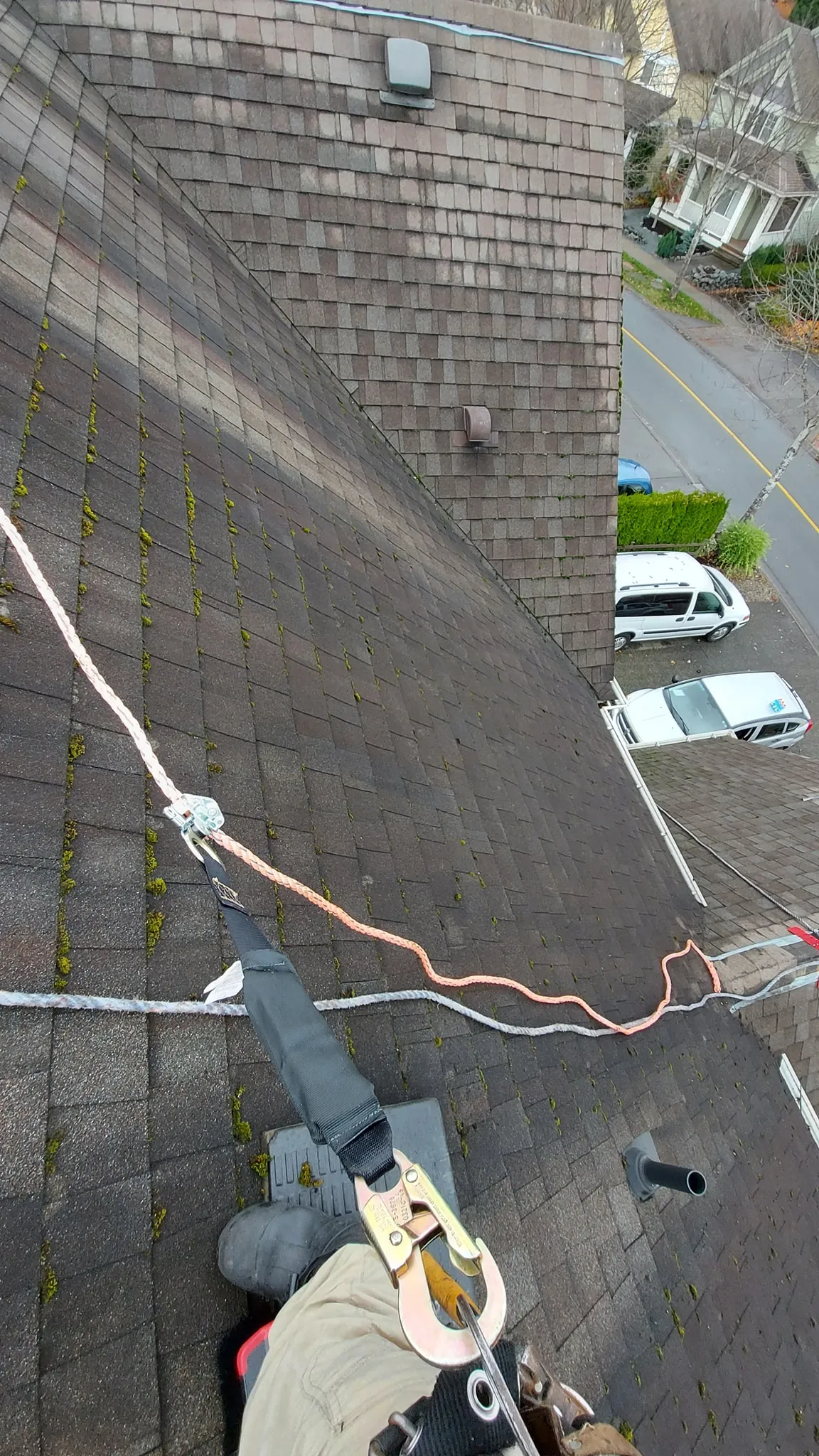
When I see a homeowner on a wet Fraser Valley roof in running shoes with no harness, it genuinely scares me. This valley is beautiful but it is treacherous for roof work. The moss, the rain, the morning dew that never fully dries — I have seen experienced roofers slip on surfaces that looked dry.
How to Decide: A Simple Framework
After 500-plus roofs, here is the decision tree Johnny and I would use if we were homeowners looking at our own roof.
- Can you reach the work area safely from a stable ladder without stepping onto the roof? If yes, it might be DIY-appropriate.
- Is the repair cosmetic (one shingle, a gutter bracket) or structural (multiple shingles, flashing, deck damage)? Cosmetic can be DIY. Structural needs a pro.
- Will the repair be covered by existing warranties? If yes, verify that DIY work will not void them before you start.
- Is the roof wet, mossy, or steep? If any of these are true, stay off it. Period.
- Can you see the full extent of the damage from ground level or the attic? If not, you need someone up there with proper safety gear to assess it first.
At Fraser Roofing Ltd., we offer completely free inspections and photo assessments across the Fraser Valley — from Hope to Abbotsford and everywhere in between. There is no sales pressure. We would rather tell you a repair is DIY-safe than upsell you on work you do not need. Call us at (778) 860-4747 or send a photo to johnny@fraserroofing.ca.
What to Look for in a Professional Roofer
If you decide the job needs a pro, here is what Johnny and I would look for if we were hiring someone — the same standards we hold ourselves to.
- Valid WorkSafeBC coverage — ask for the clearance letter, not just their word
- Comprehensive liability insurance — minimum $2 million, and verify it is current
- Manufacturer certifications for the products they install — this protects your warranty
- Verifiable local references from Fraser Valley homeowners — not stock reviews from a template
- A written scope of work before any money changes hands — if they will not put it in writing, walk away
- They stay until the job is watertight, not until the clock runs out — that is our rule, and it should be every roofer's rule
Johnny and I are not the cheapest roofers in the valley and we never will be. But we are the ones who show up with harnesses, stay until it is right, and answer the phone six months later if you have a question. We have built Fraser Roofing Ltd. on that promise since 2026, and we plan to keep building on it.
Not sure where to start? Send us a photo of the area that concerns you. We will respond within 24 hours with an honest assessment — if it is something you can handle yourself, we will tell you exactly how. No charge, no obligation. That is just how we work at Fraser Roofing Ltd.. Reach us at (778) 860-4747.