Last updated: February 2026
Nobody calls a roofer about their gutters until something has already gone wrong. That is the truth. In running Fraser Roofing Ltd. out of Agassiz, my brother Kory and I have pulled apart hundreds of gutter systems across the Fraser Valley. And every single time we find the same thing: a gutter problem that started small, got ignored, and turned into a big expensive mess.
I am Johnny Peters, and I want to talk about gutters. Not the exciting part of roofing. Not the part that makes for good photos. But after working on 500 plus roofs from Hope to Abbotsford, I can tell you this: more homes in the Fraser Valley are damaged by bad gutters than by bad shingles. And it is not even close.
The Fraser Valley Is a Gutter Stress Test
Here is the thing most people do not realize about where we live. Agassiz gets over 1,500mm of rain per year. Harrison is close to the same. Even Chilliwack and Abbotsford, which feel drier, still get well over 1,000mm. For context, Toronto gets about 830mm. We get nearly double that in some parts of the valley.
All of that water lands on your roof. Every drop. And your gutter system is the only thing standing between that water and your foundation, your siding, your fascia, and your crawlspace. When your gutters are working right, you do not even think about them. When they fail, the damage happens fast and it happens everywhere.
During a typical November atmospheric river event, Agassiz can receive 50mm or more of rain in a single day. That is 50 litres of water per square metre of roof. On a 2,000 square foot roof, that is over 9,000 litres of water your gutters need to handle in 24 hours. If they cannot, the water goes somewhere you do not want it.
What We Actually See When Gutters Fail
Kory and I grew up in the trades. We were Red Seal Boilermakers up in the Alberta oil sands before we started roofing. So when we look at a gutter system, we look at it like a piping system. There is flow, there is capacity, and there is gravity. When any of those three things are off, you get failures. Here is what we find on nearly every call.
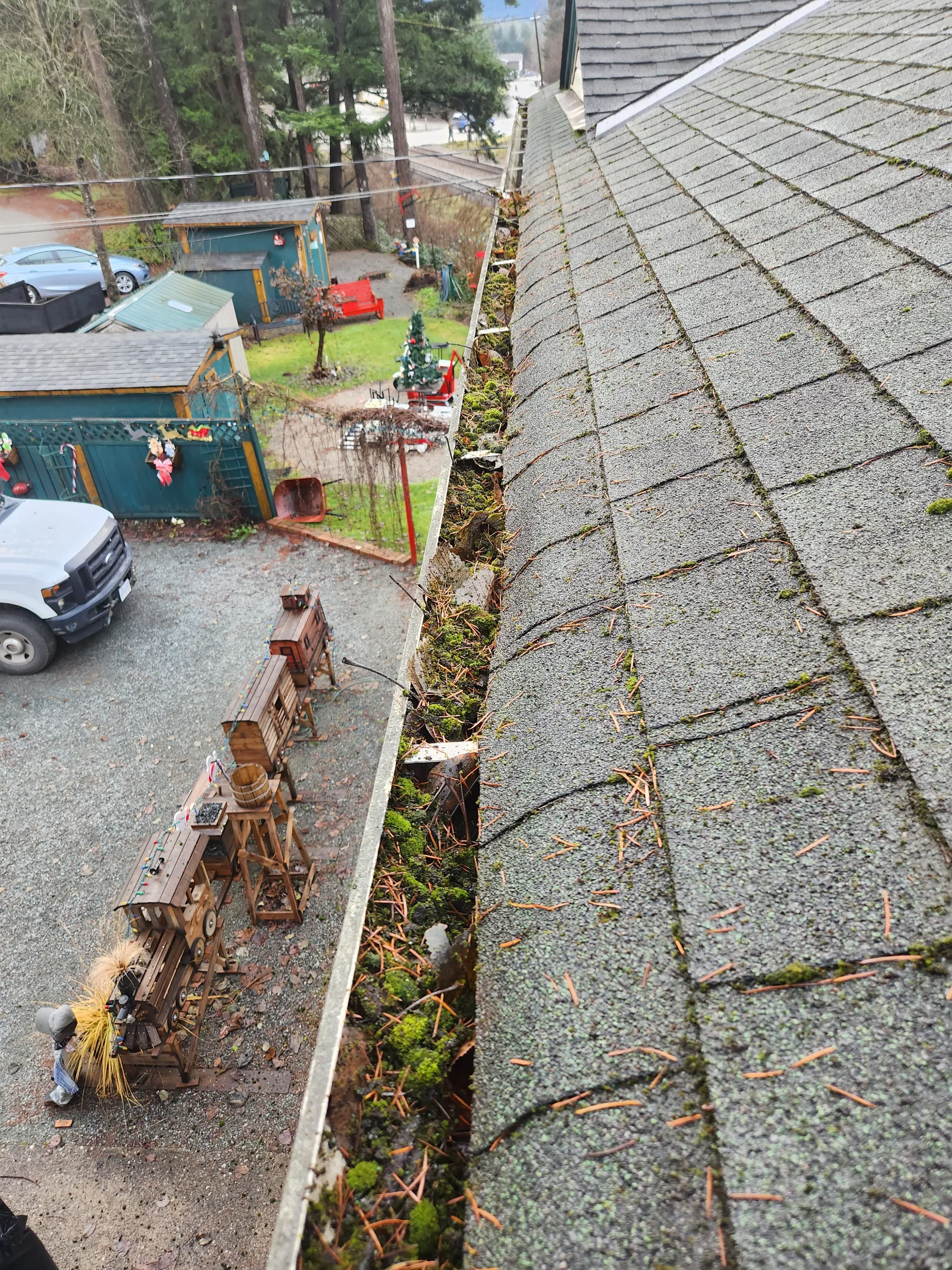
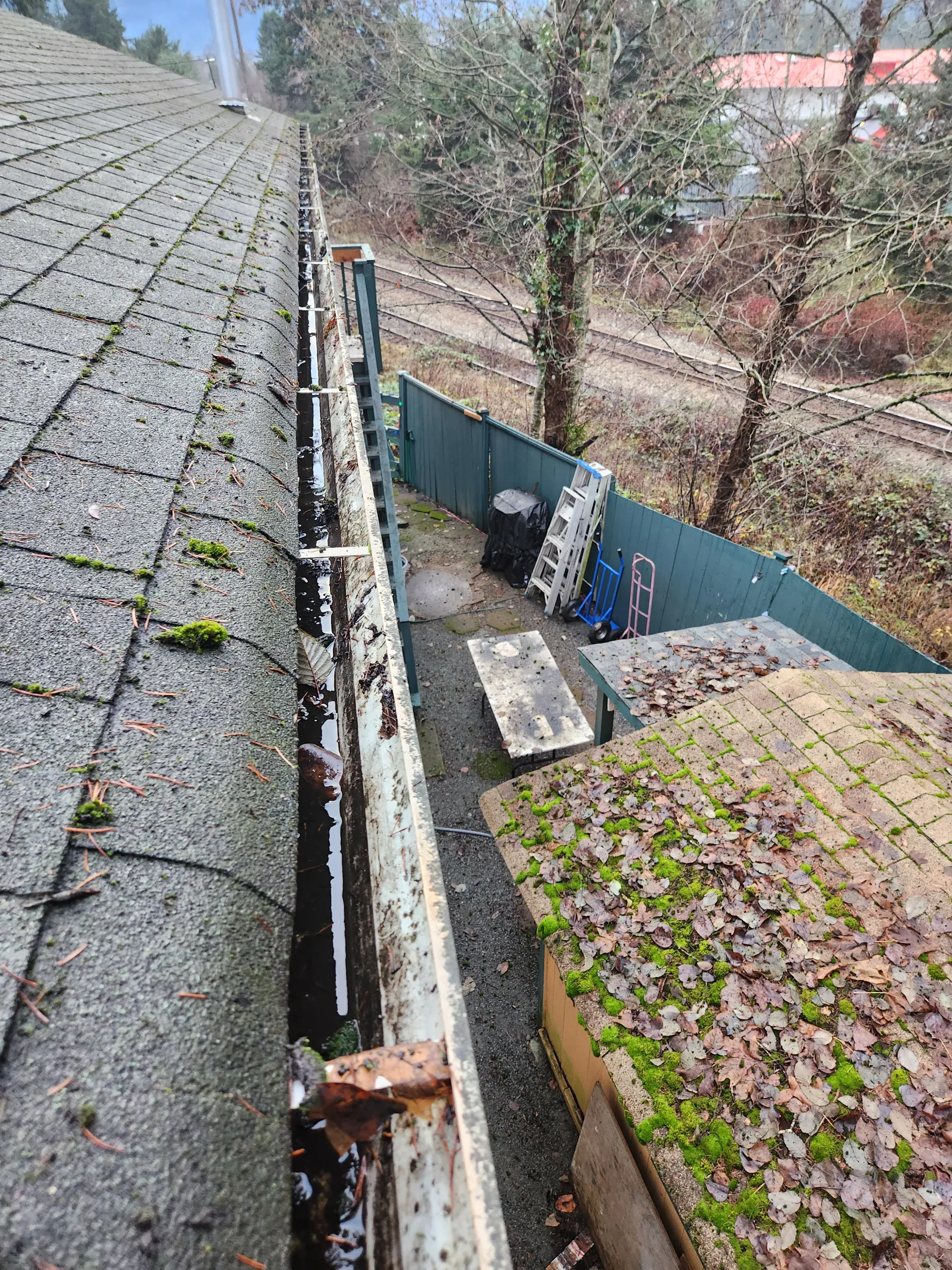
- Packed gutters: Cedar needles, cottonwood fluff, maple leaves, and moss compress into a solid plug. Water backs up, overflows the front edge, and pours down your siding. In the Fraser Valley with our tree canopy, this happens fast. We have seen gutters pack solid within six weeks of a cleaning.
- Sagging runs: Gutters are supposed to slope toward the downspouts at about a quarter inch per ten feet. When hangers rust out or pull loose from wet fascia, sections sag. Water pools in the low spots, gets heavy, and the sag gets worse. Eventually the gutter pulls away from the house entirely.
- Undersized systems: A lot of Fraser Valley homes were built with standard 4-inch or 5-inch gutters. Those are fine for a drier climate. Out here, they overflow during any serious rain event. We see this constantly in older Chilliwack and Abbotsford neighbourhoods.
- Rotted fascia behind the gutter: This is the one that scares people. Water gets behind the gutter, soaks the fascia board, and the wood rots. You cannot see it because the gutter is covering it. By the time the gutter starts pulling away, the fascia is gone. Now you are not just replacing gutters, you are replacing structural wood.
- Foundation damage from overflow: Water dumping next to your foundation saturates the soil. The clay soils we have in much of the Fraser Valley expand when wet. That expansion pushes against your foundation walls. Over a few seasons, you get cracks. Over a few years, you get serious structural issues.
A Story From the Field
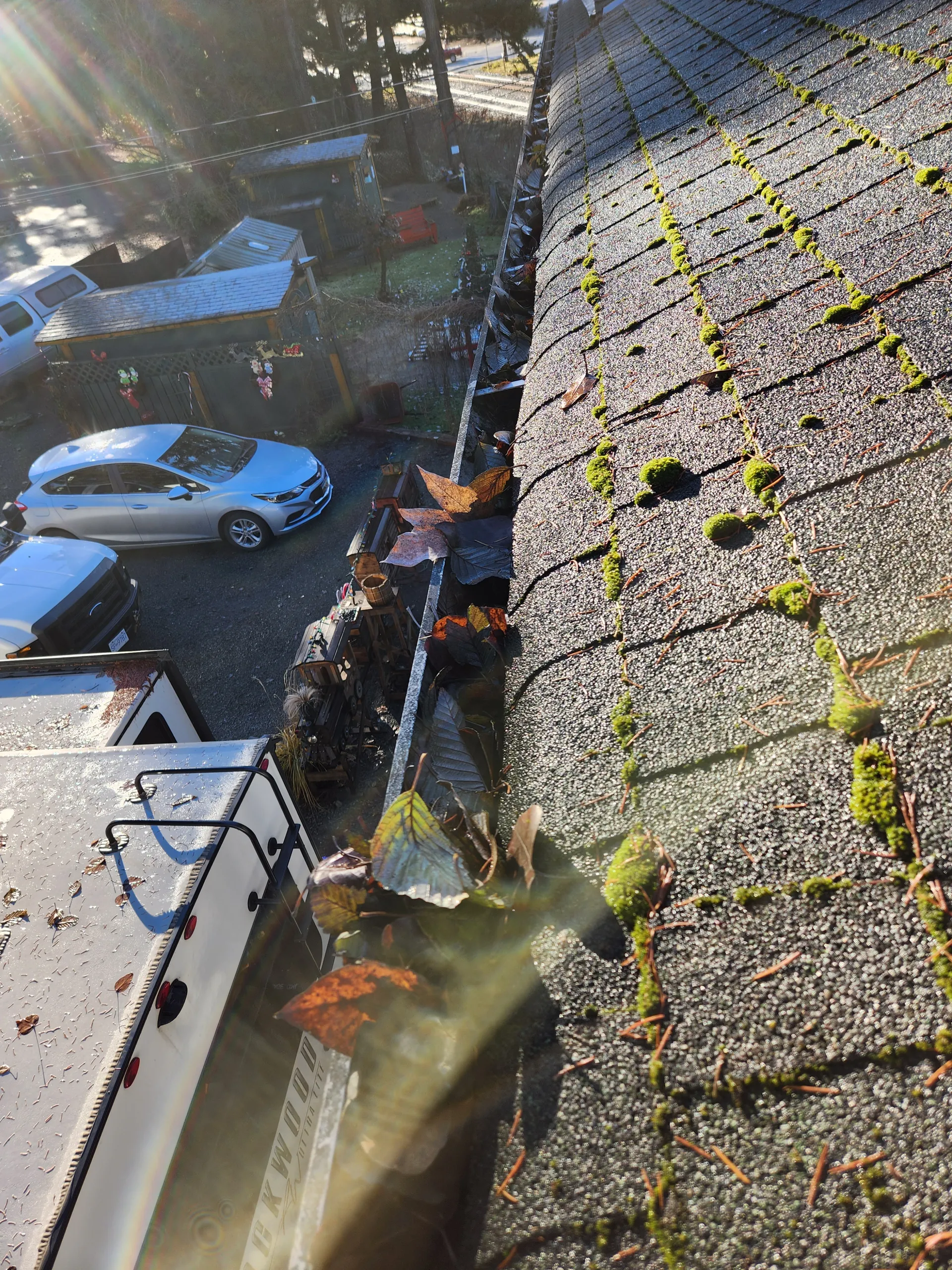
Last fall we got called out to a place in Harrison. The homeowner said they had a roof leak. We got up there and the shingles were fine. The underlayment was fine. The problem was the gutters. They had not been cleaned in what looked like three or four years. The entire system was packed with decomposed leaves and cedar debris. It had basically turned into a long, narrow planter box bolted to the side of the house.
Water was backing up behind the gutter, running down the fascia, and getting into the soffit. From inside the house, it looked exactly like a roof leak. The homeowner had been quoted thousands for roof repair by another company. We cleaned the gutters, replaced two rotted fascia sections, and reattached the gutter with new hangers. Total cost was a fraction of what the roof repair quote had been.
Kory always says the same thing on these calls: "Your roof is fine. Your gutters are trying to kill your house." It sounds dramatic but it is true more often than you would think. A solid roof with bad gutters will cause more damage than a mediocre roof with great gutters.
What Size Gutters the Fraser Valley Actually Needs
This is where our boilermaker background comes in handy. We think about water flow and pipe sizing. Here is what we recommend after five years of seeing what works and what does not in our specific climate.
- 6-inch K-style gutters minimum for most Fraser Valley homes. Standard 5-inch is marginal. During heavy rain, 5-inch gutters will overflow on any roof run longer than about 35 feet.
- 3x4 inch downspouts instead of the standard 2x3. Bigger downspouts move more water faster. This matters when you are getting 50mm of rain in a day.
- One downspout for every 600 square feet of roof area. The standard recommendation is every 800 square feet, but that assumes average rainfall. The Fraser Valley is not average.
- Extensions or buried drains that move water at least 6 feet away from the foundation. Dumping water right at the base of your house defeats the purpose of having gutters at all.
- Seamless aluminum gutters wherever possible. Every seam is a potential leak point. In our climate, seams corrode and fail faster than in drier areas.
Gutter Guards: What Works Here and What Does Not
We get asked about gutter guards on almost every job. Here is our honest take after installing and maintaining every type available.
- Micro-mesh guards: These are our top recommendation for the Fraser Valley. They handle heavy rain volume while blocking even fine debris like fir needles and cottonwood fluff. They still need an annual inspection but cleaning goes from an hour to ten minutes.
- Solid-top reverse-curve guards: These look great in marketing materials but we have seen them fail repeatedly in our climate. During heavy rain, water sheets right past the curved opening. They work fine in moderate rainfall. We do not get moderate rainfall.
- Foam inserts: Do not bother. They trap moisture, promote moss growth, and degrade within two to three years in our wet climate. We have pulled out dozens of these.
- Screen guards: Better than nothing but the mesh openings are usually too large to stop fir needles. They also tend to collect debris on top, which you still need to clean off.
Even with the best gutter guards, we recommend a visual inspection once a year. Get up on a ladder during a rainstorm and watch the water flow. If it is going where it should, you are good. If it is not, call us at (778) 860-4747 and we will take a look. Free inspections, always.
The Maintenance Schedule That Actually Works Here
Forget the generic advice you read online about cleaning gutters twice a year. That schedule was written for places that do not get Fraser Valley rain. Here is the schedule we recommend to our customers based on what actually works.
- Late April or early May: Clean out winter debris and check for any storm damage. This is also when cottonwood starts releasing fluff, so get ahead of it.
- Mid-October to early November: The big one. Most deciduous trees have dropped their leaves by now. Clean everything out before the heavy rain season hits.
- Late January or February: Check for ice damage, clear any debris that accumulated over the holidays, and make sure everything is flowing before the late-winter atmospheric rivers.
- After any major storm: Walk around the house and look up. If you see debris hanging over the gutter edge or water staining on the siding, something needs attention.
When to Call a Professional
Some gutter work is fine to do yourself if you are comfortable on a ladder. But some situations need a roofer. Here is where we draw the line.
- Two-storey or higher homes: The ladder work gets dangerous. We tie off on every job. It is not worth the risk.
- Sagging or pulling away from the house: This usually means fascia damage underneath. You need someone who can assess the wood and replace it properly before reattaching the gutter.
- Persistent overflow during rain: This could be a sizing issue, a slope issue, or a blockage deeper in the system. We diagnose the actual problem rather than just cleaning and hoping.
- Ice dams forming at the gutter line: This is a ventilation and insulation problem as much as a gutter problem. We look at the whole system.
- Visible rust or corrosion: Gutters in the Fraser Valley deal with constant moisture. When the protective coating fails, they deteriorate fast. Better to replace a section than wait for it to fail completely during a storm.
The Bottom Line From Two Roofers Who Have Seen It All
Kory and I did not start Fraser Roofing Ltd. in 2026 because we love gutters. We started it because we love building things that protect people. And gutters, boring as they are, protect more than most homeowners realize. Your foundation. Your siding. Your fascia. Your crawlspace. Your landscaping. All of it depends on water going where it is supposed to go.
In the Fraser Valley, that matters more than almost anywhere else in Canada. We get the rain. We get the trees. We get the clay soils that punish you for every drop of water that ends up in the wrong place. Take care of your gutters and they will take care of your house.
If you are not sure about the state of your gutter system, give us a call at (778) 860-4747. We will come out and take a look. Free inspection. No pressure. We serve every community from Hope to Abbotsford, including Agassiz, Harrison, Chilliwack, Rosedale, Mission, and everywhere in between. We are just two brothers who would rather fix a small gutter problem now than watch it turn into a big structural problem later.