I will be honest — Abbotsford was not on our radar when Johnny and I first started Fraser Roofing Ltd. out of Agassiz in 2026. We figured we would stick to the east end of the valley. Hope, Harrison, maybe Chilliwack. But word travels in the Fraser Valley, and by our second year a homeowner on Clearbrook Road called because his neighbour in Chilliwack told him about us. We have been driving Highway 1 west to Abbotsford every week since.
What We Have Learned About Abbotsford Roofs
Abbotsford is not one city — it is three or four stitched together. You have the dense strata developments off South Fraser Way, the older established neighbourhoods around Mill Lake, the sprawling acreages on Sumas Prairie, and the newer subdivisions climbing the hillside toward McKee Peak. Every one of those zones has different roofing challenges, and after 500-plus roofs across the Fraser Valley, we have worked in all of them.
The thing that surprised us most about Abbotsford versus our home base in Agassiz? The heat. Agassiz gets hammered with rain. Abbotsford gets rain too — around 1,500mm annually — but the summer heat is more intense. Properties sitting in full sun without proper ventilation cook their shingles from below. We have torn off 15-year-old roofs in Abbotsford that should have lasted 25 because the attic was basically an oven.
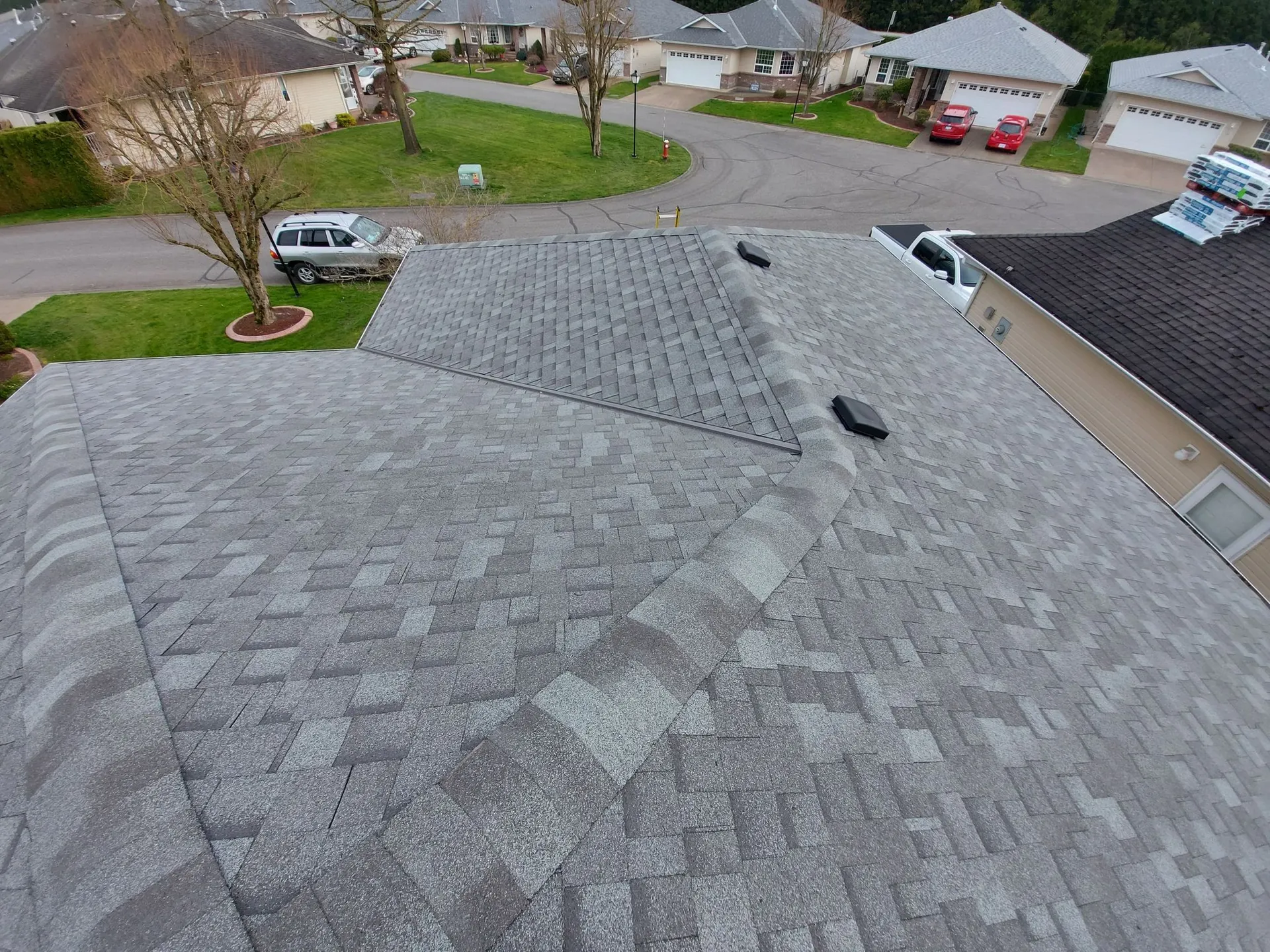
Strata Townhomes: The Coordination Challenge
Roughly a third of our Abbotsford work is strata. Townhome complexes, row houses, duplexes with shared rooflines. The roofing itself is not harder — it is the coordination that separates professionals from amateurs. You cannot just show up and start tearing shingles off a unit that shares a ridge with three neighbours. Strata councils have bylaws about materials, colours, timing, and sometimes even which direction you can park your truck.
- We attend strata council meetings to present roofing plans before any work begins
- We match materials exactly to existing rooflines so the finished product looks uniform
- We coordinate with neighbouring units to minimize disruption — nobody wants a crew on their shared wall at 7 AM
- Full WorkSafeBC coverage and liability insurance, which every strata council requires
- We provide detailed written reports to strata property managers after completion
If your strata council is considering a building-wide re-roof, call us at (778) 860-4747. We have done multi-phase strata projects in Abbotsford where we re-roof an entire complex building by building, keeping costs predictable for the strata fund.
Agricultural Properties: Metal Roofing Country
Sumas Prairie is berry country. Blueberries, raspberries, cranberries — and every one of those farms has barns, processing sheds, equipment shelters, and a farmhouse that all need roofs. Johnny and I come from an industrial background. Red Seal Boilermakers. We welded pressure vessels in the Alberta oil sands before we picked up roofing. That industrial mindset is exactly what agricultural properties need.
For outbuildings and barns, standing seam metal is the only answer that makes sense. It sheds water instantly, handles the heat that builds up inside a barn, resists the chemicals and fertilizers that float around agricultural operations, and it lasts 40 to 60 years. We have roofed barns on Sumas Prairie where the old roofing had corroded from ammonia exposure — something you do not see in residential work. Our boilermaker background means we understand material compatibility in ways that a typical residential roofer might not.
- Standing seam metal for barns, shops, and agricultural outbuildings
- Matching metal or architectural shingle for the farmhouse so the whole property looks cohesive
- Fire-resistant options for properties near dry crop fields in summer
- Large-span roof systems that minimize support structures inside working buildings
- Proper ventilation design for livestock buildings and heated greenhouses
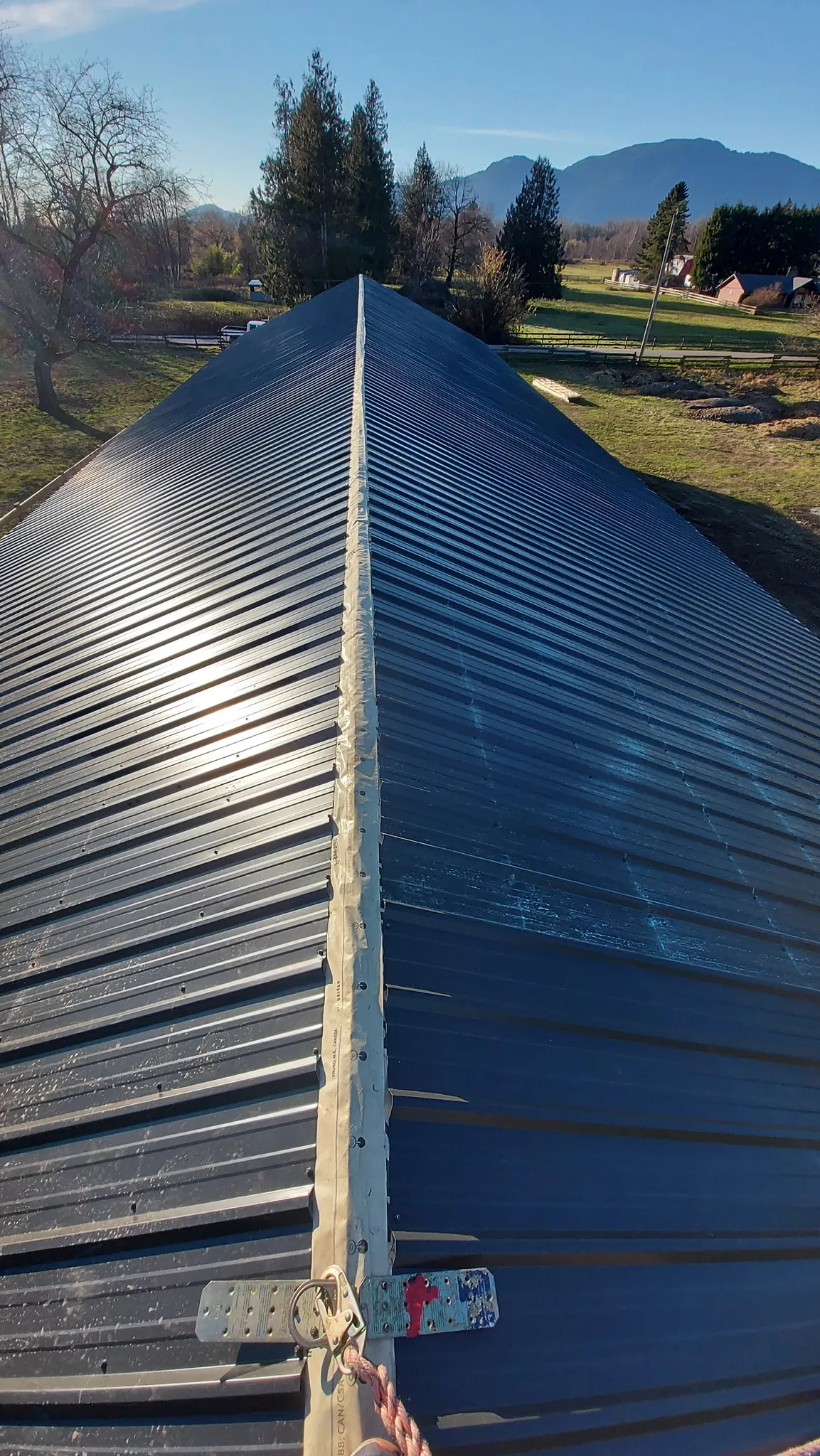
Newer Subdivisions: Getting Ventilation Right
The subdivisions climbing the east side of Abbotsford toward Auguston and McKee Peak are mostly newer construction — homes built in the last 10 to 20 years. These should be in good shape, but we see a pattern. Builders installed the minimum code-required ventilation, which is not enough for the Abbotsford climate. Minimum code was written for average Canadian conditions. The Fraser Valley is not average — it is wetter, and in Abbotsford, hotter in summer than what code writers had in mind.
When we do a roof replacement in these subdivisions, we almost always upgrade the ventilation. More soffit intake, better ridge exhaust, sometimes adding powered vents for homes that face south and bake all afternoon. It costs a few hundred dollars more during a re-roof but adds years to the new roof and cuts your cooling bills. We do not charge for the assessment — we just look at what you have and tell you what it needs.
Inadequate ventilation voids most shingle manufacturer warranties. If your builder installed the bare minimum and your shingles fail early, the manufacturer may deny your claim. We check this on every inspection and provide documentation for warranty purposes.
The Abbotsford Weather Factor
People think of the Fraser Valley as a rain zone, and they are right — but Abbotsford adds a twist. Sitting at the western edge of the valley, closer to the coast but still shielded by Sumas Mountain, Abbotsford gets temperature swings that stress roofing materials differently than what we see in Agassiz or Hope. Summer highs push past 35 degrees Celsius regularly. Winter lows drop below freezing. That thermal cycling — hot to cold, hot to cold, season after season — fatigues asphalt shingles faster than steady rain alone.
- Annual rainfall around 1,500mm — significant but less than east valley
- Summer heat reaches 35+ degrees Celsius, cooking poorly ventilated attics
- Freeze-thaw cycles through winter stress flashing and sealant joints
- Cross-border wind patterns off Mount Baker can be surprisingly strong
- Proximity to Sumas Lake floodplain means some properties face higher humidity
Why We Drive From Agassiz
When people hear we are based in Chilliwack and service Abbotsford, they sometimes ask why we do not just set up shop locally. The answer is simple — we live in Agassiz because it is home. Our families are here. My dad roofed with us before he passed, and this is where we learned the trade on our own homes before we went out and built a business. Agassiz to Abbotsford is 90 kilometres on Highway 1. We make that drive because the people in Abbotsford deserve the same quality we give our neighbours in Agassiz.
There is also a practical advantage. We work the entire corridor from Hope to Abbotsford. That means we have seen what 1,800mm of rain does to a roof in Hope, what river humidity does in Harrison, and what summer heat does in Abbotsford. Most Abbotsford-only roofers have only seen Abbotsford conditions. We bring the full picture. When we tell you that your Abbotsford roof needs a specific underlayment or ventilation setup, it is because we have seen what happens in harsher conditions when those details get skipped.

We offer free roof inspections anywhere in Abbotsford — from Clearbrook to Auguston, Sumas Prairie to Aberdeen. Call (778) 860-4747 or book online. We will drive to you, climb up, and give you an honest assessment with zero pressure.
Our Promise to Abbotsford Homeowners
Johnny and I built Fraser Roofing Ltd. on a principle we carried from the oil sands: everything gets tied off, and you do not leave until the job is watertight. In Alberta, if you left a weld unfinished on a pressure vessel, people could get hurt. Roofing is the same — if we leave your roof vulnerable to water, your home gets damaged and your family suffers. We do not cut corners. We do not use the cheapest materials. We show up when we say we will, we finish what we start, and we answer the phone when you call us six months later with a question.
Last updated: February 2026